


IM•profile M Application Note Microfluidic (4pages)

IM•profile M Application Note Microfluidic (4pages)
Droplet-based or digital microfluidics is a method used for screening in various applications, creating sequences of droplets that act as self-contained reaction vessels. These allow for faster reactions due to the small reaction spaces, leading to reagent savings and significant time reduction. Applications include analytical systems, material synthesis, and biological assays.
Principle of Droplet Generation
The generation of droplets is based on the immiscibility of two liquids, forming a phase boundary that results in droplet formation. Optical detection methods are used to recognize and evaluate these processes.
Microfluidic Devices and Imaging
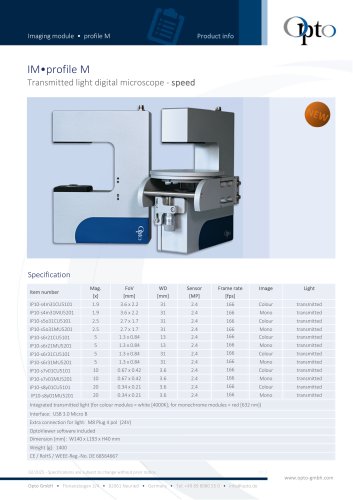
The Opto Imaging Module profile M is a digital inverted microscope designed for microfluidic experiments, addressing challenges like limited packaging space. It supports applications such as digital polymerase chain reaction (dPCR), which uses fluorescence-based readouts for biomolecule detection.
Applications and Technological Advancements
Droplet-based assays offer opportunities for quantifying low-concentration analytes. The process involves counting fluorescent droplets to determine the number of target molecules. The integration of microscopy with machine vision functionality is crucial for compact instruments.
Cell Encapsulation and Droplet Control
Encapsulation of cells or particles in droplets creates defined reaction conditions. The concentration of analytes and cells, as well as droplet size, depends on flow parameters and channel geometry. Different imaging modules are available to meet specific needs.
Microfluidic Chip Design
Microfluidic chips can have various geometries and functional units for complex experiments. Channels with small cross-sections maintain laminar flow conditions, and mixing is achieved through arch structures.
Automation and Imaging Technologies
Fluorescence imaging modules automate microfluidic applications, transitioning them from R&D setups to point-of-care devices. Applications include copy number variation, gene expression, and pathogen detection. High-quality optics and matched illumination provide high-resolution, repeatable image data.
Advantages of Opto Imaging Modules
The Opto Imaging Modules offer advantages such as high contrast and color stability, repeatability of images, open software architecture, and easy machine integration in an ultra-compact design.
Catalog excerpts

Life Science – Medical / Microfluidic Application note Droplet based microfluidics With the Opto digital inverse microscope profile M Fig. 1: The Opto Imaging Module profile M is a pure digital inverted microscope perfectly designed for microfluidic experiment Droplet-based or digital microfluidics is a screening method used in various applications in practice. It creates serial sequences of droplets that are considered as self-contained reaction vessels. Spatially separated biological or chemical reactions or kinetics are done in these reaction vessels. Due to the very small reaction spaces in the picoliter range, the reactions run much faster compared to conventional procedures. This ends in reagent savings and significant time reduction, as well as the ability to highly automate screening experiments. Applications range from fast analytical systems, synthesis of materials to biological assays with living cells. The principle behind droplet generation is based on the immiscibility of two liquids. During the transition of the two liquids, a phase boundary is formed, resulting in the formation of droplets. The reaction process is usually fast. For this purpose, optical detection methods are used for the recognition and evaluation of these processes. Challenging for the integration of microfluidic chip devices are the limited available packaging space. Therefore, inverted microscopes with long working distances are preferred for these applications. www.opto-gmbh.com Opto GmbH • Floriansbogen 2/4 • 82061 Neuried • Germany • Tel: +49 89 8980 55 0 • info@o
Open the catalog to page 1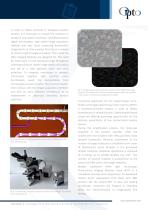
In order to follow chemical or biological reaction kinetics, it is necessary to resolve the reactions in temporal and spatial resolution. Multifluorescence digital microscopes, high speed image acquisition modules and easy cloud computing functionality integrated in an ultra-compact form factor is needed to realize a high throughput analysis. This is what the Opto Imaging Modules are designed for. The need for more point of care testing and high throughput screening solutions makes image-based cell analysis and lab on a chip approach more and more attractive. To integrate microscopy in compact...
Open the catalog to page 2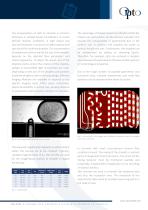
The encapsulation of cells or particles is common technique in droplet-based microfluidics to create defined reaction conditions. A high spatial and spectral resolution is necessary to detect optical and spectral shifts inside the droplets. The concentration of analytes and cells as well as the size of the droplets depends on the selected flow parameters and channel geometry. To adjust the speed, size of the droplets and to control the creation of the droplets, upright or transmitted light microscopes are used. Depending on the size of the droplets and particles inside the droplet as well as...
Open the catalog to page 3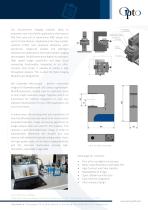
Our fluorescence imaging modules allow to automate new microfluidic applications that have to find their way out of stand-alone R&D setups into point-of-care devices. Applications like copy number variation (CNV), rare sequence detection, gene expression, single-cell analysis and pathogen detection are applications that need newest imaging technologies. Multifluorescence digital microscopes, High speed Image acquisition and easy cloud computing functionality integrated in an ultracompact form factor is needed to realize a high throughput analysis. This is what the Opto Imaging Modules are designed...
Open the catalog to page 4All OPTO catalogs and technical brochures
 IM•profile M
2 Pages
 Machine Vision Objectives
24 Pages
 Microscope Accessories
28 Pages
 043-112414-C02
2 Pages
 100-CO24-TC
2 Pages
 CylinderInspector 2D
2 Pages
 Focus Drive C, Coarse
2 Pages
 043-603020
2 Pages
 043-112108
2 Pages
 010-310345
1 Page
 100-GS100-02
2 Pages
 100-GS100-01
2 Pages
 Opto Test & Measurement
4 Pages
 Opto Medical & Life Science
4 Pages
 043-21300X
2 Pages
 IP10-06q33CU5101 four pages
4 Pages
 Opto Software
6 Pages
 Imaging Modules
6 Pages
 Trackstand
2 Pages
 043-112414-C01
2 Pages
 100-MS50-GAN
2 Pages
 100-MS50-AN
2 Pages
 100-MS25-GAN
2 Pages
 100-MS25-AN
2 Pages
 045-100130-01
2 Pages
 MMM 4.0
2 Pages
 IC10-05033CU3101 four pages
4 Pages
 IM•linea M
2 Pages
 IM•compact_M
2 Pages
 043-610022
2 Pages
 043-600505
2 Pages
 043-102302-72
2 Pages
 Jointed Coupler
1 Page
 Tilting Table
4 Pages
 Oblique Viewing Module
4 Pages
 Jointed Couplers
4 Pages
 IM MACHINEVISIONMICROSCOPE
6 Pages



- Digital imager
- Visible imager
- CMOS camera module
- Industrial camera module
- OPTO positioning stage
- Full-color camera system
- Monitoring camera system
- Calibration system
- OPTO linear positioning stage
- USB camera module
- Detection camera system
- Monochrome camera module
- OPTO optical microscope
- Image processing camera module
- Inspection system
- GigE Vision camera
- Compact imager
- Inspection imager
- Precision positioning table