


Electronic Components Anomaly Opto solino RTI sensor
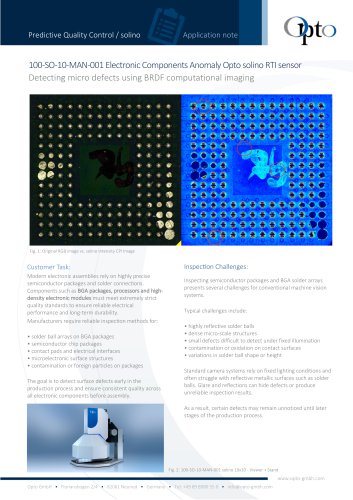
Electronic Components Anomaly Opto solino RTI sensor
Modern electronic assemblies require precise semiconductor packages and solder connections to meet strict quality standards. Reliable inspection methods are essential for components like BGA packages and processors to ensure electrical performance and durability.
Inspection Challenges
Conventional machine vision systems face challenges such as reflective solder balls, dense micro-scale structures, and small defects that are difficult to detect. Fixed lighting conditions often result in unreliable inspection results due to glare and reflections.
Technology Principle
The solino RTI sensor employs BRDF-based computational imaging to reveal surface structures. It captures images under different illumination angles and reconstructs surface reflectance information. Key elements include multi-directional LED illumination, photometric stereo image capture, and computational defect enhancement.
Technology Benefits
Controlled multi-directional illumination enhances the visibility of surface anomalies, such as solder ball defects, contamination, micro scratches, and oxidation. This technology is effective on reflective metallic surfaces where traditional imaging fails.
Application
The solino 10×10 sensor inspects semiconductor packages and electronic components before assembly. It targets BGA solder ball arrays, semiconductor chip packages, and electrical contact surfaces, making small surface irregularities visible with enhanced contrast.
Solution Architecture
The inspection system includes the solino RTI sensor, integrated dome illumination with 64 LEDs, a high-resolution 20 MP industrial camera, and solinoStudio software. The workflow involves positioning the component, capturing images, reconstructing surface reflectance, and visualizing structures.
Conclusion
The solino RTI sensor combines controlled illumination with computational imaging to detect surface structures that traditional systems miss. This improves quality assurance and reduces defects in electronic assembly.
Additional Information
Additional image processing and AI capabilities are available upon request.
Catalog excerpts
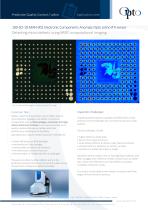
Predictive Quality Control / solino Application note G£>to100-SO-10-MAN-001 Electronic Components Anomaly Opto solino RTI sensor Detecting micro defects using BRDF computational imaging Customer Task: Modern electronic assemblies rely on highly precise semiconductor packages and solder connections. Components such as BGA packages, processors and high-density electronic modules must meet extremely strict quality standards to ensure reliable electrical performance and long-term durability. Manufacturers require reliable inspection methods for: • solder ball arrays on BGA packages • semiconductor chip packages • contact pads and electrical interfaces • microelectronic surface structures • contamination or foreign particles on packages The goal is to detect surface defects early in the production process and ensure consistent quality across all electronic components before assembly. Inspecting semiconductor packages and BGA solder arrays presents several challenges for conventional machine vision systems. Typical challenges include: • highly reflective solder balls • dense micro-scale structures • small defects difficult to detect under fixed illumination • contamination or oxidation on contact surfaces • variations in solder ball shape or height Standard camera systems rely on fixed lighting conditions and often struggle with reflective metallic surfaces such as solder balls. Glare and reflections can hide defects or produce unreliable inspection results. As a result, certain defects may remain unnoticed until later stages of the production process. Fig. 2: 100-SO-10-MAN-001 solino 10x10 - Viewer + Stand Opto GmbH • Floriansbogen 2/4 • 82061 Neuried • Germany • Tel: +49 89 8980 55 0 • [email protected]
Open the catalog to page 1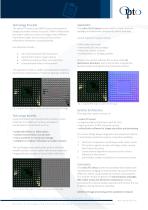
Technology Principle The solino RTI sensor uses BRDF-based computational imaging to reveal surface structures. Within milliseconds the system captures a series of images under different illumination angles and reconstructs the surface reflectance information computationally. • photometric stereo image capture • reflectance-based surface reconstruction • computational defect enhancement This approach creates a stable and repeatable inspection environment independent of external lighting conditions. Using controlled mul6-direc6onal illumina6on, solino enhances the visibility of surface anomalies...
Open the catalog to page 2All OPTO catalogs and technical brochures
 IM•profile M
2 Pages
 Machine Vision Objectives
24 Pages
 Microscope Accessories
28 Pages
 043-112414-C02
2 Pages
 100-CO24-TC
2 Pages
 CylinderInspector 2D
2 Pages
 Focus Drive C, Coarse
2 Pages
 043-603020
2 Pages
 043-112108
2 Pages
 010-310345
1 Page
 100-GS100-02
2 Pages
 100-GS100-01
2 Pages
 Opto Test & Measurement
4 Pages
 Opto Medical & Life Science
4 Pages
 043-21300X
2 Pages
 IP10-06q33CU5101 four pages
4 Pages
 Opto Software
6 Pages
 Imaging Modules
6 Pages
 Trackstand
2 Pages
 043-112414-C01
2 Pages
 100-MS50-GAN
2 Pages
 100-MS50-AN
2 Pages
 100-MS25-GAN
2 Pages
 100-MS25-AN
2 Pages
 045-100130-01
2 Pages
 MMM 4.0
2 Pages
 IC10-05033CU3101 four pages
4 Pages
 IM•linea M
2 Pages
 IM•compact_M
2 Pages
 043-610022
2 Pages
 043-600505
2 Pages
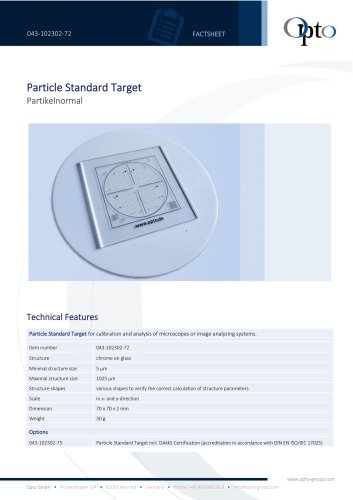 043-102302-72
2 Pages
 Jointed Coupler
1 Page
 Tilting Table
4 Pages
 Oblique Viewing Module
4 Pages
 Jointed Couplers
4 Pages
 IM MACHINEVISIONMICROSCOPE
6 Pages









- Digital imager
- Visible imager
- CMOS camera module
- OPTO positioning stage
- Full-color camera system
- Monitoring camera system
- OPTO microscope
- Calibration system
- OPTO linear positioning stage
- USB camera module
- Detection camera system
- Monochrome camera module
- OPTO optical microscope
- Image processing camera module
- GigE Vision camera
- Compact imager
- Inspection imager
- Precision positioning table