Battery Components Opto solino RTI sensor
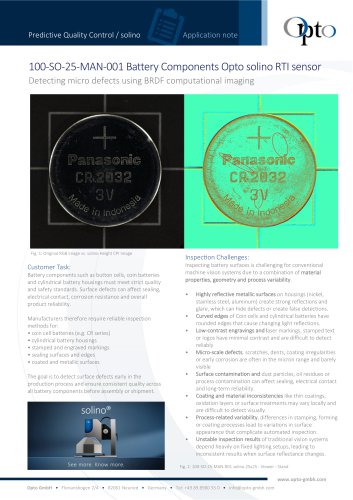
Battery Components Opto solino RTI sensor
The document discusses the importance of predictive quality control for battery components such as button cells, coin batteries, and cylindrical battery housings. These components must adhere to strict quality and safety standards to ensure product reliability.
Inspection Challenges
Inspecting battery surfaces is challenging due to:
- Highly reflective metallic surfaces causing glare and false detections.
- Curved edges leading to changing light reflections.
- Low-contrast engravings and markings that are difficult to detect.
- Micro-scale defects and surface contamination affecting reliability.
- Variability in coating and material consistency.
- Unstable results from traditional vision systems due to fixed lighting setups.
Technology Principle
The solino RTI sensor employs BRDF-based computational imaging to detect surface defects that conventional imaging cannot. It captures 64 images under various illumination directions to reconstruct surface reflectance information, enhancing defect visibility.
Technology Benefits
The solino system improves the detection of:
- Micro scratches and dents.
- Irregularities in engraved markings.
- Coating defects and corrosion spots.
- Surface contamination.
Application
The solino 25x25 system inspects a range of battery components, including:
- Coin cell surfaces and engraved labels.
- Cylindrical battery housings.
- Sealing edges and contact areas.
- Surface coatings and finishes.
Solution Architecture
The inspection system includes:
- Solino RTI sensor with 64 LED dome illumination.
- High-resolution 20 MP industrial camera.
- SolinoStudio software for image acquisition and processing.
Conclusion
The solino RTI sensor provides reliable inspection of battery components, improving quality assurance and reducing defects. Additional image processing and AI options are available upon request.
Catalog excerpts

Predictive Quality Control / solino Application note ^)tO100-SO-25-MAN-001 Battery Components Opto solino RTI sensorDetecting micro defects using BRDF computational imaging Customer Task: Battery components such as button cells, coin batteries and cylindrical battery housings must meet strict quality and safety standards. Surface defects can affect sealing, electrical contact, corrosion resistance and overall product reliability. Manufacturers therefore require reliable inspection methods for: • coin cell batteries (e.g. CR series) • cylindrical battery housings • stamped and engraved markings • sealing surfaces and edges • coated and metallic surfaces The goal is to detect surface defects early in the production process and ensure consistent quality across all battery components before assembly or shipment. Inspection Challenges: Inspecting battery surfaces is challenging for conventional machine vision systems due to a combination of material properties, geometry and process variability. • Highly reflective metallic surfaces on housings (nickel, stainless steel, aluminum) create strong reflections and glare, which can hide defects or create false detections. • Curved edges of Coin cells and cylindrical batteries have rounded edges that cause changing light reflections. • Low-contrast engravings and laser markings, stamped text or logos have minimal contrast and are difficult to detect reliably • Micro-scale defects, scratches, dents, coating irregularities or early corrosion are often in the micron range and barely visible • Surface contamination and dust particles, oil residues or process contamination can affect sealing, electrical contact and long-term reliability. • Coating and material inconsistencies like thin coatings, oxidation layers or surface treatments may vary locally and are difficult to detect visually. • Process-related variability, differences in stamping, forming or coating processes lead to variations in surface appearance that complicate automated inspection. • Unstable inspection results of traditional vision systems depend heavily on fixed lighting setups, leading to inconsistent results when surface reflectance changes. Fig. 2: 100-SO-25-MAN-001 solino 25x25 - Viewer - Stand Opto GmbH • Floriansbogen 2/4 • 82061 Neuried • Germany • Tel: +49 89 8980 55 0 • info@opto-
Open the catalog to page 1
Technology Principle Within milliseconds the system captures a series of 64 images under multiple illumination directions and reconstructs the surface reflectance information computationally. Key elements include: • coin cell surfaces and engraved labels • cylindrical battery housings • sealing edges and contact areas • surface coatings and finishes • contamination or handling damage • 64 multi-directional LED illumination • photometric stereo image capture • reflectance-based surface reconstruction • computational defect enhancement Because the system captures the surface under 64 illumination...
Open the catalog to page 2All OPTO catalogs and technical brochures
 IM•profile M
2 Pages
 Machine Vision Objectives
24 Pages
 Microscope Accessories
28 Pages
 043-112414-C02
2 Pages
 100-CO24-TC
2 Pages
 CylinderInspector 2D
2 Pages
 Focus Drive C, Coarse
2 Pages
 043-603020
2 Pages
 043-112108
2 Pages
 010-310345
1 Page
 100-GS100-02
2 Pages
 100-GS100-01
2 Pages
 Opto Test & Measurement
4 Pages
 Opto Medical & Life Science
4 Pages
 043-21300X
2 Pages
 IP10-06q33CU5101 four pages
4 Pages
 Opto Software
6 Pages
 Imaging Modules
6 Pages
 Trackstand
2 Pages
 043-112414-C01
2 Pages
 100-MS50-GAN
2 Pages
 100-MS50-AN
2 Pages
 100-MS25-GAN
2 Pages
 100-MS25-AN
2 Pages
 045-100130-01
2 Pages
 MMM 4.0
2 Pages
 IC10-05033CU3101 four pages
4 Pages
 IM•linea M
2 Pages
 IM•compact_M
2 Pages
 043-610022
2 Pages
 043-600505
2 Pages
 043-102302-72
2 Pages
 Jointed Coupler
1 Page
 Tilting Table
4 Pages
 Oblique Viewing Module
4 Pages
 Jointed Couplers
4 Pages
 IM MACHINEVISIONMICROSCOPE
6 Pages