
- Catalogs
- Optical Gaging Products
- An Introduction To Video Measuring Systems


An Introduction To Video Measuring Systems

An Introduction To Video Measuring Systems
Introduction to Video Measurement Systems
Video measurement systems are essential tools in manufacturing for monitoring critical dimensions of parts. These systems provide non-contact measurement by analyzing magnified images of parts, ensuring that manufacturing processes remain within specification.
Key Differences Between Video and Vision Systems
Video measurement systems focus on high-resolution images for precise measurements, whereas vision systems typically handle lower resolution images for tasks like part comparison or counting. Video systems are standalone and measure stationary parts, while vision systems can operate on moving parts.
Image Processing and Optics
Video measurement relies heavily on image processing, converting images into electrical signals through digital sensors. High-quality optics are crucial to avoid measurement errors, and systems often use sub-pixeling algorithms for enhanced edge detection. Zoom lenses and fixed magnification systems are used to accommodate various feature sizes.
Positioning and Motion
Accurate measurement requires precise positioning of both the image and the part. This involves macro and micro scale position sensing, with motorized linear slides and scales ensuring proper alignment and focus. Motion in the X-Y plane is quantified, with systems using either open or closed loop motion for accuracy.
Illumination Techniques
Proper illumination is vital for edge detection, with methods like back lighting and oblique angle lighting used to highlight different features. Adjustable intensity and segmented lighting allow for optimal contrast and feature visibility.
Structural Integrity
The structural integrity of the system is crucial for accurate measurements, requiring precision design and stable materials like steel and granite to maintain orthogonality and prevent independent movement of machine parts.
System Integration and User Interaction
Video measurement systems integrate XYZ stage motion, magnification, illumination, and data processing to create a digitized model of the part. Metrology software simplifies user interaction, focusing on measurement results rather than system operation.
Advancements and Multi-Sensor Systems
Recent advancements include multi-sensor systems that incorporate touch probes and laser sensors for enhanced functionality. These systems reduce fixture requirements and lower total ownership costs, expanding the capabilities of video measurement platforms.
Catalog excerpts

ideo measurement is anaccepted way of monitor-ing critical dimensions ofmanufactured parts. It letsmanufacturers ensure that processes areunder control and that parts are withinspecification. Video measurement systemsanalyze an image of the part, so the pro-cess is non-contact. The image is usuallymagnified many times, so the system islike a microscope with the eyepiece re-placed by a camera. This alone does notmake a video measurement system. Manysystems magnify the image of a part andpresent it on a video monitor, but do notmeasure. For example, an inspector might make decisions by visual analysis of amagnified image. So how is a video mea-surement system different?Video systems measure, relying onhigh resolution images for the neces-sary accuracy. Vision systems typicallyanalyze lower resolution images tocompare a part to a master, count partsin the image, or do simple measure-ments. Video systems are usuallystandalone you take the part to thesystem. Vision can be standalone, or itcan be done on-line, viewing parts asthey pass by on a belt, for example.The key difference is that vision sys-tems usually דlook at parts that may be in motion, while video systemsmeasure parts that are on the machinefor the specific purpose of being mea-sured. > Video measurement relies on imageprocessing. This requires the image to beconverted to electrical signals. This isdone by ԓreading the signal levels fromeach of the pixels in a digital sensor(camera). The image is magnified untilthe feature of interest covers many pixelsso individual details can be determinedunambiguously. Good video measure-ment systems use sub-pixeling algo- >
Open the catalog to page 1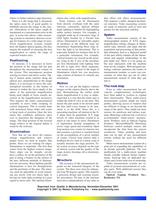
rithms to further enhance edge detection.Since it is the image that is measured,the optics must be of good quality tofaithfully present the image to the cam-era. Aberrations in the optics might beinterpreted as a measurement error in thepart. A zoom lens allows video measur-ing systems to maximize detector cover-age for features of a wide range of sizes.Fixed magnification systems usuallyhave the highest optical quality, but theyrequire the tradeoff of choosing the bestmagnification to satisfy the range ofexpected feature sizes. > Video measurement consists of thechoreographed motion of XYZ stages,magnification...
Open the catalog to page 2All Optical Gaging Products catalogs and technical brochures
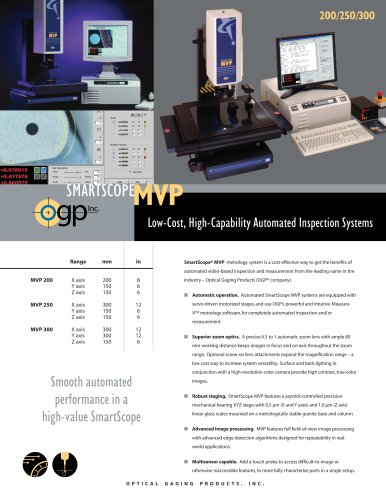 Smartscope Flash 250/300
2 Pages
Archived catalogs
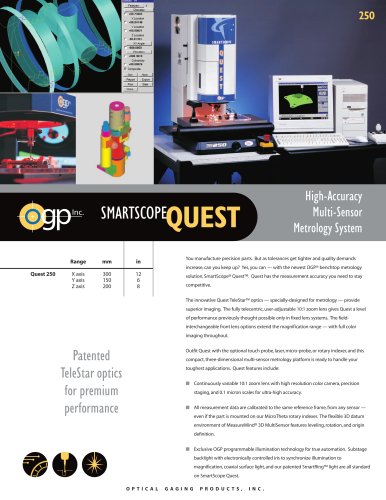 Smartscope Quest 250
2 Pages
 Smartscope Flash 200
2 Pages
- Measuring device
- Analysis software solution
- Measuring machine
- Real-time software
- Windows software
- Computer-aided design software
- Simulation software solution
- Programming software
- Digital gauge
- Automatic measurement system
- Optical measurement system
- 3D scanning system
- Measurement scanner
- Laser scanner
- Benchtop measuring module
- Automatic measuring module
- Parts measurement system
- Compact measuring module
- Distance measurement system
- Non-contact measurement system