
- Catalogs
- Optical Gaging Products
- ABCs of Multisensor Measurement


ABCs of Multisensor Measurement
1 / 3 PagesView full catalog
ABCs of Multisensor Measurement
Product catalog summary
Introduction to Multisensor Measurement Systems
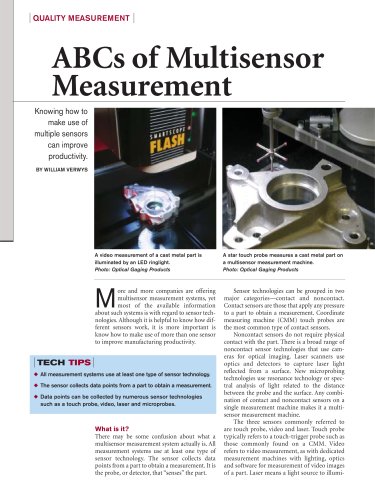
Multisensor measurement systems integrate multiple sensor technologies to enhance manufacturing productivity. These systems utilize both contact and noncontact sensors to collect data points from parts for measurement purposes. Contact sensors, like CMM touch probes, physically interact with parts, while noncontact sensors, such as cameras and laser scanners, gather data without direct contact.
Types of Sensors
The primary sensors used in multisensor systems include touch probes, video, and laser sensors. Touch probes are typically used in CMMs for point-to-point data collection. Video sensors capture images for measurement, while laser sensors use light to scan surfaces. Advanced microprobing technologies, such as resonant and spectral analysis microprobes, are also employed for detailed measurements.
Sensor Usage and Data Collection
Sensors can be used for single-point data collection or continuous scanning. Touch-trigger probes collect data at specific points, while scanning probes maintain contact with the surface to gather continuous data. Video measuring machines can create 3D contour maps by scanning parts, and laser scanners continuously collect data points across surfaces.
Benefits of Multisensor Systems
Multisensor systems offer significant time savings and improved measurement capabilities. They allow for the automation of measurement routines, accommodating complex products and varying part features. These systems are particularly beneficial for measuring complex dimensional forms and surface relationships that single-sensor systems cannot handle.
Choosing a Multisensor System
When selecting a multisensor system, consider the integration of sensors within the system's software and the ease of sensor changes during measurement routines. True multisensor systems optimize the performance of all sensors, unlike systems that merely add additional sensors to a primary one.
Conclusion
Multisensor measurement systems are akin to multifunction office machines, offering space-saving, utility reduction, and streamlined training and service requirements. They are essential tools for achieving productivity improvements and cost reductions in manufacturing.
Multisensor measurement systems integrate multiple sensor technologies to enhance manufacturing productivity. These systems utilize both contact and noncontact sensors to collect data points from parts for measurement purposes. Contact sensors, like CMM touch probes, physically interact with parts, while noncontact sensors, such as cameras and laser scanners, gather data without direct contact.
Types of Sensors
The primary sensors used in multisensor systems include touch probes, video, and laser sensors. Touch probes are typically used in CMMs for point-to-point data collection. Video sensors capture images for measurement, while laser sensors use light to scan surfaces. Advanced microprobing technologies, such as resonant and spectral analysis microprobes, are also employed for detailed measurements.
Sensor Usage and Data Collection
Sensors can be used for single-point data collection or continuous scanning. Touch-trigger probes collect data at specific points, while scanning probes maintain contact with the surface to gather continuous data. Video measuring machines can create 3D contour maps by scanning parts, and laser scanners continuously collect data points across surfaces.
Benefits of Multisensor Systems
Multisensor systems offer significant time savings and improved measurement capabilities. They allow for the automation of measurement routines, accommodating complex products and varying part features. These systems are particularly beneficial for measuring complex dimensional forms and surface relationships that single-sensor systems cannot handle.
Choosing a Multisensor System
When selecting a multisensor system, consider the integration of sensors within the system's software and the ease of sensor changes during measurement routines. True multisensor systems optimize the performance of all sensors, unlike systems that merely add additional sensors to a primary one.
Conclusion
Multisensor measurement systems are akin to multifunction office machines, offering space-saving, utility reduction, and streamlined training and service requirements. They are essential tools for achieving productivity improvements and cost reductions in manufacturing.
See more
Catalog excerpts
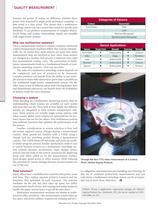
Touch ProbesVideo LaserResonant (Microprobe) Spectral Analysis (Microprobe) > SensorSingle PointStrengthScanningStrength Touch Probe Video > Through-the-lens (TTL) laser measurement of a surface. Photo: Optical Gaging Products Reprinted from Quality , Copyright December 2004. size="-2">
Open the catalog to page 3All Optical Gaging Products catalogs and technical brochures
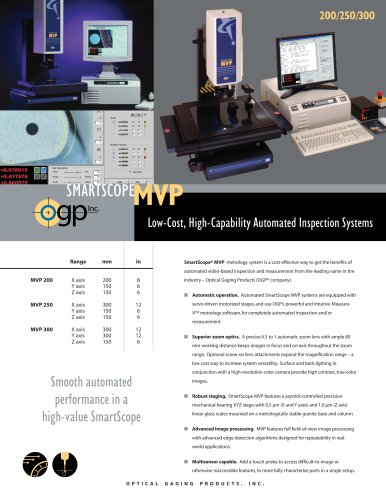 Smartscope Flash 250/300
2 Pages
Archived catalogs
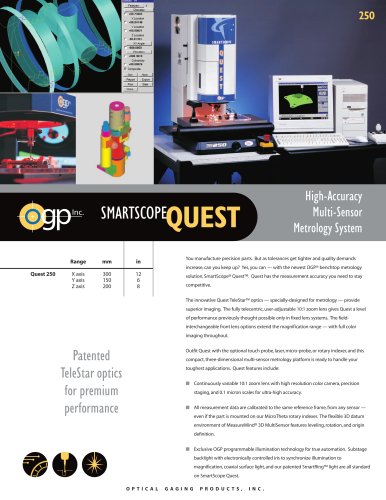 Smartscope Quest 250
2 Pages
 Smartscope Flash 200
2 Pages

Related Searches
- Measuring device
- Analysis software solution
- Measuring machine
- Real-time software
- Windows software
- Computer-aided design software
- Simulation software solution
- Programming software
- Digital gauge
- Automatic measurement system
- Optical measurement system
- 3D scanning system
- Measurement scanner
- Benchtop measuring module
- Parts measurement system
- Automatic measuring module
- Compact measuring module
- Distance measurement system
- Non-contact measurement system
*Prices are pre-tax. They exclude delivery charges and customs duties and do not include additional charges for installation or activation options. Prices are indicative only and may vary by country, with changes to the cost of raw materials and exchange rates.
About DirectIndustry
DirectIndustry is a marketplace that offers B2B players a complete experience, from product sourcing to purchase. DirectIndustry is an entity of VirtualExpo Group.
Are you a buyer?
Are you a supplier?