
- Catalogs
- Ophir Optronics
- Thermal Power Sensors

Thermal Power Sensors

Thermal Power Sensors
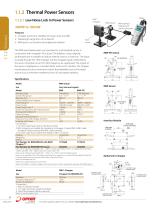
- Model RMC1 Chopper: Used with RM9/RM9-PD sensors, features an aperture of Ø22mm, a fixed chopping frequency of 18Hz, and power consumption of 85mA. Connections include BNC to interface module, 12V power supply, and a Mini USB connector for factory use.
- Model RM9 Sensor: Utilizes a pyroelectric absorber with a spectral range of 0.15 - 12 µm, power range of 100nW to 100mW, and a power noise level of ~30nW. It has a response time of 3.5 seconds and a power accuracy of ±5%.
- Model RM9-PD Sensor: Uses a Si photodiode absorber with a spectral range of 0.2 - 1.1 µm, power range of 300fW to 300nW, and a power noise level of 30fW. It has a response time of 3.6 seconds and a power accuracy of ±5%.
- Both sensors connect via a 1.5-meter cable to an interface module, with a BNC connector for chopper connection and a DB15 connector for module termination.
- The RMC1 chopper is essential for the operation of RM9 sensors, requiring a chopping frequency of 18Hz.
- The RM9 series radiometers use a lock-in amplifier to minimize external noise, with signals processed through an 18Hz chopper.
- The sensors are designed to suppress signals not at the 18Hz frequency, ensuring accurate readings displayed on an Ophir meter or PC interface.
- Power accuracy varies with wavelength, with additional errors for non-calibrated wavelengths.
- Thermal drift is noted for the RM9 sensor in typical laboratory environments.
Catalog excerpts
1.1.2 Thermal Power Sensors 1.1.2.1 Low Noise Lock In Power Sensors RM9 interface module with synch connection Features ֺ ֺ Chopper and lock in amplifier for lowest noise and drift ֺ ֺ Wavelength range from UV to deep IR ֺ ֺ RM9 pyro is not sensitive to background radiation From source The RM9 series Radiometers use a pyroelectric or photodiode sensor in conjunction with chopped CW or quasi CW radiation, using a digitally synthesized lock-in amplifier to reduce external noise to a minimum. The signal is passed through the 18Hz chopper and the chopped signal is detected by the sensor. All signals not at this 18Hz frequency are suppressed. The output of the sensor is displayed on a standard Ophir meter or PC interface. The chopper may be placed at any convenient location but preferably close to the signal source so as to eliminate interference from all unchopped radiation. Very low level signals Model RM9 RM9-PD Absorber Type Pyroelectric Si Photodiode 0.2 - 1.1 (b) Spectral Range µm 0.15 - 12 (a) Aperture mm Ø8mm Ø8mm Surface Reflectivity % approx. 50 50 100nW – 100mW 300fW – 300nW Power Range (c) Power Scales 100mW to 3µW 300nW to 3pW ~30nW 30fW Power Noise Level (d) Minimum Frequency for Pulsed Sources 200Hz 200Hz ~30nW N.A. 62 Thermal Drift (20min) (e) 8 ±5% (b) Power Accuracy ±5% (a) Damage Threshold W/cm² 5 5 Response Time with Display (0-95%) s 3.5 3.6 7.5 Linearity with Power ±2% ±2.5% Connections: ADJUSTABLE 1. 1.5 meter cable hard wired to interface module. 90-139 2. BNC connector on module for connection to chopper (2 meter3BNC to BNC cable 0° included). Perform zeroing with BNC cable removed. 3. 0.5 meter cable from module terminated in DB15 connector. Cooling convection convection Weight kg 0.37 100 0.37 Version Part Number for RM9/RM9-PD with RMC1 7Y70669 7Y70672 Chopper (f) Part Number for RM9/RM9-PD Sensor 7Z02952 7Z02953 Interface Module 0.5M cable to smart connector 1.5M cable to sensor 1/4-20 BSW x 6 deep Mounting Thread 1/4-20 BSW x 6 deep Mounting Thread Notes: (a) not adjustable by user. 1/4-20 BSW x 6 deep Mounting Thread Aperture Chopping frequency (a) Power consumption Connections: 1. BNC to interface module 2. 12V wall cube power supply (included) 3. Mini USB connector (factory use only) 19.5 1/4-20 BSW x 6 deep Mounting Thread Notes: (a) At calibrated wavelengths 500 – 1100nm. At other wavelengths, there is an additional error as follows: <500nm add ±8%, 1100 – 3000nm add ±5%, 10.6µm add ±15% Notes: (b) At calibrated wavelengths 200 – 1100nm. For <700nm add ±2% additional error Notes: (c) For LaserStar, Pulsar, USBI, Quasar and Nova/Orion, upper limit is 1mW for RM9 and 90nW for RM9-PD. For these models, accuracy may also be less than values given above Notes: (d) Averaged over 10s Notes: (e) In a typical laboratory environment Notes: (f ) The RMC1 or another chopper unit that can be set to 18Hz is required for operation of the RM9 sensors For latest updates please visit our website: www.ophiropt.co
Open the catalog to page 1All Ophir Optronics catalogs and technical brochures
 SP932U
1 Page
 ConoPoint-3
2 Pages
 nova catalog
2 Pages
 nova ii catalog
2 Pages
 vega catalog
2 Pages
 BeamWatchAM
2 Pages
 StarBright
2 Pages
 680274
1 Page
 L2000W-PF-120
1 Page
 L40(250)A-BB-50
1 Page
 IS1.5-VIS-FPD-800
1 Page
 Optimet Industrial Catalog 2017
34 Pages
 StarLite
2 Pages
 Power Meters Vega
2 Pages
 Goniometric Radiometers
3 Pages
 1780 Instantly measure M 2
2 Pages
 M200s
M200s3 Pages
 NanoScan 2s
14 Pages
 LBS-100 Attenuato
1 Page
 LBS-400 Beam Splitters
1 Page
 maging UV lasers
1 Page
 Near Field Profilers
1 Page
 BeamWatch®
5 Pages
 ModeCheck ®
3 Pages
 Nova
Nova2 Pages
 Calorimetric Power Meter
1 Page
 Power Pucks
1 Page
 ompact Juno USB Interface
7 Pages
 StarBrigh
2 Pages
 Standard Photodiode Sensors
3 Pages
 YAG Focal Spot Analyzer
2 Pages
 PC Interfaces Juno
5 Pages
 Photodiode Energy Sensors
5 Pages
 Orion
Orion2 Pages
 Laserstar
2 Pages
 RP Sensors
2 Pages


Archived catalogs
 Laser Beam Profile Catalog
42 Pages
 Laser Beam Prifile catalog
42 Pages
 Complete Catalogue OPHIR
155 Pages
 Laser Beam Profile
42 Pages
 Laser Power Meters
4 Pages


- CMOS camera module
- Industrial camera module
- Infrared imager
- Automatic analyser
- Benchtop analyser
- USB camera module
- Portable analyzer
- GigE Vision camera
- Continuous analyzer
- Compact imager
- Compact analyzer
- Infrared analyser
- Calibration analyzer
- Camera with global shutter
- USB 3.0 camera module
- Distance sensor
- Camera objective
- Power meter
- Medical video camera
- 3D scanning system