
- Catalogs
- Onto Innovation Inc.
- Advanced Packaging Lithography and Inspection Solutions for Next Generation FOWLP-FOPLP Processing

- Products
- Catalogs
- News & Trends
- Exhibitions
Advanced Packaging Lithography and Inspection Solutions for Next Generation FOWLP-FOPLP Processing

Advanced Packaging Lithography and Inspection Solutions for Next Generation FOWLP-FOPLP Processing
The document explores the evolution of semiconductor packaging, focusing on the transition from traditional wafer-level packaging to Fan-out Wafer Level Packaging (FOWLP) and Fan-out Panel Level Packaging (FOPLP). This shift is motivated by the need to reduce costs and enhance productivity, with OSAT companies transitioning from silicon to reconstituted Epoxy Mold Compound (EMC) wafers, enabling larger panel-based substrates.
A. Lithography System Requirements
The JetStep S3500 Panel Lithography System is noted for its capability to manage larger substrate exposure areas, thereby reducing the number of exposures needed per panel and increasing throughput.
B. Alignment and Overlay
Challenges in die placement accuracy on reconstituted panels are addressed through mapping techniques that enhance overlay accuracy.
C. Resolution and Depth of Focus
The system achieves the high resolution and depth of focus required for advanced packaging, with specific equations provided for calculating these parameters.
D. Patterning Over Topography
Focus adjustments are necessary for larger panels to accommodate topography changes.
E. Warpage
Handling warpage in panels is discussed, with techniques borrowed from flat panel display manufacturing.
F. Panel Throughput Advantage
Switching to rectangular panels from circular wafers significantly increases productivity, as demonstrated by comparative data.
The Firefly™ Inspection system with ClearFind™ technology is introduced for detecting defects in warped wafers or panels. It employs a dual focus system and fluorescent illumination to improve defect detection and reduce false positives.
The transition to panel-based processing offers significant productivity gains and cost reductions, making it a viable solution for OSATs and foundries.
The semiconductor industry is at the forefront of adopting new manufacturing technologies to create devices with enhanced functionality while minimizing costs, facilitating global consumer acceptance and the adoption of new technologies.
Panel-based processing is highlighted as a significant improvement over traditional wafer-based methods, representing a strategic move to achieve higher throughput and cost efficiency.
The authors express gratitude to the Rudolph Technologies Applications Lab team for their process support and to Michael Thompson for providing SEM cross-section images.
The document cites several references, including works by K. Ruhmer, P. Cochet, and R. McCleary on cost reduction through panel-based fan-out packaging, and studies on lithographic process capabilities for 2.5D and 3D applications.
Catalog excerpts

Advanced Packaging Lithography and Inspection Solutions for Next Generation FOWLP-FOPLP Processing Keith Best, Gurvinder Singh, and Roger McCleary Rudolph Technologies, Inc. 16 Jonspin Rd. Wilmington, MA 01887, U.S.A. Ph: 978-253-6200; Fax: 978-658-6349 Email: [email protected] Abstract For more than 50 years the semiconductor industry has pursued Moore’s law, continuously improving device performance, reducing cost, and scaling transistor geometries down to where advanced CMOS has reached beyond the 10nm technology node. The commensurate increase in I/O count has created many challenges for device packaging which hitherto was considered low cost with simple solutions. It was once thought that old backend foundry lithography steppers could be used to address the new packaging requirements; which was true whilst the substrates remained in the traditional 300mm Silicon format. The recent unprecedented rapid growth in Fan-out Wafer Level Packaging (FOWLP) applications has introduced a more complicated landscape of process challenges, with no restriction on substrate format, where cost is the main driver and high yields are mandatory. This paper discusses the lithography process challenges that have ensued from disruptive FOWLP, and more recently the paradigm shift to Fan-out Panel Level Packaging (FOPLP). The work reports on lithography solutions for CD control over topography and high aspect ratio imaging of 2µm line/space RDL. In addition, the introduction of new inspection capabilities for defects and metrology is reported for both wafers and panels. The increase in lithography productivity and cost reduction provided by FOPLP is also discussed with production examples. Key words Fluorescence, FOWLP, Inspection, Panel, Stepper, Thick Resist presents a number of manufacturing and process control challenges. These includes chip placement on the carrier, molding, via reveal, Re-distribution layer (RDL) fabrication and final ball placement. OSATs are also continuously pushing for smaller line space pitch RDL on these fan-out packages. This drives the need for high resolution lithography and inspection systems that are capable of handling, patterning and inspecting large panels. In addition, BEOL processing induces stress to the substrates which results in significant warpage on both wafers and the panels, this presents additional challenges to not only handling but also detection of sub-micron defects. I. Introduction With the ever increasing pressure to reduce costs and improve productivity, Out-Sourced Assembly and Test (OSAT) companies continuously make changes to their processing methods and substrate formats. In particular, moving from Silicon to reconstituted Epoxy Mold Compound (EMC) wafers has enabled the OSATs to become independent of substrate size & shape. Moreover, this freedom has enabled the use of large area panels which leverage economy of scale to further reduce costs, Fig. 1. shows the significant increase in die as a function of substrate size. Larger panel based substrates in back-end packaging processes promise significant reductions in cost per package. A 30-40% cost reduction of the panel can be achieved relative to round 300mm wafer fan-out. In addition to the economic benefit, panel fan-out packaging enables the industry to move to larger fan-out packages with multiple chip integration. However, panel scale fan-out processing
Open the catalog to page 1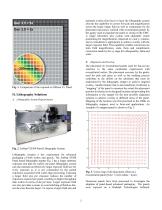
maintain overlay from layer to layer the lithography system also has the capability to correct for scale and magnification across the larger image field as well as compensate for die placement inaccuracy realized with reconstituted panels by the gantry used to populate the panel or curing of the EMC. A single telecentric lens system with adjustable reticle positioning for magnification, trapezoid in x and y, rotation, and xy translation is appropriate to achieve overlay with the larger exposure field. This capability enables corrections for intra field magnification, scale, theta and compliments...
Open the catalog to page 2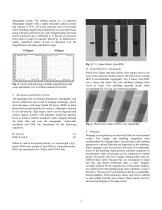
lithography system. The JetStep system is a 2x reduction lithography stepper with a single telecentric optical system that exposes a 59.4 x 59.4 mm exposure area on the panel while enabling magnification adjustment on a per panel basis along with grid corrections for scale. Magnification and scale can be corrected, up to ±400 ppm or 11.88 µm of correction from center to edge of exposure field (Fig. 4). Distortion is tightly controlled within <0.1µm of distortion over the magnification and scale adjustment range. Fig. 5. 5:1 Aspect Ratio, 2µm RDL D. Patterning Over Topography Panels have larger...
Open the catalog to page 3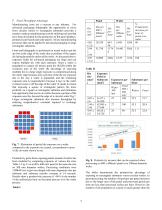
F. Panel Throughput Advantage Manufacturing costs are a concern in any industry. For advanced packaging lithography the opportunity to move from circular wafers to rectangular substrates provides a means to reduce manufacturing costs by utilizing tool sets that have been developed for the production of flat panel displays, printed circuit boards and solar panels. All use manufacturing processes that can be applied to advanced packaging on large rectangular substrates. Front-end lithography is performed on round wafers and die are lost at the edge of the wafer due to portions of the square die...
Open the catalog to page 4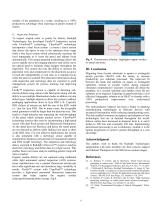
number of die populated on a wafer, resulting in a >89% productivity advantage when exposing on panels instead of wafers. G. Inspection Solutions To inspect warped wafer or panels for defects, Rudolph Technologies has developed Firefly™ Inspection system with ClearFind™ technology. ClearFind™ technology incorporates a dual focus system - a coarse z focus system that allows the optics to stay in the optimum focus range while a fine focus system which continuously measures the local topography as it scans the panel and adjusts focus automatically. This unique patented methodology allows the user...
Open the catalog to page 5
R. Dudley, D. Marx, R. Roy, D. Grant, M. Wilson, and S. Balak, “Inspection and metrology solutions from TSV through reveal for high volume manufacturing”, Rudolph Technologies IMAPS 47th International Symposium on Microelectronics, October 2013. R. Roy, “Front-end-ization of the back-end”, Rudolph Technologies IMAPS 47th International Symposium on Microelectronics, October 2013 N. Devanciard [CEI-Leti] and Dario Alliata [Rudolph Technologies, Inc.], “Combining defect detection/metrology to accelerate microbump/pillar fabrication, (Periodical style-submitted for publication),” Chip Scale Review,...
Open the catalog to page 6All Onto Innovation Inc. catalogs and technical brochures
 Onto Innovation
19 Pages
 Solid State Technology
6 Pages
 Use style: paper title
6 Pages
 rudolph technologies
1 Page


- Management software solution
- Analysis software solution
- Process software
- Real-time software
- Windows software
- Computer-aided design software
- Design software solution
- Monitoring software solution
- Industrial software
- Automatic tester
- Visualization software solution
- Industrial tester
- Automated software
- Thickness gauge
- Development software
- Reporting software
- Automatic inspection system
- Machine software
- Inspection machine