
- Catalogs
- OMS Motion, Inc.
- PC78/104 Bus


PC78/104 Bus

PC78/104 Bus
- Controller Capabilities: Supports four axes of stepper or servo control with encoder feedback up to 12MHz.
- Communications: Compatible with PC/104 bus and RS-232 port, offering interrupt or polling communication and 4 I/O registers.
- Control Functionality: Includes 16-bit DAC resolution, motion coordination, slip & stall detection, interpolation, and electronic gearing.
- Processor: 32-bit processor for co-processing, minimizing host overhead with custom trajectory profiles and watchdog timer.
- Control Signals: High-density SCSI3 connector, up to 12 user I/O, and motion control output options.
- Software: OMS-EZ™ software with over 150 commands, compatible with Windows OS, and field upgradeable firmware.
- Support: Factory direct technical support, application notes, and example programs available.
The PC78 is a versatile motion controller supporting PC/104 ISA bus and RS-232 communication, compatible with the PC68 family for 2-4 axes control, with up to 12 TTL I/O bits and encoder feedback for slip and stall detection.
PC78 controllers use ASCII commands for sophisticated motion profiles, stored in a FIFO queue for execution.
- Axis Specific Commands: Direct operations to specific or all axes for synchronized or multitasking modes.
- System Control Commands: Manage system parameters and operating modes.
- Move Specification Commands: Specify move parameters tailored to system requirements.
- Move Execution Commands: Execute specified moves.
- Move Termination Commands: Terminate move sequences.
- Loop Control Commands: Manage loop execution and synchronization.
- Home and Initialization Control Commands: Manage home position coordination.
- Move Synchronization Commands: Synchronize moves with external events or multiple axis sequences.
- System Status Request Commands: Request status of move parameters and system information.
Commands for specifying move parameters in user-defined units, with options to revert to default units.
Commands for manipulating user-definable I/O, including setting outputs and reporting I/O states.
Commands for executing sequences at constant velocity, useful for machine tools.
Commands for setting PID filter parameters, including acceleration, differential, integral, and proportional gains.
Support for encoder use, including ratio settings and position correction.
Commands for velocity changes at prescribed positions.
Combine several commands into a macro for execution.
Velocity up to 1,044,000 counts/sec, acceleration up to 8,000,000 counts/sec², position range of ±33,500,000 counts, environmental conditions, power requirements, dimensions, communication interfaces, and I/O configurations.
Pin description for the signal connector, detailing connections for axes X, Y, Z, and T.
Details on ordering PC78 models, including interface, servo and stepper axes, user I/O, and accessories.
Catalog excerpts

PC78Intelligent Motion Controller forPC/104 or RS-232 FEATURES Controller capabilities * Four axes of stepper control with encoder feedback or servo * Encoder feedback to 12MHz Communications * PC/104 bus * Stand-alone with RS-232 port * Interrupt or polling communication * 4 I/O registers for control & status Sophisticated Control Functionality * 16 bit DAC analog resolution * Independent and coordinated motion of all axes at the same time * Slip & Stall detection with encoder feedback * Crystal controlled step pulse from 0 to 1,044,000 steps per second * Circular interpolation * Constant velocity linear interpolation (all axes) * Electronic gearing 32 bit Processor for Extensive Co-Processing * Does not burden the host with overhead * Custom, parabolic, cosine, linear trajectory profiles * Patented technology to minimize torque ripple and velocity modulation * Internal watchdog timer for safety Control signals * Single high density shielded SCSI3 connector * Up to 12 user I/O * Motion Control Output is +/-10V or 0-10V Servo or Step & Direction * Dedicated home and plus / minus over-travel inputs for each axis OMS - EZ™ Software programming * High level programming expertise not required * Over 150 commands, "universal” to all Pro-Dex, Inc. controllers * Commands are ASCII characters * Capable of conversion to "user” defined units i.e. inches / revolutions * Software for WIN95/98, NT, 200 and XP. * Software supplied at no additional cost Flash Memory * Field upgradeable firmware within Windows operating systems * Non-volatile program storage and parameter storage Flexible and Expandable * Conforms 100% to all PC/104 specifications * Customizable solutions available for your requirements Factory Direct Technical Support * Person to person toll-free tech support: call 800-707-8111 * Application notes and Documentation on the Web * Example programs and application code provided * All Pro-Dex, Inc. controls are 100% tested and quality inspected Beaverton, Oregon
Open the catalog to page 1
DESCRIPTION The PC78 is both a PC/104 controller that supports the PC/104 ISA bus standard as well as a stand-alone controller via a RS-232 communication port and is compatible with the PC68 family with 2-4 axes control. The PC78 supports up to 12 general purpose TTL I/O bits, 8 of which are user definable. The step pulse is a TTL level 50% duty cycle square wave that supports velocities of 0 through 1,044,000 pulses per second. The encoder feedback functionality supports quadrature encoders up to 12 MHz at a 4 times the encoder line resolution and is used as closed-loop feedback for the stepper...
Open the catalog to page 2
The LF command turns off the limit switches for the addressed axis. This allows the stage to move beyond the limit switch and should be used with caution. LH LIMIT HIGH The LH command sets the logic sense of the overtravel limit inputs to active high. LL LIMIT LOW The LL command sets the logic sense of the overtravel limit inputs to active low. LN LIMITS ON The LN command restores the operation of the limit switches for the addressed axis. PF PARABOLIC OFF The PF command restores linear acceleration and deceleration ramps. PN# PARABOLIC ON The PN command enables parabolic ramps. The parameter...
Open the catalog to page 3
The SA command flushes all queues and causes all axes to decelerate to a stop at the rate previously specified in an AC command. SD STOP AND RESET DONE The SD command will stop all axes and clear any done flags. ST STOP The ST command flushes the queue for the currently addressed axis only and causes the axis to decelerate to a stop at the rate previously specified in an AC command. LOOP CONTROL COMMANDS These commands allow move sequences to be repeated within loops. Loops can be nested up to four levels deep on each axis. LE LOOP END The LE command terminates the most recent LS command. LS#...
Open the catalog to page 4
SYSTEM STATUS REQUEST COMMANDS These commands allow the host to request the status of various move parameters, including the status of limit and home switches. QA QUERY AXIS The QA command returns the status of the single addressed axis like the RA command, except the status register and flags are not affected. QI QUERY INTERRUPT STATUS The QI command returns the status of all axes like the RI command, except the status register and flags are not affected. RA REPORT AXIS INTERRUPT STATUS The RA command returns the state of the limit and home switches, and the done and direction flags...
Open the catalog to page 5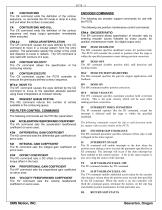
CE CONTOUR END The CE command ends the definition of the contour sequence, i.e. terminate the CD mode or ramp to a stop and exit when the contour is executed. CK CONTOUR END AND KILL The CK command ends the definition of the contour sequence and stops output generation immediately when executed. CR#,#,# CIRCULAR INTERPOLATION The CR command causes the axes defined by the CD command to move in a circular pattern from the entry position. The parameters specify the center of the circle and distance to travel in radians. The CR command is only valid with contours of 2 axes. CV# CONTOUR VELOCITY The...
Open the catalog to page 6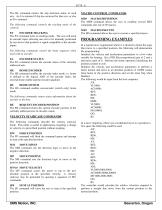
The RL command returns the slip detection status of each axis. An S is returned if slip has occurred for that axis, or else an N is returned. The following command controls the tracking mode of the controls. ET ENCODER TRACKING The ET command turns on tracking mode. The axis will track its encoder input, allowing one axis to be manually positioned by any device that produces a signal compatible to the encoder inputs. The following commands control the home sequence when used with an encoder. EA ENCODER STATUS The EA command returns the encoder status of the currently addressed axis. HE HOME...
Open the catalog to page 7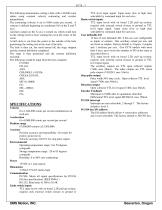
The following demonstrates cutting a hole with a 10,000 count radius using constant velocity contouring and circular interpolation: The contouring velocity is set to 1000 counts per second. A contour is defined beginning at coordinates 0,0 on the Z and T axes. Auxiliary output on the X axis is turned on, which could turn on the cutting torch or laser starting the cut at the center of the circle. A half circle is cut from the center to the outside of the hole positioning the cutting tool at the start of the hole. The hole is then cut, the torch turned off, the stage stopped and the contour definition...
Open the catalog to page 8All OMS Motion, Inc. catalogs and technical brochures
 General Product Catalog
25 Pages
 MAXnet 10-Axis
4 Pages
 PC78
PC784 Pages
 MAXv
MAXv4 Pages
 MAXv Specifications
88 Pages
 UMX-USB
4 Pages
 IODnet Interconnect Module
3 Pages
 MAXnet Motion Controller
4 Pages

- Electrical cable
- Data connector
- Polymer connector
- Industrial connector
- Electrical data cable
- Cable connector
- Motor controller
- Cable assembly
- Armored cable
- Crimp connector
- Armored electrical cable
- DC motor controller
- Stepper motor controller
- Nylon connector
- Motor driver
- Multi-axis positioning controller
- Compact motor controller
- Flexible electrical cable assembly
- Ethernet positioning controller