- Catalogs
- Omniseal Solutions
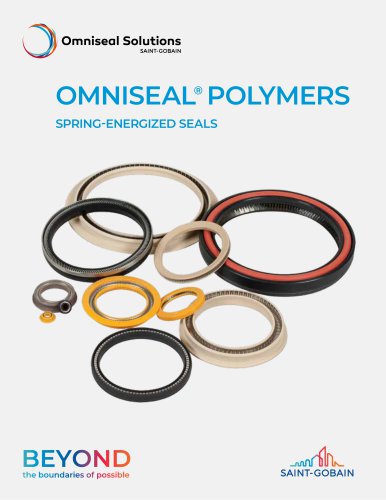
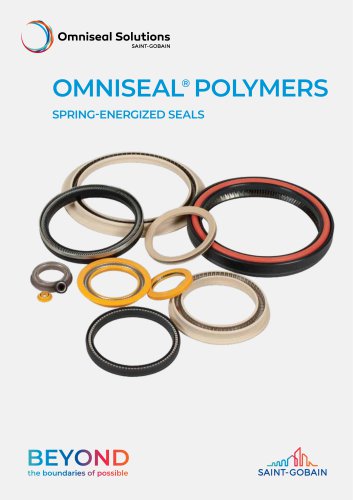
- OmniSeal® Spring Energized Seals

- Company
- Products
- Catalogs
- News & Trends
- Exhibitions
OmniSeal® Spring Energized Seals

OmniSeal® Spring Energized Seals
OmniSeal® is a leading brand in high-performance sealing, known for its spring-energized seals that offer durability, chemical resistance, and functionality under extreme temperatures. It is part of Saint-Gobain Performance Plastics, a company with a rich history of innovation in engineered materials.
Saint-Gobain, founded in 1665, is a global leader in engineered materials, including high-performance seals, and is recognized as one of the top 100 industrial corporations worldwide.
OmniSeal® seals are utilized across various industries such as aerospace, transportation, and medical instrumentation, known for their versatility and superior design.
OmniSeal® seals are manufactured globally to ISO 9100 standards, designed to address complex sealing issues with support from experienced engineers and advanced facilities.
Made from PTFE and other high-performance polymers, OmniSeal® seals can withstand temperatures from cryogenic levels to +300°C, with various spring energizers for specific applications.
- Static Seals: Used in applications with no relative motion, such as bolted flanges.
- Dynamic Seals: Suitable for applications with relative motion, like hydraulic cylinders, handling reciprocating or rotary motion.
OmniSeal® offers a range of spring-energized PTFE seals, requiring careful installation to avoid damage, with special assembly tools provided by Saint-Gobain.
Friction is influenced by material, lubrication, temperature, and surface finishes. OmniSeal® provides charts and formulas to estimate friction values for optimal performance.
SGPPL manufactures springs with various load capacities, with special springs available as needed. Total load calculations are provided for different applications.
OmniSeal seals are designed for high-speed, high-pressure rotary applications, with material coefficients of friction crucial for performance calculations.
Seal materials harden at cold temperatures and soften at high temperatures. Minimizing the extrusion gap is essential to prevent seal failure.
A smoother sealing surface is recommended for static applications, while dynamic surfaces require a balance between material transfer and wear.
Proper gland geometry is crucial to avoid installation issues, with split or separable glands preferred.
OmniSeal offers various spring energizer configurations and design variations for different applications.
SGPPL offers a range of materials, including Virgin PTFE and Polymer Filled PTFE, each suitable for different applications.
Various metallic and elastomeric energisers are available, compatible with most fluids.
Materials used include various stainless steels, Inconel® 718, Elgiloy®, and Hastelloy® C276, each offering unique properties.
Descriptions of products like OmniSeal 400A, 103A, RP II, and RACO 1100A, each designed for specific sealing applications.
Options like FDA-approved RTV silicone filling for food processing and elastomeric O-Ring energisers are available.
OmniSeal 103A is suitable for static applications, while OmniSeal 400A is designed for dynamic applications.
OmniSeal RACO 1100A is designed for extreme static sealing conditions and dynamic marine applications.
Detailed specifications for gland designs, emphasizing the importance of appropriate cross-section and surface finish.
Contact Technical Support for specific design requirements and additional data.
The document provides comprehensive information on sealing solutions, including specifications, design capabilities, and applications.
Lists minimal seal diameters and specific measurements for various applications.
Saint-Gobain uses advanced modeling software and FEA to enhance design confidence and reduce testing time.
- Diaphragm Seals: For corrosive fluids in chemical equipment.
- Machined Spring Face Seal: Low leak rate sealing for gases.
- Integral Piston Seal: For small diameter applications.
- Anti-Blowout Seal: Prevents deformation under pressure.
- Belleville Spring Seals: High deflection without collapse.
- Bi-Directional Seals: For moderate temperature/pressure applications.
- Sanitary Seals: For food equipment.
Descriptions of specialized seals like OmniGasket and high-pressure seals.
Contact details for Saint-Gobain locations worldwide.
A limited warranty is offered, with a disclaimer advising users to perform their own suitability tests.
Catalog excerpts

PERFORMANCE PLASTICS
Open the catalog to page 1
A Worldwide Leader in High Performance Sealing OmniSeal®, a recognized name in sealing for over fifty years. First as Fluorocarbon then Furon and now as Saint-Gobain Performance Plastics (SGPPL). OmniSeals, have been used in a multitude of applications where durability, resistance to chemicals and operation at temperature extremes is crucial. Our spring energised seal designs are widely recognized throughout the industry. OmniSeal high-performance spring energised seals reduce friction, operate in harsh environments, reduce downtime and extend equipment service life. Compagnie de Saint-Gobain...
Open the catalog to page 2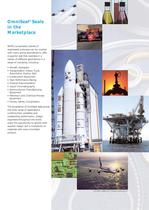
OmniSeal ® Seals in the Marketplace SGPPL’s proprietary blends of engineered polymers can be coupled with many spring geometries to offer a superior seal that operates in a variety of different applications in a range of industries, including: • Aircraft, Aerospace • Transportation (Heavy Truck, Automotive, Marine, Rail) • Construction Equipment • High Performance Racing • Medical Instrumentation • Liquid Chromatography • Semiconductor Manufacturing Equipment • Petroleum and Chemical Process Equipment • Pumps, Valves, Compressors The acceptance of OmniSeal seals across this wide range of applications...
Open the catalog to page 3
Technology High Performance Seals Backed by a proud heritage of product innovation, technological expertise and market leadership, Saint-Gobain Performance Plastics is dedicated to working with our customers to solve today’s tough seal application issues and the challenges that lie ahead. OmniSeal seals are manufactured throughout the world, with sites located in North America and South America, Europe and Asia. The seals were originally designed and developed in Southern California. The current facilities located in Garden Grove, California, Kontich in Belgium and Suwa Japan design and manufacture...
Open the catalog to page 4
How OmniSeal seals Work OmniSeal Components PTFE JACKET METAL SPRING ENERGIZER The OmniSeal is a spring actuated, pressure assisted sealing device consisting of a PTFE (or other polymer) jacket, partially encapsulating a corrosion resistant metal spring energiser. When the OmniSeal is seated in the gland, the spring is under compression, forcing the jacket lips against the gland walls thereby creating a leak-tight seal. OmniSeal jackets are precision machined from PTFE, filled PTFE composites and other high performance polymers. OmniSeal seals with PTFE jackets are serviceable at temperatures...
Open the catalog to page 6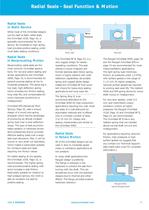
Radial Seals - Seal Function & Motion Radial Seals in Static Service While most of the OmniSeal designs can be used as static radial seals, the OmniSeal 103A, Page 16, is generally recommended for this service. Its moderate to high spring load provides positive sealing under most static sealing conditions. Radial Seals in Reciprocating Motion Reciprocating radial seals are the most common OmniSeal applications. For rod and piston sealing and similar applications, the OmniSeal 400A, Page 18, is recommended for general purpose sealing at low to moderate pressures. This series has a low load, high...
Open the catalog to page 7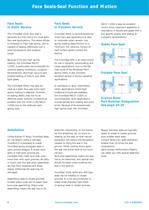
Face Seals-Seal Function and Motion Face Seals in Static Service Face Seals in Dynamic Service The OmniSeal 103A, face seal is generally the first choice for most static face seal applications. This series utilizes a moderate to high load spring, and is capable of sealing effectively over a wide temperature and pressure range. OmniSeal 400A, is recommended for rotary face seal applications at slow to moderate rotary speeds. Low spring loading keeps friction to a minimum. For ultra-low friction or high surface speed contact the factory. Because of its very high spring loading, the OmniSeal RACO®...
Open the catalog to page 8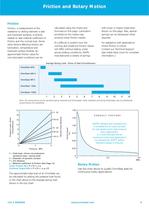
Friction and Rotary Motion Friction calculated using the charts and formulas on this page. Lubrication provided by the media may produce lower friction results. with lower or higher loads than shown on this page. Also, special springs can be developed when required. It is difficult to predict how the running and break-out friction values will differ without testing under actual existing conditions. SGPPL manufacturers a variety of springs Friction, a measurement of the resistance to sliding between a seal and hardware surfaces, is directly related to seal material coefficient of friction and...
Open the catalog to page 9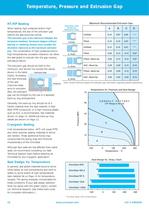
Temperature, Pressure and Extrusion Gap Maximum Recommended Extrusion Gap HT/HP Sealing When sealing high pressures and/or high temperatures, the size of the extrusion gap behind the seal becomes critical. This extrusion gap is the clearance between the hardware members. Hardware designs without bearing or centering devices must consider the diametral clearance as the maximum extrusion gap. The combination of high pressures and/or high temperatures, excessive clearance can allow the seal jacket to extrude into the gap causing premature failure. (OmniSeal 103A Shown for Illustration Only) 0,07...
Open the catalog to page 10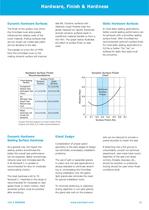
Hardware, Finish & Hardness Dynamic Hardware Surfaces seal life. Dynamic surfaces with relatively rough finishes wear the jacket material too rapidly. Extremely smooth dynamic surfaces result in insufficient material transfer to form a thin film. The graph below illustrates the effect of surface finish on seal wear. The finish of the surface over which the OmniSeal must slide greatly influences the relative wear of the cover material. Mating surfaces that are too rough can create leak paths and be abrasive to the seal. Static Hardware Surfaces In most static sealing applications, better overall...
Open the catalog to page 11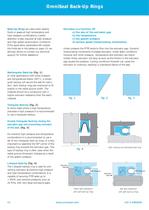
OmniSeal Back-Up Rings Back-Up Rings are used when sealing fluids or gases at high temperature and high pressure combinations. Careful attention is also required at high pressure and high speed reciprocation conditions. If the application parameters fall outside the limits set in the tables on page 10, we strongly advice to contact our technical support for further assistance. Extrusion is a function off a) the size of the extrusion gap b) the temperature c) the system pressure d) surface speed (reciprocating movements) Under pressure the PTFE tends to flow into the extrusion gap. Dynamic reciprocating...
Open the catalog to page 12All Omniseal Solutions catalogs and technical brochures
 Metal Seals Handbook
68 Pages
 Railway Bogies Sliding Plate
4 Pages
 Coiling Mandrels Composites
4 Pages
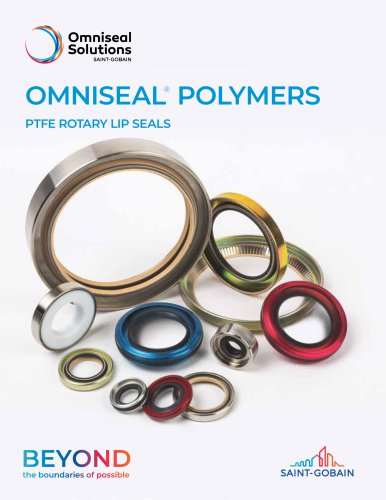 Rotary Lip Seals Handbook
32 Pages
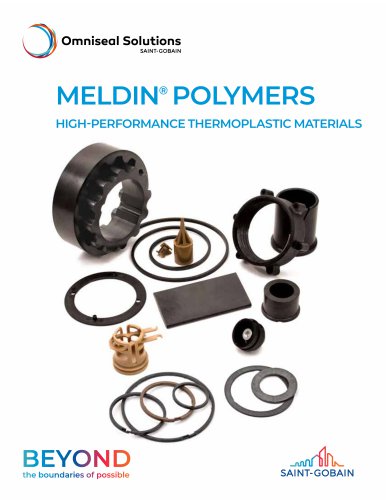 Medlin Thermoplastics Handbook
34 Pages
 Rulon Fluoropolymers Handbook
28 Pages
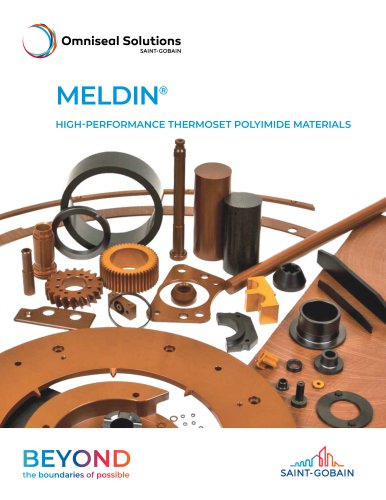 Meldin Polyimides Handbook
12 Pages
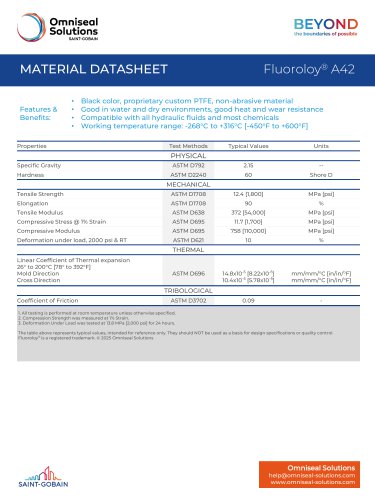 Fluoroloy® A42
1 Page
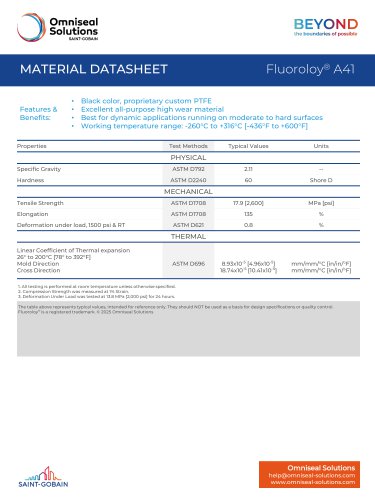 Fluoroloy® A41
1 Page
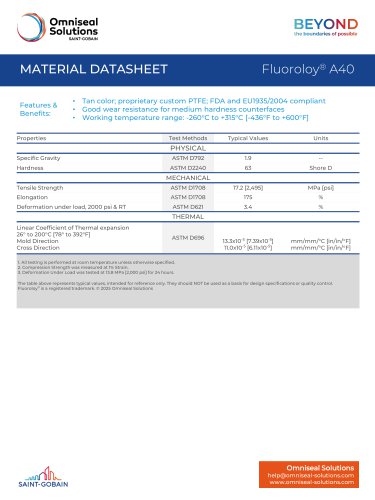 Fluoroloy® A40
1 Page
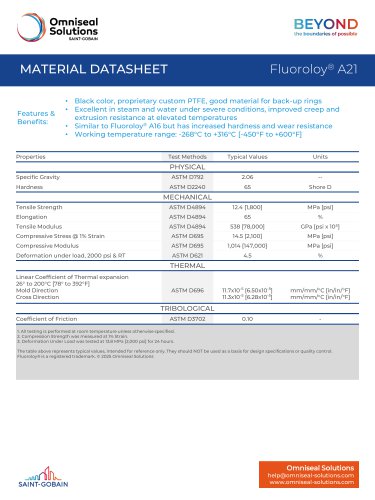 Fluoroloy® A21
1 Page
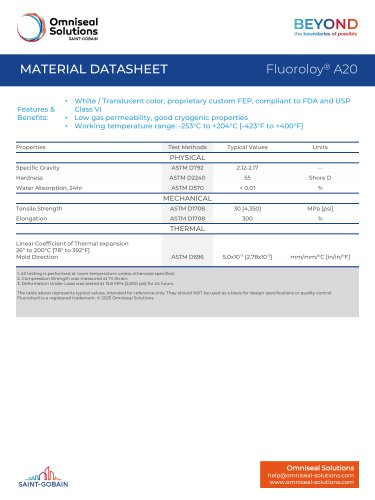 Fluoroloy® A20
1 Page
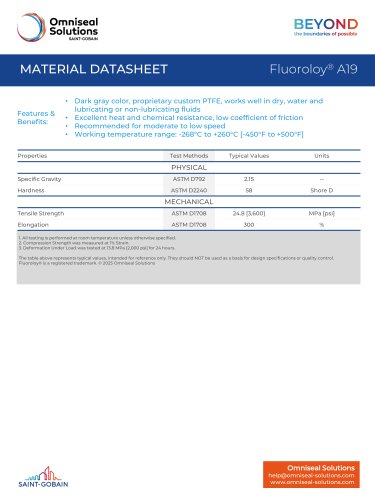 Fluoroloy® A19
1 Page
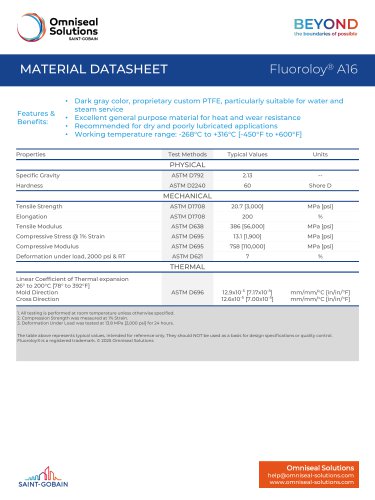 Fluoroloy® A16
1 Page
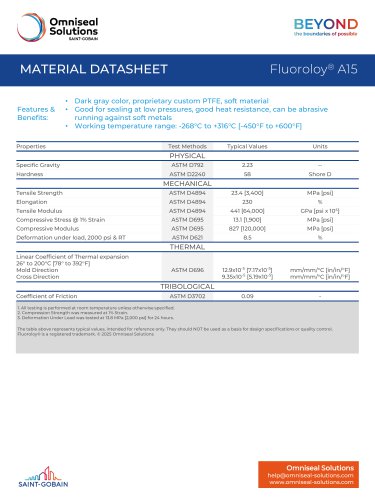 Fluoroloy® A15
1 Page
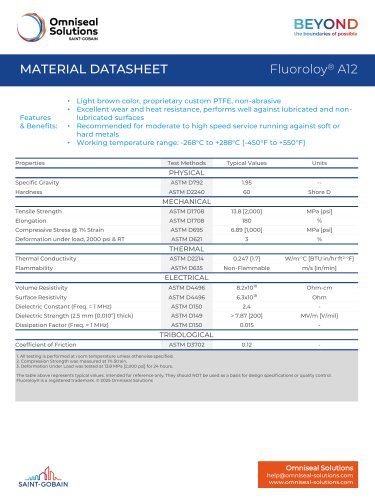 Fluoroloy® A12
1 Page
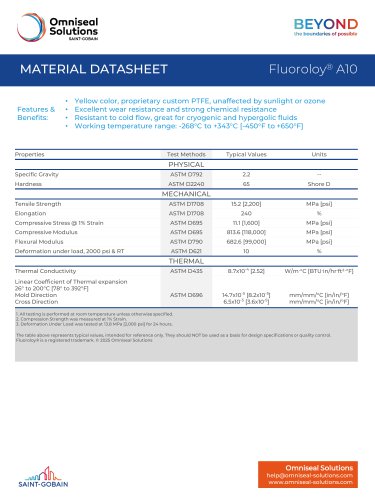 Fluoroloy® A10
1 Page
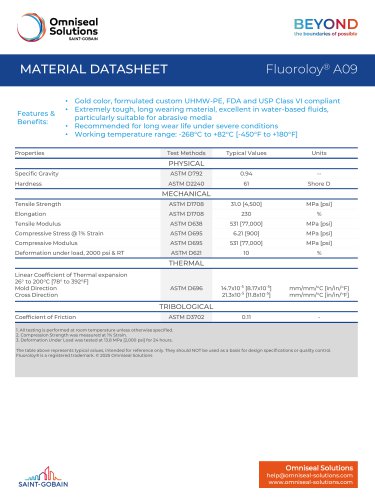 Fluoroloy® A09
1 Page
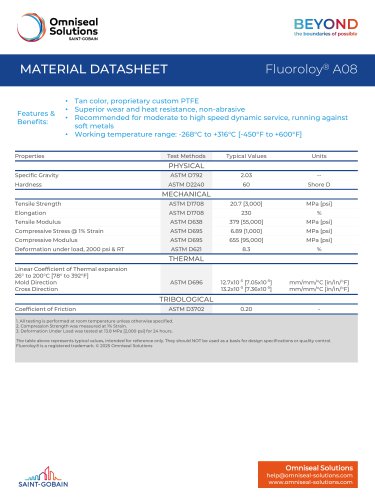 Fluoroloy® A08
1 Page
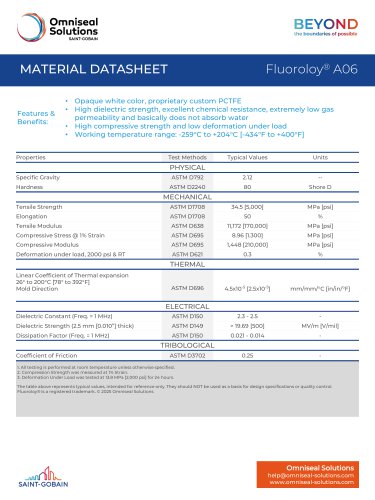 Fluoroloy® A06
1 Page
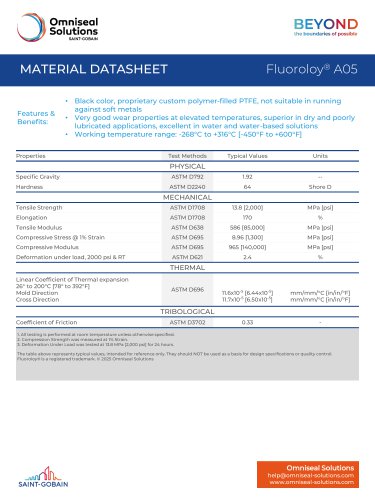 Fluoroloy® A05
1 Page
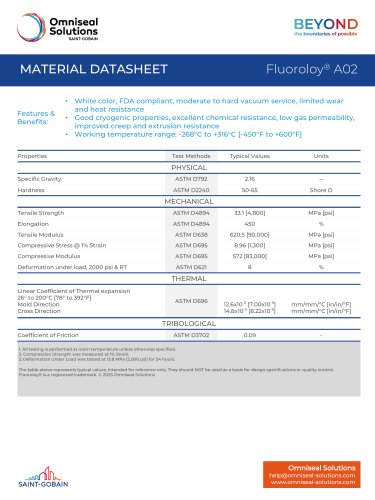 Fluoroloy® A02
1 Page
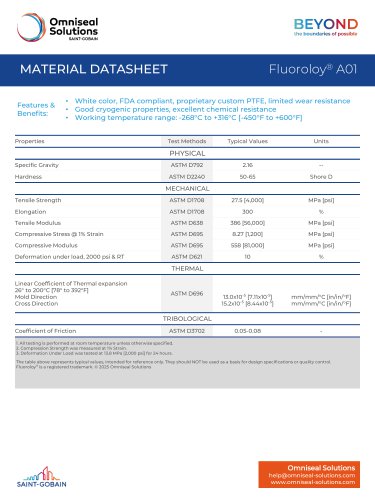 Fluoroloy® A01
1 Page
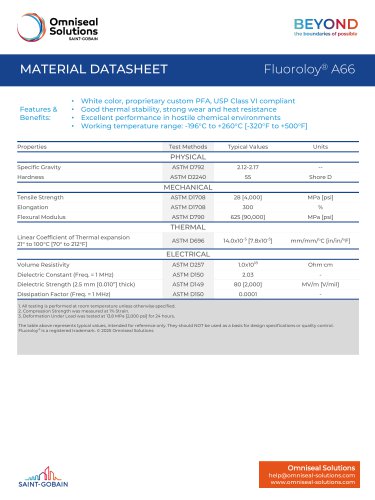 Fluoroloy® A66
1 Page
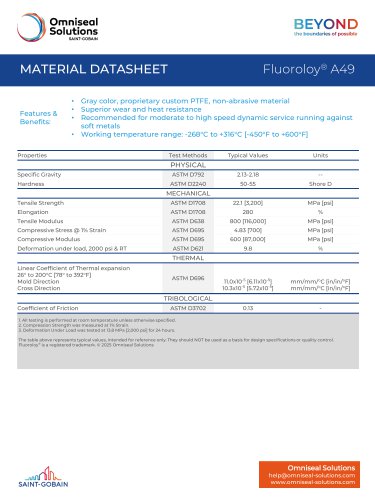 Fluoroloy® A49
1 Page
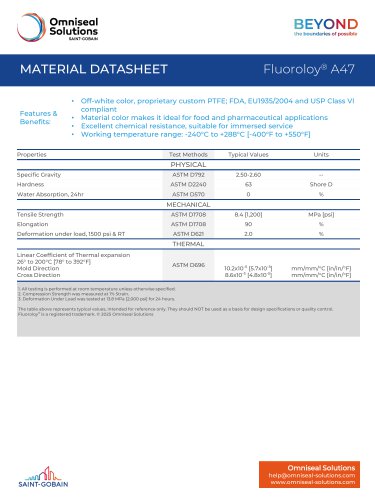 Fluoroloy® A47
1 Page
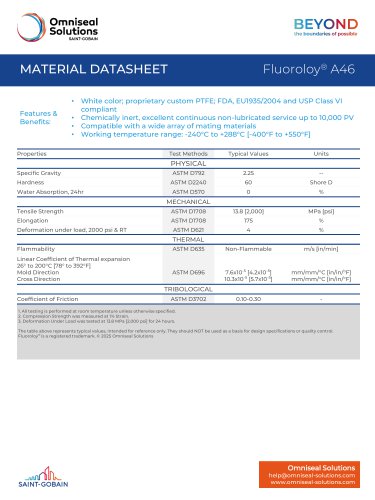 Fluoroloy® A46
1 Page



Archived catalogs
 Omniflex Fluoroelastomer seals
20 Pages
 OmniSeal® Rotary Lip Seals (US)
34 Pages
 OmniSeal® Spring-Energized Seals
60 Pages
 Rulon® Fluoropolymer
28 Pages
 Meldin® Thermoplastic
44 Pages
 Meldin® Thermoset
12 Pages
 Meldin® 7000 Series Design
17 Pages
 OmniSeal® Backup Rings
1 Page
 Fluoroloy® A01
1 Page
 Fluoroloy® A08
1 Page
 OmniLip? PTFE Rotary Shaft Seals
32 Pages
 aerospace industry
6 Pages
 OmniLip, PTFE Rotary Lipseals
16 Pages
 Meldin® CMP Retaining Rings
4 Pages
 OmniSeal, Spring Energised Seals
32 Pages