
- Catalogs
- Omniseal Solutions
- Meldin® 7000 Series Design

- Company
- Products
- Catalogs
- News & Trends
- Exhibitions
Meldin® 7000 Series Design

Meldin® 7000 Series Design
Introduction
The Meldin 7000 Series Design Guide by Saint-Gobain Performance Plastics provides detailed information on the Meldin 7000 series, a family of polyimide, thermosetting materials known for their high dimensional stability and minimal degradation at elevated temperatures. These materials are ideal for high-temperature applications due to their wear resistance, chemical resistance, and electrical properties. The guide emphasizes the company's control over the production process, ensuring high-quality standards.
Mechanical Properties vs. Temperature
The mechanical properties of Meldin 7000 series materials, such as tensile and flexural strength, decrease linearly with increasing temperature. These materials can operate continuously at 315°C and intermittently at 482°C. The guide includes graphs showing the relationship between temperature and mechanical properties, aiding engineers in predicting performance under various conditions.
Flexural Strength vs. Temperature
Meldin 7000 materials exhibit a gradual decline in flexural strength with temperature, unlike many plastics that show a sharp decrease at their glass transition temperature. The presence of fillers affects the initial property values and the rate of decline.
Stress-Strain Information
The stress-strain behavior of Meldin 7000 materials shows no transition from elastic to plastic deformation, indicating brittleness in filled materials compared to unfilled ones. The guide provides stress-strain graphs for both ambient and high-temperature conditions.
Direct Formed Stress-Strain
Stress-strain properties measured perpendicular to the forming direction are slightly lower, reflecting anisotropy in material properties. The guide includes graphs for these measurements at different temperatures.
Stress-Strain Under Compression
Meldin 7000 materials can withstand high strain conditions without failure, making them suitable for seals and bearings. The guide provides compression stress-strain graphs at various temperatures.
Linear Thermal Expansion
The coefficient of linear thermal expansion is provided for the temperature range of 23°C to 300°C, highlighting the material's stability under thermal stress.
Conclusion
The guide concludes with a note on the importance of testing Meldin 7000 materials in actual applications to ensure suitability, as Saint-Gobain does not assume liability for performance outcomes. The document serves as a valuable resource for design engineers in selecting and specifying Meldin 7000 series materials.
Overview
The document provides detailed technical specifications, properties, and guidelines for the Meldin 7000 series polyimide materials, focusing on their mechanical, thermal, and electrical properties, as well as their resistance to various chemicals and flammability ratings. It also includes machining guidelines and application recommendations.
Specifications
The document outlines the mechanical properties of different Meldin grades (7001, 7021, 7022, 7211, 7003) at room temperature and elevated temperatures (500°F/260°C). Key properties include tensile strength, elongation, flexural strength, compressive stress, and modulus. The coefficient of thermal expansion and thermal conductivity are also specified.
Procedures
The document describes the testing methods used to determine the properties of Meldin materials, including ASTM standards for tensile strength (D638), flexural strength (D790), compressive stress (D695), and thermal expansion (E831). It also details the creep testing procedures and results for Meldin 7001, 7021, and 7022 under various loads and temperatures.
Norms and Standards
Meldin materials meet several industry standards, including ASTM D 6456-99, AMS SAE 3644G, and MIL-R-46198, ensuring their suitability for aerospace and other high-performance applications.
Recommendations
The document provides machining guidelines for Meldin 7000 materials, recommending specific tooling, feed rates, and holding methods to achieve optimal results. It emphasizes the importance of using appropriate tools and techniques to maintain the material's dimensional stability and surface finish.
Key Data from Figures and Tables
The document includes stress-strain curves for Meldin materials at different temperatures, showing their performance under compression. It also presents data on linear thermal expansion and chemical resistance, highlighting the materials' stability and resistance to various chemicals and conditions.
Applications
Meldin materials are recommended for use in high-temperature environments, electrical insulation, and applications requiring wear resistance and dimensional stability, such as bearings, thrust washers, and sealing rings.
Specifications and Procedures
The document outlines the "go/no-go" method for measuring tolerances using a micrometer. The micrometer is set at the high end of the tolerance to check if the piece passes through without drag, indicating acceptability. Similarly, at the low end, any resistance indicates the piece is above the low tolerance and acceptable. Pins should not be forced through a bore; they should fall through by their own weight.
Basic Shapes and Materials
Meldin® 7000 series materials are available in various basic shapes such as blocks, disks, rods, and tubes, offering design flexibility and optimal material utilization. The document provides detailed dimensions for these shapes, including blocks, disks, tubes, and molded rods, both isostatic and compression molded.
Contact Information
The document lists contact details for Saint-Gobain Performance Plastics locations worldwide, including the USA, Mexico, Brazil, Germany, Spain, Belgium, Poland, China, Taiwan, South Korea, Japan, India, Italy, the UK, and Thailand.
Warranty and Disclaimer
Saint-Gobain Performance Plastics offers a limited warranty for six months from the date of sale, covering manufacturing defects. The company disclaims all other warranties, including implied warranties of merchantability and fitness for a particular purpose. Users are advised to perform their own tests to determine product suitability.
Additional Notes
The document emphasizes that Saint-Gobain does not assume responsibility for advice or the performance of installations or use of the products. Meldin® is a registered trademark of Saint-Gobain Performance Plastics Corporation.
Catalog excerpts

Design Guide
Open the catalog to page 1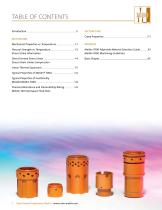
Saint-Gobain Performance Plastics www.rulon-meldin.com
Open the catalog to page 2
Meldin 7000 SERIES Design Guide ® With more than fifty years of engineered plastics technology and extensive fabrication expertise, Saint-Gobain Polymer Products is recognized the world over as a leader in the high performance polymer components business. The materials and customized components we supply our customers are designed to withstand the harshest environments and perform under the toughest operating conditions. As a result, design engineers trust Saint-Gobain Polymer Products to provide practical, affordable solutions to the most demanding high temperature applications. The Meldin 7000...
Open the catalog to page 3
Meldin 7000 SERIES Design Guide ® Evident in all the Meldin® 7000 series products is Saint-Gobain Polymer Products’ unwavering commitment to quality and service to our customers. Our manufacturing plants have been certified to such worldwide quality standards as: > AS EN9100 > ISO-9001 Production batches of Meldin 7000 resin are tested to a number of ASTM test methods to ensure the performance characteristics meet the requirements and expectations of the most demanding customers in every industry and market we serve. Finished parts made from Meldin 7000 series are also qualified to such specifications...
Open the catalog to page 4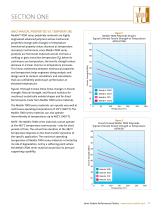
Section one MECHANICAL PROPERTIES VS. TEMPERaTURE Figures 1 through 6 show these linear changes in tensile strength, flexural strength, and flexural modulus for machined, isostatically molded shapes and for direct formed parts made from Meldin 7000 series materials. The Meldin 7000 series materials can operate very well at continuous operating temperatures of 315˚C (600˚F). The Meldin 7000 series materials can also operate intermittently at temperatures up to 482˚C (900˚F). NOTE: The Meldin 7000 series materials cannot operate at the 482˚C temperature continuously – only for short periods of...
Open the catalog to page 5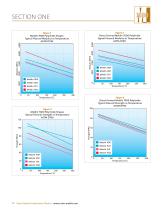
Figure 3 Meldin 7000 Polyimide Shapes Typical Flexural Modulus vs Temperature ASTM D790 Meldin 7001 Meldin 7021 Meldin 7211 Meldin 7022 Figure 5 Direct Formed Meldin 7000 Polyimide Typical Flexural Modulus vs Temperature ASTM D790 Figure 4 Meldin 7000 Polyimide Shapes Typical Flexural Strength vs Temperature ASTM D790 Figure 6 Direct Formed Meldin 7000 Polyimide Typical Flexural Strength vs Temperature ASTM D790 1-2 Saint-Gobain Performance Plastics www.rulon-meldin.com
Open the catalog to page 6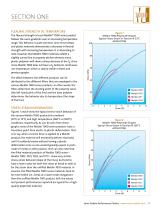
Section one Flexural Strength vs. Temperature Stress-strain information Figures 7 and 8 show the typical stress-strain behavior of the various Meldin 7000 products for ambient (23°C or 73°F) and high temperature (260°C or 500°F) conditions, respectively. As can be seen from these graphs, none of the Meldin 7000 series products have a transition point from elastic to plastic deformation. That is to say, when a tensile force is applied to a Meldin product, the material will essentially deform elastically until it suddenly breaks without having a plastic deformation zone as one would typically expect...
Open the catalog to page 7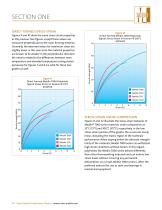
Section ONE direct formed Stress-strain Figure 9 Direct Formed Meldin 7000 Polyimide Typical Stress-Strain in Tension @ 23°C ASTM E8 Figure 10 Direct Formed Meldin 7000 Polyimide Typical Stress-Strain in Tension @ 260°C ASTM E8 Figures 9 and 10 show the same stress-strain properties as the previous two figures, except these values are measured perpendicular to the main forming direction. Generally, the observed values for maximum stress are slightly lower in this case since the material properties are known to be weaker in the perpendicular direction. All remarks related to the differences between...
Open the catalog to page 8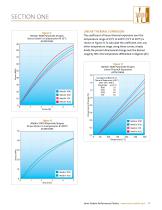
Section one linear thermal expansion Figure 11 Meldin 7000 Polyimide Shapes Stress-Strain in Compression @ 23°C ASTM D695 The coefficient of linear thermal expansion over the temperature range of 23°C to 300°C (73°F to 572°F) is shown in Figure 13. To calculate the coefficient over any other temperature range using these curves, simply divide the percent dimensional change over the desired range by 100 x the temperature differential in degrees (ΔT). Figure 13 Meldin 7000 Polyimide Shapes Linear Thermal Expansion ASTM D696 Dimensional Change (%) Figure 12 Meldin 7000 Polyimide Shapes Stress-Strain...
Open the catalog to page 9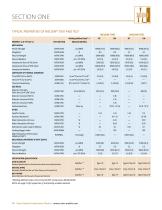
Section one Typical Properties of Meldin® 7001 and 7021 PROPERTY at @ 73˚F (23˚C) TEST METHOD Molding Method Code* ENGLISH (METRIC) MECHANICAL Tensile Strength Flexural Strength Flexural Modulus Compressive Stress @ 1% Strain Compressive Stress @ 10% Strain Compressive Modulus ELECTRICAL Dielectric Strength, Short time 2mm (.08") thick Surface Resistivity OTHER Specific Gravity Water Absorption, 24 hours Water Absorption, 48 hours Deformation under Load @ 2000 psi Limiting Oxygen Index High Temperature Dimensional Stability @ 500˚F MECHANICAL PROPERTIES @ 500ºF (260ºC) Tensile Strength Flexural...
Open the catalog to page 10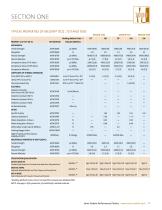
Section one Typical Properties of Meldin® 7022 , 7211 and 7003 PROPERTY at @ 73˚F (23˚C) MECHANICAL TEST METHOD Molding Method Code* ENGLISH (METRIC) Tensile Strength Flexural Strength Flexural Modulus Compressive Stress @ 1% Strain Compressive Stress @ 10% Strain Compressive Modulus Coefficient of Thermal Expansion 73 to 500ºF (23 to 260ºC) Thermal Conductivity Dielectric Strength, Short time 2mm (.08") thick Surface Resistivity Specific Gravity Water Absorption, 24 hours Water Absorption, 48 hours Deformation under Load @ 2000 psi Limiting Oxygen Index Tensile Strength High Temperature Dimensional...
Open the catalog to page 11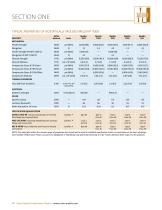
Section ONE Typical Properties of Isostatically Molded Meldin® 7000 PROPERTY MECHANICAL ASTM Method Units psi (MPa) Tensile Strength Flexural Strength Flexural Modulus Compressive Stress @ 1% Strain Compressive Stress @ 10% Strain Compressive Stress @ 0.1% Offset Compressive Modulus Thermal Expansion ELECTRICAL Dielectric Strength OTHER Specific Gravity Water Absorption, 24 Hours ASTM D 6456-99 Standard Specification for Finished Satisfies Type 1M Parts Made from Polyimide Resin Satisfies Plaque, and Formed Parts Satisfies Type 1M and Sintered SPECIFICATION QUALIFICATION AMS SAE 3644G Polyimide,...
Open the catalog to page 12All Omniseal Solutions catalogs and technical brochures
 Metal Seals Handbook
68 Pages
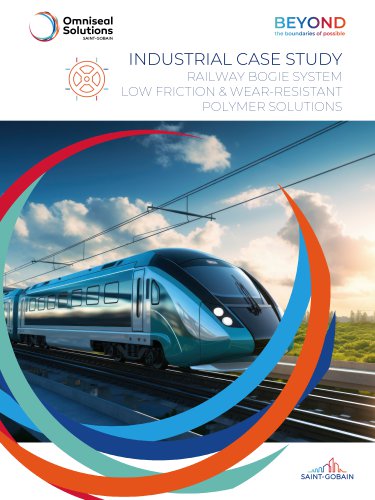 Railway Bogies Sliding Plate
4 Pages
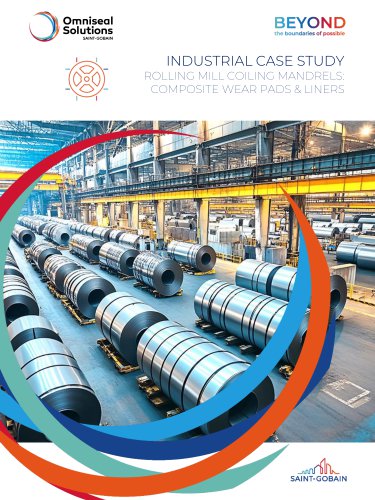 Coiling Mandrels Composites
4 Pages
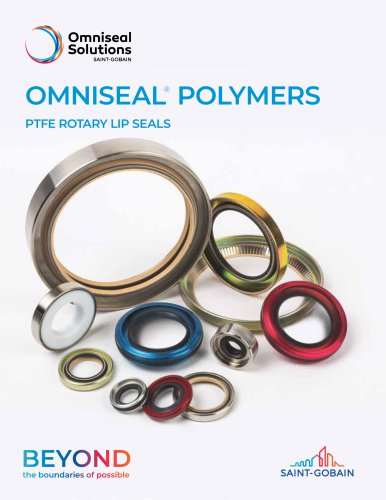 Rotary Lip Seals Handbook
32 Pages
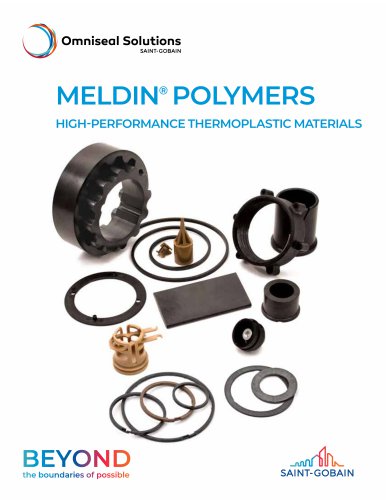 Medlin Thermoplastics Handbook
34 Pages
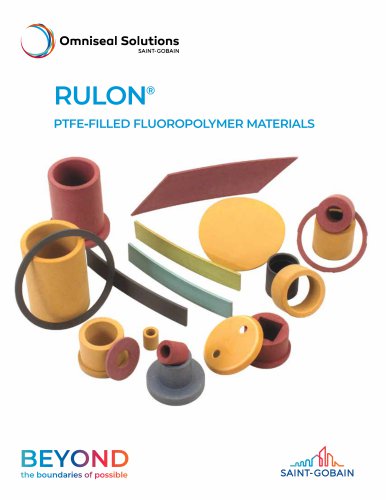 Rulon Fluoropolymers Handbook
28 Pages
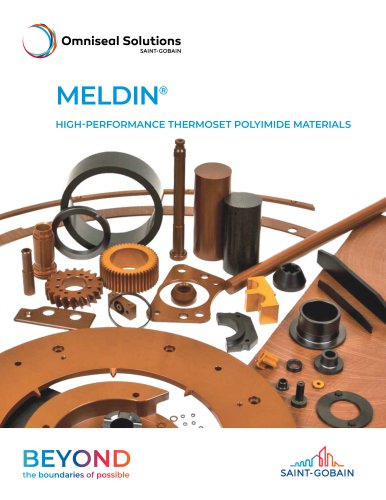 Meldin Polyimides Handbook
12 Pages
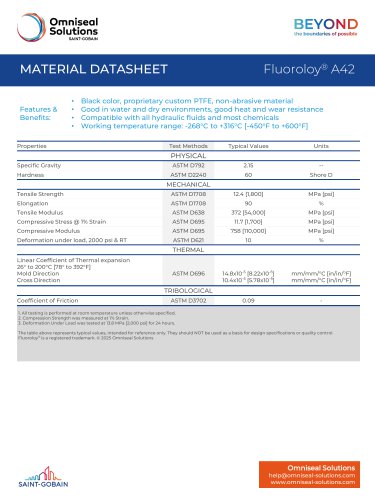 Fluoroloy® A42
1 Page
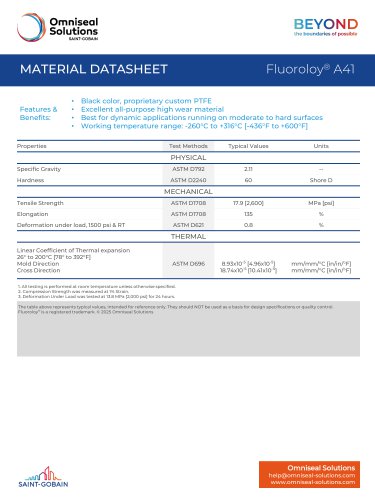 Fluoroloy® A41
1 Page
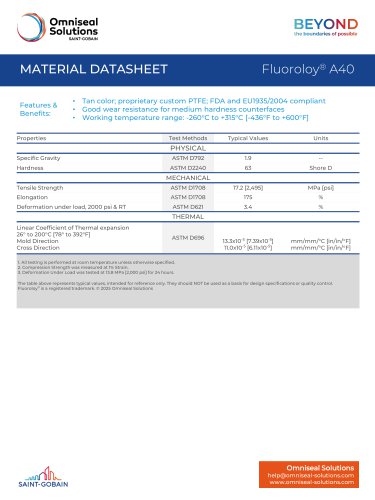 Fluoroloy® A40
1 Page
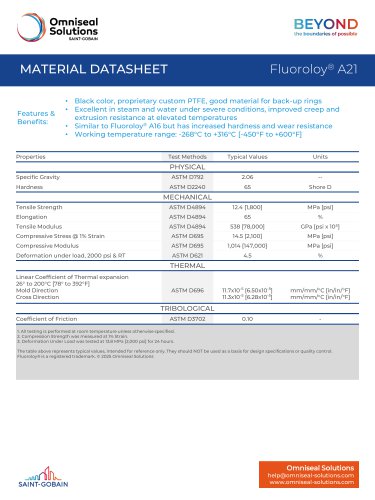 Fluoroloy® A21
1 Page
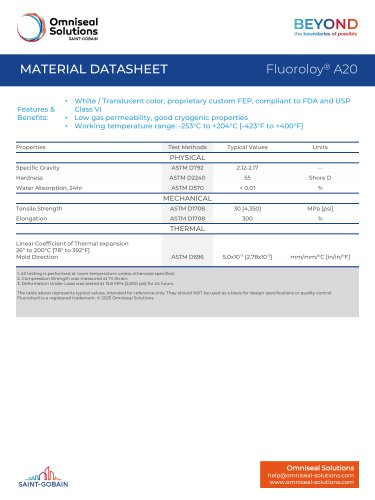 Fluoroloy® A20
1 Page
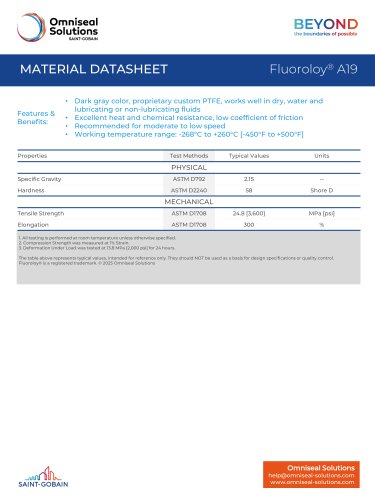 Fluoroloy® A19
1 Page
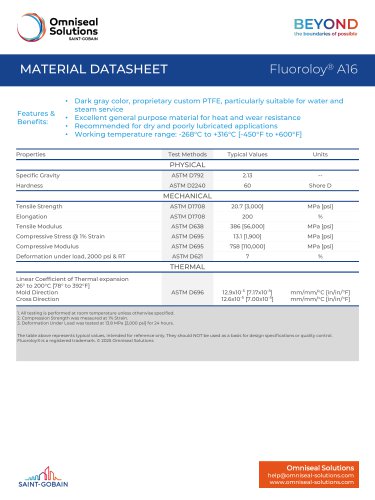 Fluoroloy® A16
1 Page
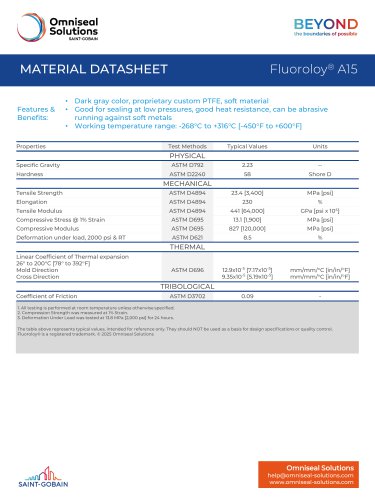 Fluoroloy® A15
1 Page
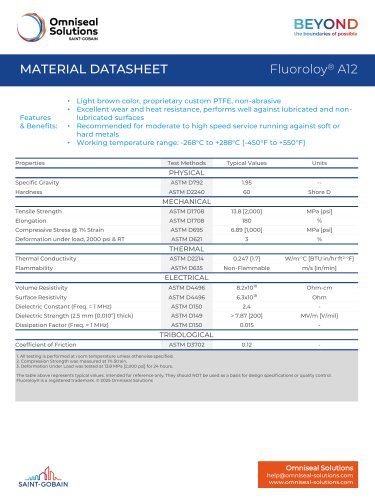 Fluoroloy® A12
1 Page
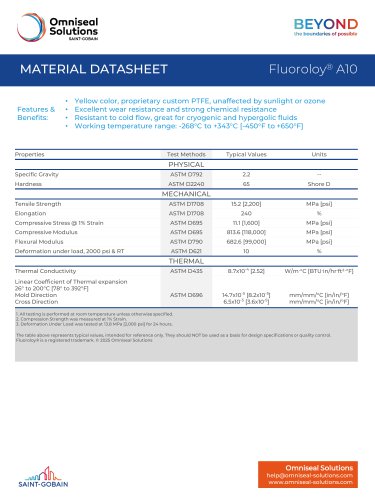 Fluoroloy® A10
1 Page
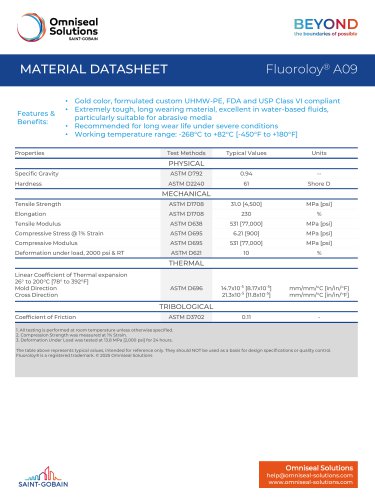 Fluoroloy® A09
1 Page
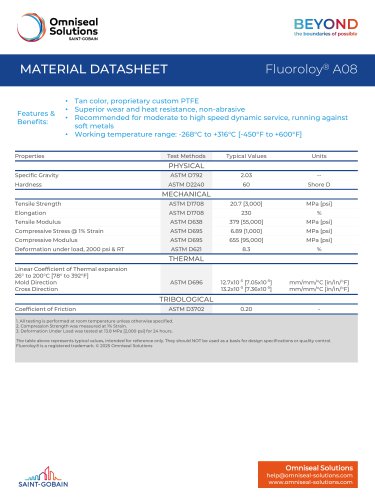 Fluoroloy® A08
1 Page
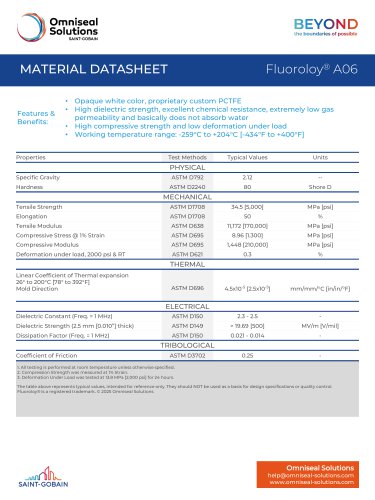 Fluoroloy® A06
1 Page
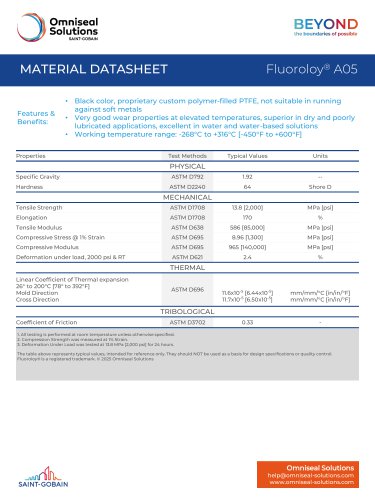 Fluoroloy® A05
1 Page
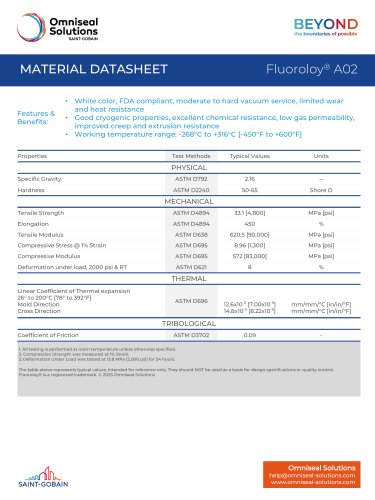 Fluoroloy® A02
1 Page
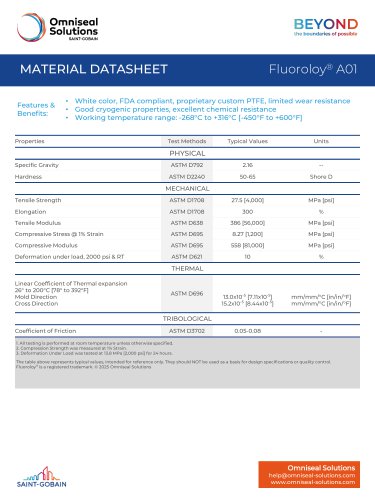 Fluoroloy® A01
1 Page
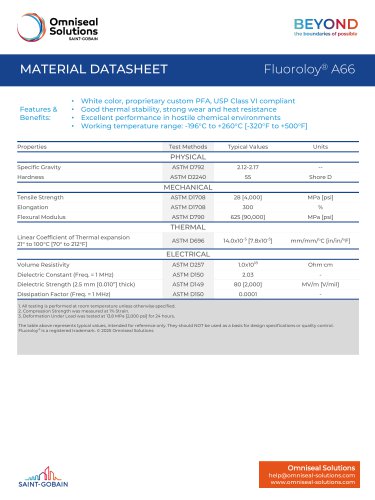 Fluoroloy® A66
1 Page
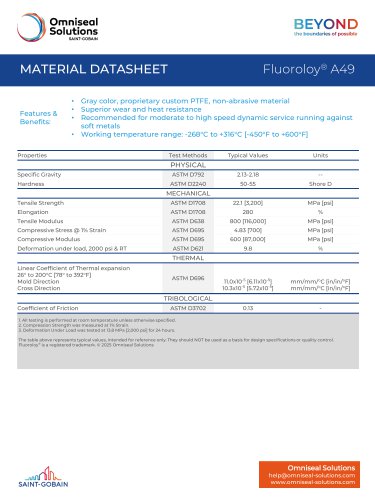 Fluoroloy® A49
1 Page
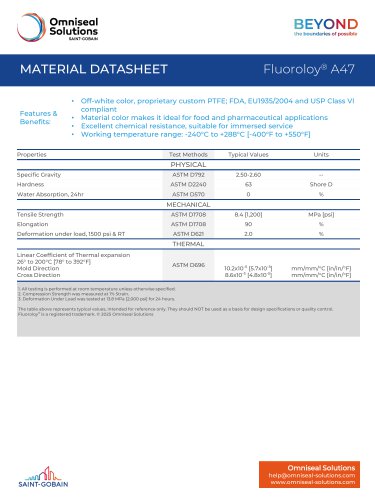 Fluoroloy® A47
1 Page
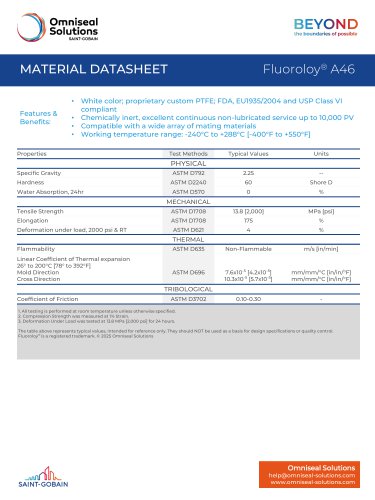 Fluoroloy® A46
1 Page


Archived catalogs
 Omniflex Fluoroelastomer seals
20 Pages
 OmniSeal® Rotary Lip Seals (US)
34 Pages
 OmniSeal® Spring-Energized Seals
60 Pages
 Rulon® Fluoropolymer
28 Pages
 Meldin® Thermoplastic
44 Pages
 Meldin® Thermoset
12 Pages
 OmniSeal® Backup Rings
1 Page
 OmniSeal® Spring Energized Seals
32 Pages
 Fluoroloy® A01
1 Page
 Fluoroloy® A08
1 Page
 OmniLip? PTFE Rotary Shaft Seals
32 Pages
 aerospace industry
6 Pages
 OmniLip, PTFE Rotary Lipseals
16 Pages
 Meldin® CMP Retaining Rings
4 Pages
 OmniSeal, Spring Energised Seals
32 Pages





- Omniseal plastic seal
- Omniseal circular seal
- Omniseal lipped seal
- Plain bearing
- Omniseal metal seal
- Round seal
- Gasket sheet
- Rubber seal
- Hydraulic seal
- Piston seal
- Elastomer seal
- Omniseal dynamic seal
- Bar seal
- Cylindrical plain bearing
- Static seal
- Self-lubricating plain bearing
- Omniseal gas seal
- VMQ seal
- Plastic plain bearing