
- Catalogs
- OMEGA FUSIBILI
- Cylindrical fuses


- Company
- Products
- Catalogs
- News & Trends
- Exhibitions
Cylindrical fuses

Cylindrical fuses
Cylindrical fuses are critical components in electronic circuits, designed to protect against overcurrents and isolate subsystems during faults. They are available in various types, including glass, ceramic, and special fuses, with specific approvals like UL-CSA.
Common sizes for cylindrical fuses include 5x20mm and 6.3x32mm. Subminiature fuses are used in space-constrained applications and are available in through-hole and surface mount designs, with standard surface mount sizes being 1608, 3216, and 6125.
Fuses protect components and people from fire and shock risks due to overcurrents, which can be overloads or short circuits. Selecting the right fuse involves considering voltage ratings, full load currents, short circuit currents, and environmental conditions.
The fuse's voltage rating must match or exceed the circuit voltage. Current ratings are marked on each fuse, and factors like clip material and conductor size can affect performance. Proper installation with clean, tight connections is crucial to avoid additional heat and premature fuse opening.
A fuse's breaking capacity is its ability to safely interrupt maximum available current without rupturing. While fuse resistance is generally negligible, it must be considered in critical applications.
Fuses are color-coded for easy identification of their ratings, with specific codes for time delay and fast fuses ranging from 32 mA to 6.3 A.
Fuses must be installed with clean and solid connections to prevent increased resistance and excess heat, which can reduce the lifespan of the fuse. The opening capacity of a fuse is crucial; it must safely interrupt the maximum available current at the rated voltage without causing damage to the surrounding environment.
- I2t (Ampere squared seconds): A measure of heat energy supplied to a circuit during a fault clearance.
- Arcing Time: The time from when the fuse link melts until the overcurrent is interrupted.
- Clearing Time: The total time from the start of the overcurrent to the final circuit opening.
- Fast Acting Fuses: Quickly open on overloads and short circuits but are not designed for temporary overloads.
- Overcurrent and Overload: Conditions where the normal load current is exceeded, with overloads being a specific type of overcurrent.
- Resistive Load: An electrical load without significant in-rush current.
- RMS Current: The effective value of a periodic current.
- Short Circuit: An overcurrent significantly exceeding the normal load current.
- Time Delay Fuses: Allow temporary in-rush currents but open on sustained overloads and short circuits.
- Voltage Rating: The maximum open circuit voltage a fuse can handle safely.
Standardized tests for fuse current carrying capacity are conducted at 23°C and 25°C. In practical applications, ambient temperatures may be higher, affecting the operating current. Adjustments must be made according to the ambient temperature conditions.
The ability of a fuse to withstand surge pulses without thermal stress is determined by calculating the circuit's pulse I2t. The fuse's melting I2t must be greater than or equal to the pulse I2t multiplied by a pulse factor, which depends on the fuse's construction.
The document discusses the selection and characteristics of fuses, particularly focusing on their ability to withstand pulse currents without degradation. It emphasizes the importance of selecting a fuse with a melting I2t value greater than or equal to the pulse I2t multiplied by a pulse factor (Fp).
The document explains the capacity of fuses to resist discharge pulses without causing thermal stress to the fuse wire. It highlights the need for circuit designers to ensure that the fuse's melting I2t value is greater than or equal to the pulse I2t multiplied by the pulse factor Fp.
The document lists various international standards for miniature fuses, including IEC, EN, NF, UL, and CSA standards. It provides a detailed comparison of time-current characteristics according to IEC and North American standards.
The document includes tables detailing the characteristics of different fuses, such as their dimensions, voltage ratings, breaking capacity, and approval codes.
- Dimensions: Fuses are available in 5x20 mm and 6.3x32 mm sizes.
- Rated Current: Ranges from 32 mA to 25 A, with specific codes assigned to each current rating.
- Voltage: All fuses are rated for 250 V, with some 6.3x32 mm fuses rated for 500 V.
- Breaking Capacity: 35 A for 5x20 mm fuses and up to 1500 A for 6.3x32 mm fuses.
- Body Material: Made from glass or ceramic filled with sand.
- Complies with EN60127, VDE 0820, CEI 32.6.2, BS 4265, SEMKO 104, and DIN 41661 standards.
- Approval codes include Bussmann S501 and S505 for specific models.
- Fast Acting (F): Designed for rapid response to overcurrent.
- Time Delay (T): Allows temporary overcurrent without blowing.
- Test Currents: Various multiples of the rated current are used to test the fuses, with specific time limits for each multiple.
- Voltage Drop and I2t Values: Detailed for each fuse type, indicating energy let-through and efficiency.
- Fuses are available in stock and can be ordered in quantities of 10/100 or 1000 pieces.
- Some fuses are marked as 'NEW', indicating recent additions to the product line.
The document serves as a comprehensive guide for selecting the appropriate fuse based on size, current rating, and compliance with safety standards. It provides essential data for understanding the performance and application of each fuse type in electrical circuits.
Catalog excerpts

FUSIBILI CILINDRICI Cylindrical fuses Fusibles cylindriques
Open the catalog to page 1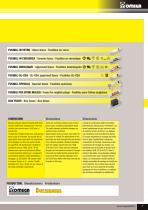
FUSIBILI IN VETRO | Glass fuses | Fusibles en verre FUSIBILI IN CERAMICA | Ceramic fuses | Fusibles en céramique FUSIBILI OMOLOGATI | Approved fuses | Fusibles homologués FUSIBILI UL-CSA | UL-CSA approved fuses | Fusibles UL-CSA FUSIBILI SPECIALI | Special fuses | Fusibles spéciaux FUSIBILI PER SPINE INGLESI | Fuses for english plugs | Fusibles pour fiches anglaises BOX FUSES | Box fuses | Box fuses Esistono diverse misure di fusibili elettronici, inclusi i fusibili sub-miniaturizzati. I formati cilindrici più comuni sono i 5x20 mm e i 6,3x32 mm. I fusibili sub-miniaturizzati sono usati spesso...
Open the catalog to page 2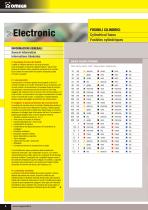
FUSIBILI CILINDRICI Cylindrical fuses Fusibles cylindriques INFORMAZIONI GENERALI General Information Informations Générales ■ Tecnologia di base dei fusibili I fusibili in miniatura servono a due scopi principali: a) per proteggere componenti, apparecchiature e persone dal pericolo di incendi e shock causati da sovraccarichi di corrente. b) per isolare dei sotto sistemi dal sistema principale quando si verifica un guasto. ■ I sovraccarichi si verificano quando viene superato il carico di corrente normale di un circuito. Può essere sia un sovraccarico che un corto circuito. Un sovraccarico è...
Open the catalog to page 3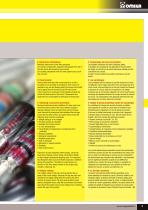
Basic Fuse Technology Selecting overcurrent protection Miniature fuses serve to two main purposes: a) to protect components, equipment and people from risk of fire and shock risk caused by overcurrents. b) to isolate subsystems from the main system once a fault has occurred. ■ Overcurrents exist when the normal load for a circuit is exceeded. It can be either an overload or short circuit. An overload is any current flowing within the normal circuit path that is higher than the normal circuit full load current. A short circuit is an overcurrent which greatly exceeds the normal full load current...
Open the catalog to page 4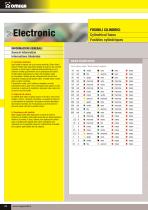
FUSIBILI CILINDRICI Cylindrical fuses Fusibles cylindriques INFORMAZIONI GENERALI General Information Informations Générales ■ Corrente nominale Ogni fusibile è marcato con una corrente nominale. Diversi fattori possono influire sulla capacità del fusibile di portare la sua corrente nominale. In primo luogo il materiale della pinzetta/clip su cui il fusibile è montato può interferire con la prestazione del fusibile. Un altro fattore importante è la misura del conduttore usato per connettere il fusibile agli altri componenti del circuito: se il conduttore è troppo piccolo genera calore. Il fusibile...
Open the catalog to page 5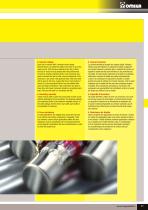
Current ratings Breaking capacity Fuse resistance Each fuse is marked with a nominal current rating. Several factors can affect the ability of the fuse to carry this rated current. First the base material of the clip in which the fuse is mount-ed may greatly affect the performance of the fuse. Another important factor is the conductor size used to connect the fuse to other circuit components. If the conductor is too small, it will generate heat. That extra heat will be seen by the fuse, causing the fuse to open before it should. It is also important that the fuse be installed with clean and tight...
Open the catalog to page 6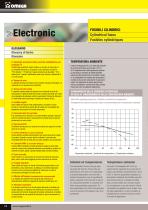
FUSIBILI CILINDRICI Cylindrical fuses Fusibles cylindriques GLOSSARIO Glossary of terms Glossaire ■ Quadrato del valore della corrente moltiplicato per il tempo I2t Si tratta della quantità di calore fornita a un circuito nel momento in cui il fusibile interviene su un guasto. Si può esprimere coi termini “I2t di fusione”, “ I2t dell’arco” oppure la somma dei due detta “ I2t di interruzione”. Questa è solitamente usata come misura di attuazione di un corto circuito. ■ È il periodo di tempo che intercorre tra l’istante di fusione del fusibile e il momento in cui il sovraccarico è interrotto. ■...
Open the catalog to page 7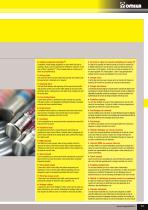
Ampere squared seconds I2t A measure of heat energy supplied to a circuit while the fuse is clearing a fault. It can be expressed as melting I2t, arcing I2t, or the sum of them “clearing I2t”. This is usually used as a meas-ure of short circuit performance. ■ Arcing time The amount of time from the instant the fuse link has melted until the overcurrent is interrupt-ed, or cleared. ■ Clearing time The total time between the beginning of the overcurrent and the final opening of the circuit at the rated voltage by an overcurrent protective device. Clearing time is the total of the melting time and...
Open the catalog to page 8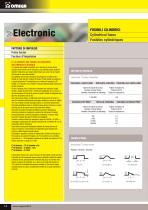
FUSIBILI CILINDRICI Cylindrical fuses Fusibles cylindriques FATTORE DI IMPULSO Pulse factor Facteur d’impulsion ■ LA CAPACITÀ DEI FUSIBILI DI RESISTERE AGLI IMPULSI DI SCARICA La capacità dei fusibili di resistere ad un impulso di scarica senza causare stress termico al filo di fusione, che potrebbe creare problemi durante l’intervento, può essere determinata una volta che gli impulsi del circuito I2t sono stati calcolati. Il progettista del circuito ha bisogno di individuare correttamente il fusibile in modo tale che il valore di fusione I2t del fusibile sia superiore o uguale all’impulso I2t...
Open the catalog to page 9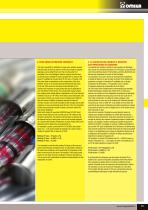
FUSE SURGE WITHSTAND CAPABILITY The fuse’s capability to withstand a surge pulse without causing thermal stress to the fuse element, which may result in nuisance openings, can be determined once the circuit’s pulse I2t is calculated. The circuit designer needs to properly size the fuse so that the fuse’s melting I2t value is greater than or equal to the pulse I2t multiplied by a pulse factor Fp (I2t fuse ≥ I2t pulse x Fp). The pulse factor is dependent on the construction of the fuse element. A wire-in-air constructed fuse element (ferrule fuses, 6125 and 1025 series for example) will be affected...
Open the catalog to page 10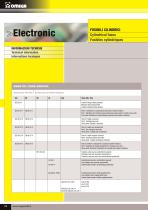
FUSIBILI CILINDRICI Cylindrical fuses Fusibles cylindriques INFORMAZIONI TECNICHE Technical information Informations tecniques NORME PER I FUSIBILI MINIATURA Standards for fuse links IEC IEC 60127 Normes pour les fusibles miniatures NF Titolo Title Titre Fusibili miniatura (titolo generale) Miniature fuses (general title) Fusibles miniatures (titre général) Parte 1: Definizione e caratteristiche generali dei fusibili miniatura Part 1: Definitions for miniature fuses and general requirement for miniature fuse-links 1ère partie: Définitions et caractéristiques générales des fusibles miniatures...
Open the catalog to page 11All OMEGA FUSIBILI catalogs and technical brochures
 AIR MOVING 2020
158 Pages
 ELECTRONIC 2016
30 Pages
 AIR MOVING 2016
84 Pages
 POWER 2016
174 Pages
 PROFESSIONAL 2016
156 Pages
 CONNECTION 2016
148 Pages
Archived catalogs
 EUROPEAN CATALOGUE 2012 - POWER
200 Pages
 IEC connectors
16 Pages
 IP68 connectors
26 Pages
 CH series
20 Pages
 DC fans
30 Pages
 EUROPEAN CATALOGUE 2012 - ELECTRONIC
184 Pages
 Electronic
23 Pages


- Connector
- Data connector
- Electrical power supply connector
- Circular connector
- Polymer connector
- Single-pole switch
- Junction block
- Screw-in connector
- Socket electrical connector
- Push-button switch
- Rectangular connector
- Male connector
- Isolator switch
- Multipole switch
- Screw connection terminal block
- RF connector
- Electronic filter
- Multipole connector
- Polyamide connector
- Rocker switch
- VirtualExpo Group
- Our Partners
- Recruitment
- Testimonials