
- Catalogs
- OMEGA AIR d.o.o. Ljubljana
- OMEGA AIR - H2 Purification units


- Company
- Products
- Catalogs
- News & Trends
- Exhibitions
OMEGA AIR - H2 Purification units
OMEGA AIR - H2 Purification units
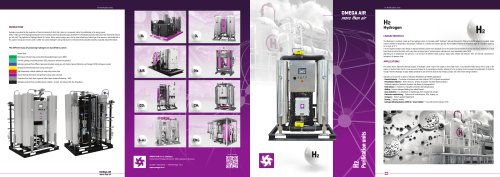
Omega Air provides an overview of hydrogen purification units, focusing on the characteristics, applications, production, and specifications of hydrogen purification systems.
Hydrogen (H2) is a diatomic molecule, colorless, odorless, and the lightest element. It is abundant in the universe but rarely found alone on Earth. It can exist in various states, but the focus here is on its gaseous state.
Hydrogen is used in various industries: chemical (ammonia production), petrochemical (sulfur removal, hydrocracking), food (margarine production), welding, glass production, electronics, aerospace, housing, and hydrogen refueling stations for green mobility.
Hydrogen is primarily produced from fossil fuels, with 95% coming from natural gas, oil, and coal. Low-carbon hydrogen production involves renewable or nuclear energy sources, with methods classified by colors, such as electrolysis and steam methane reforming with carbon capture.
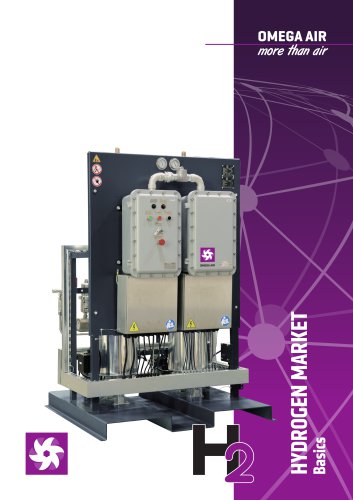
The H2-DRY purification units are designed to remove water vapor, oxygen, and solid particles from hydrogen gas. They are suitable for fuel cells and can be integrated into electrolyzer systems. Key specifications include operating pressure up to 37 (45) bar, inlet temperature up to +80 °C, and pressure dew point of -40 °C. The units are CE/ATEX certified and support Modbus TCP/IP communication.
The purification units come in various models with capacities ranging from 105 m3/h to 16800 m3/h. They are designed for efficient and reliable operation with easy maintenance.
The purification process involves filtration, DEOXO, and drying units. The system ensures zero hydrogen loss during regeneration and reduces oxygen content to less than 5 ppm.
The units include container and box units for outdoor installation, condensate collectors, oxygen sensor panels, and cooling systems. They are equipped with electric actuators and remote control cabinets for efficient operation.
Catalog excerpts
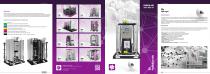
2 Purification units Air | Hand Gas PRODUCTION Hydrogen is produced by the separation of chemical elements of which the H atom is a component and by the mobilization of an energy source. Today, a major part of the hydrogen production is from natural gas and more generally, approximately 95 % of hydrogen production still comes from fossil fuels (natural gas, oil, coal). The production of hydrogen thanks to a renew able or nuclear energy source (or by steam reforming of natural gas if the process is associated with a CO2 capture, storage and recovery unit) is called “low-carbon hydrogen” and quickly became an environmental and political priority, especially around Electrolysis. CHARACTERISTICS The dihydrogen H2 molecule, made up of two hydrogen atoms, is commonly called “hydrogen” and was discovered in 1766 by the British physicist Cavendish. Under normal conditions of temperature and pressure, hydrogen is a colorless and odorless gas but also the lightest element of the periodic table. It is soluble in water up to 1.6 mg/L at 21 °C. It is the simplest member of the family of chemical elements and the most abundant one in the universe (main element of the Sun and stars). However, it is rarely found alone on and in the Earth, and is very often an integral part of various organic materials and, more importantly, water (H20). Depending on its temperature and pressure, it can be found in different states: gaseous, liquid, solid, metallic and triatomic. Here, we will only concentrate on hydrogen in its gaseous state. The different ways of producing hydrogen are classified by colors: Natural state Electrolysis with electricity coming from Renewable Energy Sources (RES) Thermal splitting of methane pyrolysis (CO2 produced is solid and not gaseous) Hydrogen produced from different processes including natural gas, with Carbon Capture Utilization and Storage (CCUS) techniques involved The earliest known important chemical property of hydrogen is that it burns with oxygen to form water (H2O), it was therefore made famous for its usage in the process of nuclear fusion. But it is now even more famous for its extremely low density, allowing it to be an energy vector to answer the problematic of electricity storage. Therefore Hydrogen is today widely considered as one of the key features that will play a major role in the world’s energy transition. Electrolysis with electricity from nuclear power plant High temperature catalytic splitting of water using nuclear heat Chemo-thermal electrolysis through direct nuclear power and heat Hydrogen can be used for a variety of Industrial, Residential and Mobility applications: - Chemical industry | Production of ammonia and other fertilizers (50 % of global consumption) - Petrochemical industry | Sulfur removal | Creation of gasoline and diesel (hydrocracking) | Methanol production (synthesis of amines and alkanes by hydrogenation) - Food industry | Production of margarine and butter (fat hydrogenation) - Welding | Atomic Hydrogen Welding (also called Plasma) - Glass production | As antioxidant or shielding gas when coupled with nitrogen - Electronics manufacturing | Production of semiconductors, LEDs, displays, etc - Aerospace | Rocket’s engines (liquid form) - Housing | Lighting, Heating - Hydrogen Refueling Stations (HRS) for ‘’Green Mobility’’ | Fuel Cells Electric Vehicles, FCEVs Production from fossil fuels in general (often Steam Methane Reforming - SMR) OMEGA AIR d.o.o. Ljubljana Cesta Dolomitskega odreda 10, 1000 Ljubljana, Slovenia PRODUCT OVERVIEW Purification units Hydrogen produced from coal (bituminous or lignite – brown). CO2 released
Open the catalog to page 1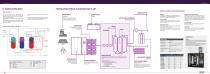
PURIFICATION MODULE IN ELECTROLYSIS PLANT SPECIFICATIONS The H2-DRY X/XD purification units are specifically designed for continuous removal of water vapor, oxygen, and solid particles from hydrogen gas, making them suitable for a wide range of applications, including Fuel Cells (ISO 14687:2019). These purification units are easily integrated into electrolyzer hydrogen systems. With a proven and durable design, the units provide efficient, reliable operation, quick installation, and easy maintenance. They can handle fluctuating loads with ease. The purification unit includes filtration, a dryer,...
Open the catalog to page 2All OMEGA AIR d.o.o. Ljubljana catalogs and technical brochures
 Oil free compressors XR 37-280
20 Pages
 OMEGA AIR - Product overview
72 Pages
 OMEGA AIR - COMPANY PORTFOLIO
27 Pages
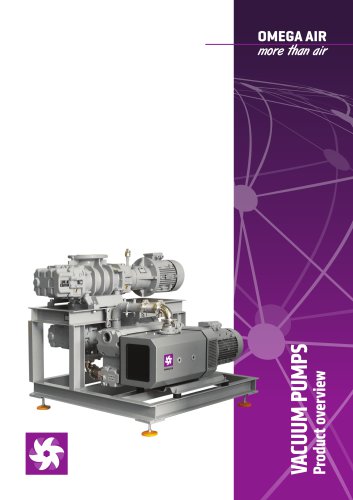 Vacuum pumps - Catalogue
22 Pages
- Pump
- Flowmeter
- Compressor stage
- Vessel
- Air compressor
- Positive-displacement compressor
- Stationary compressor
- OMEGA AIR vacuum generator
- Liquid filter
- OMEGA AIR vacuum pump
- Industrial compressor
- Storage vessel
- Electrically-powered compressor
- Data logger
- Single-stage vacuum pump
- Reciprocating piston compressor
- OMEGA AIR pressure gauge
- Filter with cartridge
- Gas flow monitor
- Metal tank