
- Catalogs
- OKS Spezialschmierstoffe GmbH
- For a world in motion

- Company
- Products
- Catalogs
- News & Trends
- Exhibitions
For a world in motion
For a world in motion
OKS Spezialschmierstoffe GmbH, part of the Freudenberg Group, specializes in high-quality lubricants and maintenance products. Their products are developed and manufactured in Germany, adhering to ISO 9001:2015, ISO 14001:2015, and ISO 45001:2018 standards, with a focus on sustainability and minimizing environmental impact.
Tribology is the study of friction, wear, and lubrication. It involves understanding the resistance to movement between surfaces, which can lead to energy loss and wear. The Stribeck curve is used to illustrate the relationship between friction and lubrication states, emphasizing the importance of lubricant functions such as separating, sealing, cooling, and protecting.
- Oils: Formulated with additives to enhance properties like viscosity and temperature resistance, used in gears, chains, and compressors.
- Greases: Consist of a base oil and thickener, providing long-term lubrication and protection, classified by consistency (NLGI grades).
Lubricants are tested for properties such as viscosity and temperature stability. Standards like DIN and ISO provide guidelines for classification and performance assessment.
Base oils are categorized into types such as ester oils and synthetic hydrocarbons. Additives include EP additives and solid lubricants like MoS2.
Lubricants are classified based on operating temperature and behavior with water. Pastes and dry lubricants are used for extreme conditions and high-temperature applications, respectively.
Includes flashing point, thread friction, condensed water test, and consistency measurement. The SKF-EMCOR process assesses corrosion-preventive properties, and the four-ball test rig evaluates lubricants under high pressure.
Definitions of terms like additives and corrosion are provided, with references to standards such as DIN 51 502 and NSF classification for food-safe lubricants.
Tables provide identifiers for base oil types, operating temperature ranges, and classify solid lubricants by maximum operating temperature.
Discusses characteristics of lubricants like polydimethylsiloxane, highlighting molecular structures.
Advantages include low coking tendency and excellent viscosity-temperature characteristics.
Over 165 high-performance products are listed, including pastes, oils, greases, and maintenance products.
Information is based on extensive testing and experience, with liability limited to written agreements. Customers are advised to conduct their own testing for suitability.
Contact details for OKS Spezialschmierstoffe GmbH are provided for further information.
Catalog excerpts
Corrosion Protection Maintenance Products TRIBOLOGY BASIC KNOWLEDGE Speciality Lubricants Maintenance Products
Open the catalog to page 1
45 YEARS OF TRIBOLOGICAL EXPERTISE – MADE IN GERMANY OKS – your professional partner for chemical-technical special products The OKS brand stands for high-performance products for reducing friction, wear and corrosion. Our products are used in all the areas of production and maintenance technology in which the performance limits of classic lubricants are exceeded. Quality – Made in Germany The continued success of OKS for 45 years is decisively characterised by the high quality and reliability of our products, as well as the fast implementation of customer requirements through innovative solutions....
Open the catalog to page 2
4_ Basic Knowledge of Tribology 6_ Types of Lubricants 6_ Oils 10_ Greases 14_ Pastes 16_ Dry Lubricants 18_ Testing Procedures and Standards 23_ Technical Terms
Open the catalog to page 3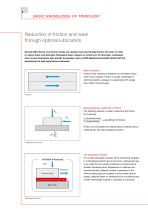
BASIC KNOWLEDGE OF TRIBOLOGY Reduction of friction and wear through optimal lubrication Several billion Euros of economic losses are caused every year through friction and wear. In order to reduce these cost extensive tribological basic research is carried out. On this basis, companies then occupy themselves with specific knowledge, such as OKS Spezialschmierstoffe GmbH with the development of high-performance lubricants. What is friction? Friction is the mechanical resistance to the relative movement of two surfaces. Friction is usually undesirable in technical systems, because it is associated...
Open the catalog to page 4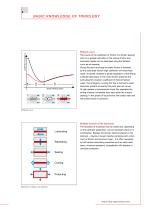
BASIC KNOWLEDGE OF TRIBOLOGY Speed / Sliding speed Stribeck curve The course of the coefficient of friction of a friction bearing with oil or grease lubrication in the various friction and lubrication states can be described using the Stribeck curve as an example. During the start-up phase the static friction is followed by the solid state friction (high coefficient of friction/high wear). As speed increases a partial separation of the sliding surfaces takes place in the mixed friction phase by the lubricating film (medium coefficient of friction/medium wear). The emergency running film that...
Open the catalog to page 5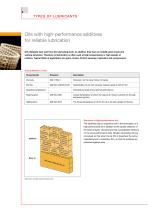
Oils with high-performance additives for reliable lubrication Oils dissipate heat well from the lubricating point. In addition, they have an notedly good creep and wetting behaviour. Therefore oil lubrication is often used at high temperatures or high speeds of rotation. Typical fields of application are gears, chains, friction bearings, hydraulics and compressors. Characteristics of oils Characteristic Dimension for the inner friction of liquids Classification of oils into viscosity classes based on DIN 51 561 Operating temperature Temperature range of the optimal performance Flashing point...
Open the catalog to page 6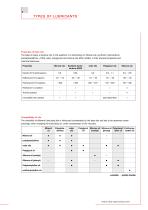
The base oil plays a decisive role in the selection of a lubricating oil. Mineral oils, synthetic hydrocarbons (polyalphaolefines = PAO), ester, polyglycols and silicone oils differ notably in their physical properties and chemical behaviour. ■ miscible □ partially miscible
Open the catalog to page 7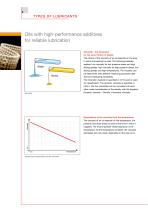
Oils with high-performance additives for reliable lubrication Viscosity – the dimension for the inner friction of liquids The choice of the viscosity of an oil depends on the area in which the lubricant is used. The following basically applies: Low viscosity for low pressure stress and high sliding speeds, high viscosity for high pressure stress, low sliding speeds and high temperatures. The viscosity can be determined with different measuring processes (see Test and measuring processes). The kinematic viscosity in specified in mm2/s and is used for classification. The dynamic viscosity is specified...
Open the catalog to page 8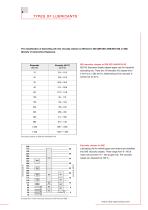
The classification of lubricating oils into viscosity classes is effected to ISO (DIN ISO 3448:2010-02) or SAE (Society of Automotive Engineers). Kinematic ISO-VG ISO viscosity classes to DIN ISO 3448:2010-02 ISO-VG (Viscosity Grade) classes apply only for industrial lubricating oils. There are 18 kinematic VG classes from 2 mm2/s to 1,500 mm2/s. Determining of the viscosity is carried out at 40 °C. Viscosity classes to SAE Lubricating oils for vehicle gears and motors are classified into SAE viscosity classes. These range from 0 – 60 at motor oils and from 70 – 250 at gear oils. The viscosity...
Open the catalog to page 9
Greases for long-term lubrication under critical operation conditions If, for structural reasons, no oil lubrication is possible or if a cooling function is not required, a lubricating grease is used in most cases. Greases consist of a base oil that is bound by a thickener (soap). This ensures that the lubricant remains at the lubricating point. There it ensures permanently effective protection against friction and wear and seals the lubricating point against external influences such as moisture and foreign matter. Greases are often used at rolling and friction bearings, spindles, fittings, seals,...
Open the catalog to page 10
Influence of the thickener on the performance features of a grease
Open the catalog to page 11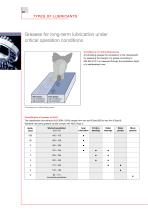
Greases for long-term lubrication under critical operation conditions Consistency of a lubricating grease At lubricating greases the consistency is the characteristic for assessing the strength of a grease. According to DIN ISO 2137 it is measured through the penetration depth of a standardised cone. Classification of greases to NLGI The classification according to NLGI (DIN 51 818) ranges from very soft (Class 000) to very firm (Class 6). Standard lubricating greases usually comply with NLGI Class 2.
Open the catalog to page 12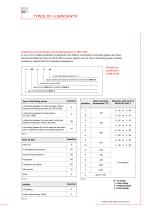
Designation and classification of lubricating greases to DIN 51502 In view of the multiple possibilities of application and different compositions, lubricating greases are classified and described according to DIN 51 502 by various aspects such as type of lubricating grease, usability, consistency classes (NLGI) and operating temperatures. Lower operating temperature in °C Upper operating temperature and behaviour with water (Table 4) Consistency class to NLGI Base oil type (Table 2) and additives (Table 3) Type of lubricating grease (Table 1) Type of lubricating grease
Open the catalog to page 13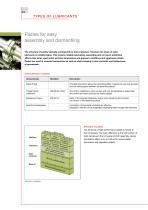
Pastes for easy assembly and dismantling The structure of pastes basically corresponds to that of greases. However, the share of solid lubricants is notably higher. This ensures reliable lubricating, separating and corrosion protection effects also when used under extreme temperature and pressure conditions and aggressive media. Pastes are used at screwed connections as well as when pressing in pins and bolts and furthermore at gearwheels. Characteristics of pastes Characteristic Press-fit test Provides information about the lubricating effect of pastes at very high pressure and low sliding speed...
Open the catalog to page 14All OKS Spezialschmierstoffe GmbH catalogs and technical brochures

Archived catalogs
 OKS 2681
2 Pages
 Mox-Active
2 Pages
 The OKS Airspray System
6 Pages
 OKS 481
2 Pages
 OKS Speciality Lubricants
6 Pages
 OKS 451
2 Pages
 Folder Chronolube
6 Pages
 OKS Image Brochure
8 Pages




- OKS synthetic lubricant
- Manual gun
- OKS mineral lubricant
- OKS bearing lubricant
- Leak monitor
- OKS high-temperature lubricant
- OKS high-performance oil
- OKS gear lubricant
- OKS bearing grease
- OKS metal lubricant
- OKS long-life lubricant
- Protective coating
- OKS metal oil
- OKS universal lubricant
- Gas leak detector
- Oil for automotive applications
- OKS high-temperature oil