

Oetiker Product Guide.

Oetiker Product Guide.
- Ear Clamps: Introduced by Hans Oetiker in 1951, these clamps are a cornerstone of the product range, offering reliable and leak-proof connections.
- Low Profile Clamps: Designed for space efficiency and low imbalance on rotating parts, featuring the CrossTech® design.
- Screw Clamps and Universal Clamps: Known for their adaptability and ease of assembly, suitable for various applications.
- Multi Crimp Rings and Profile Clamps: Provide flexibility and superior joint integrity, engineered to meet customer requirements.
- Assembly Tools: High-quality tools ensure secure and verifiable assembly processes.
- 360° Solution Approach: Oetiker offers a comprehensive service package including technical consulting, application testing, and maintenance support.
- Typical Connecting Solutions: Detailed applications in the automotive industry (e.g., airbag systems, fuel systems) and industry & trade (e.g., food & beverage, electronics).
- StepLess® Design: Eliminates steps and overlaps, providing uniform compression and surface pressure.
- ToothLock® Technology: Offers high compression rates and expansion resistance, enhancing performance under thermal stress.
- Burr-Free Strip Edges: Protects clamped parts from damage and ensures safety during assembly.
The document details the specifications for Oetiker's ToothLock® Ear Clamp 293 and StepLess® Ear Clamps 123 & 193. The clamps are made from stainless steel (Material no. 1.4301/UNS S30400) with corrosion resistance of ≥ 1000 hours according to DIN EN ISO 9227. The size range for the ToothLock® Ear Clamp is 40.0 – 120.5 mm with a diameter graduation of 0.5 mm. The StepLess® Ear Clamps are available in both standard and heavy-duty series with varying size ranges and material dimensions.
To determine the correct clamp diameter, the hose should be pushed onto the attaching material and the outer diameter measured. The clamp should be selected such that its average size range is slightly greater than the hose's outer diameter. The nominal diameter must be reduced by at least 2.2 mm for full ToothLock® engagement. The assembly should be done using Oetiker's recommended tools, ensuring the clamp's ear is closed at a uniform rate without exceeding the maximum closing force.
The document emphasizes the importance of 'force priority' during assembly to maintain constant clamp tension and ensure tolerance compensating features remain functional. Block closure, where the ear is fully closed, should be avoided as it absorbs assembly force rather than transferring it to the parts being clamped.
The ToothLock® Ear Clamp features include a security hook, ear dimple, teardrop dimple, and ToothLock® Technology with a tongue-in-groove design. The StepLess® Ear Clamps offer uniform compression, high radial loads, and adjustable surface pressure with a security hook to prevent unintended opening during transport.
Various tools are recommended for assembly, including manual clamping tools and torque wrenches, as well as mechanical or electronically controlled pincers like the HO 7000 and HO 10000 series.
- Closing Force: The selection of closing force is crucial and depends on the material's compression or surface pressure. Maximum closing forces are specified for different material dimensions, particularly for thermoplastics and materials with high Shore hardness.
- Rotation Diameter: The rotation diameter is critical for applications requiring rotation within limited spaces. It varies based on the ear gap resulting from clamping attempts.
- Ensure that the ear height is not influenced by altering the ear gap or using hold-down devices in assembly tools.
- Use a single tool stroke closure without applying secondary crimping force.
- The figures provided are guidelines and may vary based on the type and tolerances of the parts being clamped.
- Functional tests with several assemblies are recommended to ensure optimal clamp selection.
- Materials: Stainless steel (1.4307/UNS S30403) and zinc-plated steel (1.0338/SAE 1008/1010) are used, offering corrosion resistance according to DIN EN ISO 9227.
- Corrosion Resistance: 153 and 154 clamps ≥ 800 hours; 101 clamps ≥ 96 hours.
- Size Range: 153 clamps range from 3.3 to 30.7 mm, while 154 clamps range from 2.9 to 30.0 mm.
- Manufacturing Process: Involves spiral roll-forming and welding of raw material into tubes, creating a robust, continuous welded ring.
- Assembly: Clamps are closed by drawing together the lower radii of the ear using Oetiker-endorsed tools. Single tool stroke closure is recommended to avoid secondary crimping force.
- Assembly Recommendations: Use force priority closure for uniform stress application. Ensure ears are adequately closed for perfect sealing.
- Process Monitoring: Electronically Controlled Pneumatic Power Tool (Oetiker ELK) is recommended for complete process monitoring and documentation.
- 1-Ear Clamps: Compact, one-piece design for secure connections, with deburred edges to reduce damage risk.
- 2-Ear Clamps: Extended clamping range with elasticity to accommodate size changes due to thermal expansion or vibration.
- 1-Ear Clamp with Insert: Combines 1-Ear Clamp geometry with a stainless steel insert for demanding applications.
- Maximum closing force varies by material and size, with specific tools recommended for each range.
- Important to conduct functional tests with several assemblies to ensure optimum clamp selection.
The StepLess® Low Profile Clamp 168 is made from 168 stainless steel (Material no. 1.4301 or UNS S30400) with corrosion resistance according to DIN EN ISO 9227, lasting ≥ 1000 hours. It is available in various sizes with nominal diameter widths ranging from 10.5 mm to 120.5 mm and thicknesses from 0.5 mm to 0.6 mm. Some sizes require a minimum order quantity.
Design Features:
The clamp features a 360° StepLess® design for uniform compression and constant surface pressure. It has a low assembled height, minimizing space requirements and imbalance on rotating parts. The clamp includes load retaining hooks for visual assembly confirmation and burr-free strip edges to reduce damage risk.
Reusability:
The clamps are reusable and can be repeatedly opened and re-assembled, suitable for applications like automotive maintenance.
Assembly Recommendations:
Clamps can be assembled using manual or pneumatic tools. The assembly involves reducing the clamp's diameter by engaging the load retaining hooks in the appropriate apertures. The sealing pressure depends on the compression factor and material resistance.
Tolerance Compensation:
Some clamps include a tolerance compensation element to accommodate component variations and thermal expansion. This feature allows for minor adjustments during assembly.
Order Information:
Clamps are identified by their nominal closed diameter. Various sizes are available, with specific item numbers and reference numbers provided for ordering.
Additional Notes:
The document emphasizes that the data provided is based on extensive experience and is intended for reference, not as design specifications. Complete process monitoring and documentation are available using the Oetiker ELK pneumatic power tool.
The document specifies the use of stainless steel for both the band and fastener, with material numbers 1.4301/UNS S30400 for the band and 1.4305/UNS S30300 for the screw. The clamps are available in various series and sizes, with specific dimensions provided for each type.
Product Series and Sizes:
The document details different series of clamps, including Mini R and Mini R+S, with size ranges from 7.0 to 219.0 mm. The Mini R series is made of stainless steel, while the Mini R+S series is both stainless and acid-proof. The clamps feature a compact design, cylindrical screw head for easy assembly, and an embossed band strip to reduce damage risk.
Assembly Recommendations:
For safe tightening, a standard screwdriver is recommended. Maximum static tightening torques are specified for different clamp types, with Mini R at 70 Ncm and Mini R+S with wing screw at 120 Ncm.
Order Information:
Detailed order information is provided for various types of worm drive clamps, including Mini R, Mini R+S, and Universal Clamps. Each type has specific item numbers, clamping ranges, and band dimensions.
Universal Clamps:
Universal clamps are made of stainless steel and are available in different sizes and materials. They feature a perforated steel band and a screw lock for easy assembly and high holding force. The document provides assembly instructions and static tightening torque recommendations.
Worm Drive Clamps:
The document describes Oetiker Worm Drive Clamps, which are multi-range hose clamps covering a wide range of diameters. They are made with high-quality materials and designed for durability and reliability. Installation recommendations include using a flexible screwdriver for professional installation.
Technical Data and Recommendations:
The document emphasizes that the data provided is based on extensive experience and is intended for reference, not as design specifications. It includes static tightening torque values and test torque values for different band widths and clamping ranges.
- Materials: Straps are available in carbon steel and stainless steel, with various surface treatments such as zinc coating, Aluzinc, galvanization, anti-corrosion primers, and powder coating.
- Dimensions: Lengths range from 30.00 to 3000.00 mm, band widths from 15 to 110 mm, and thickness from 0.7 to 3.0 mm.
- Fasteners: Options include M6/M8, M8/M10, and M10/M12.
- Types: Includes pneumatic and cordless pincers, manual closure tools, and assembly tools for ear clamps and low-profile clamps.
- Features: Tools offer high process reliability, efficient assembly, electronic monitoring, and integration into automated systems.
- Technical Data: The ELK 02 control unit requires a power supply of 85–265 V and compressed air supply of 4–10 bar.
- Use the strap design configurator for selecting the appropriate strap for specific applications.
- Perform assembly tool pincer tests daily to ensure uniform and reproducible process quality.
- Ensure sufficient compressed air pressure and volume for consistent pincer force.
- Pincer heads are available in different jaw widths and opening gaps, suitable for various ear widths. Item numbers are provided for each type.
- Complete pincer systems consist of a pincer head and a pincer, with item numbers for different regional specifications.
- Technical data for the Oetiker CC 20 cordless crimp pincer includes dimensions, weight, and closing time, along with a list of accessories and spare parts.
- Selection of pincer types involves choosing the appropriate pincer head and corresponding pincer type based on requirements.
- Assembly of multi crimp rings requires specific swaging tools to ensure correct assembly and optimal performance.
- Regular pincer tests are mandatory to ensure uniform and reproducible process quality.
- Various assembly tools are listed for ear clamps, including compound action pincers, manual pincers with force monitoring, and ratchet pincers.
- Swaging tools for multi crimp rings include the Oetiker Compact, Compact XL, Flex, and ELS 01, each with specific technical data and item numbers.
- Calibration equipment like the Oetiker CAL 01 is used to ensure uniform closing forces for clamps.
- Use the appropriate assembly tools and swaging tools developed for specific clamp types to ensure correct assembly and product performance.
- Perform regular pincer tests and calibrations to maintain process quality and compliance with specifications.
- Oetiker CC 20: Dimensions - 476 × 81 × 124 mm, Weight - 3300 g, Closing time - 4–6 seconds.
- Swaging Tool Compact: Dimensions - 316 x 268 x 58 mm, Weight - 22 kg, MCR size range - Ø 16 mm to Ø 60 mm.
- Swaging Tool ELS 01: Dimensions - 1550 x 1800 x 700 mm, Weight - 240 kg, MCR size range - Ø 16 mm to Ø 132 mm.
The document outlines the recommended procedures for ensuring uniform and reproducible process quality in assembly tools. It mandates performing an assembly tool pincer test at least once per shift, or daily, and whenever pincer components are replaced. After the pincer test, verifying the closing force is recommended as a secondary validation. The CAL 01 test equipment should be calibrated annually by an authorized institution to comply with local standards.
Oetiker Test Equipment CAL 01:
The CAL 01 includes a calibrator with technical descriptions, operating instructions, a coded load cell with interchangeable pressure jaws, a check gauge, a power transformer, data cables, and a lithium block battery. It is available in multiple language versions and comes with optional accessories like mains-plug chargers and various pressure jaws.
Technical Data:
The CAL 01 operates at 100–200 V / 47–63 Hz with a current consumption of 400 mA. It has external dimensions of 190 x 110 x 60 mm and weighs 0.8 kg (CAL 01) or 3.4 kg (complete case).
Oetiker Closing Force Gauges:
Three models (SKM 00, SKM 01, SKM 02) are available for closing force calibration, each with different force ranges and graduations. These gauges are economical alternatives for verifying closing forces in small series and service applications.
Quick Connectors:
Oetiker Quick Connectors offer tool-free assembly, are space-efficient, and have a robust modular design. They are suitable for pressure lines carrying media and are particularly useful for oil and coolant lines. The connectors are available in thread-optimized and length-optimized ranges, with specific performance metrics like operating pressure and pull-out load.
Global Presence:
Oetiker has a global footprint with over 1400 employees, 10 production facilities, and 20 sales offices worldwide, dedicated to providing successful connections for customers.
Catalog excerpts

Oetiker Product Guide. Connecting solutions and assembly tools.
Open the catalog to page 1
Our competencies Typical connecting solutions: Automotive Industry Typical connecting solutions: Industry & Trade Screw Clamps and Universal Clamps Multi Crimp Rings Profile Clamps Assembly Tools Quick Connectors
Open the catalog to page 2
Zurich, main station
Open the catalog to page 3
Horgen, Oetiker Headquarters
Open the catalog to page 4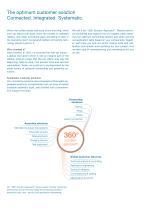
The optimum customer solution Connected. Integrated. Systematic. When the coffee tastes delicious every morning, when your car steers with ease, when the harvest is collected reliably, and when everything goes according to plan in the operating room: be assured Oetiker connecting technology played a part in it. Who invented it? Hans Oetiker. In 1951, he invented the first ear clamp – a global innovation which is still an integral part of the Oetiker product range. But the ear clamp was only the beginning. Step by step, new product lines and services were added. Today, we continue to be fascinated...
Open the catalog to page 5
Your requirements are the starting point When customer requirements are demanding, the Oetiker experts are delighted. Our integrated "Solution Approach" makes it possible to find the optimum solution for you. We consult, analyze, and test for you until every detail We never let up on finding your best connections Oetiker continuously develops and tests its products. We work on new solutions daily with our own Research and Development and Application centers in Europe, Asia, From the center of Europe to the whole world Oetiker is headquartered in Horgen on Lake Zurich in Switzerland. It is still...
Open the catalog to page 6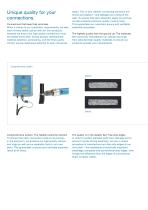
Unique quality for your connections. Connections that keep their promises When it comes to our customers’ requirements, we take care of every detail, just as with our own products, because we know your high quality connections must be reliable every time. During product development, material selection, processing, and the final quality control, we pay meticulous attention to every minuscule detail. This is why Oetiker connecting solutions are sturdy and resilient – and leakages are a thing of the past. To ensure that each assembly keeps its promise, we also produce premium-quality closing tools....
Open the catalog to page 7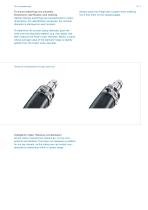
To ensure everything runs smoothly: Dimensions, identification and ordering Oetiker Clamps and Rings are manufactured to metric dimensions. For identification purposes, the nominal diameter is stamped on each product. To determine the correct clamp diameter, push the hose onto the attaching material, (e.g. the nipple), and then measure the hose’s outer diameter. Select a clamp whose average value of the diameter range is slightly greater than the hose’s outer diameter. Tolerance compensation through clamp ear Intelligently made: Tolerance compensation As the result of production tolerances, no...
Open the catalog to page 8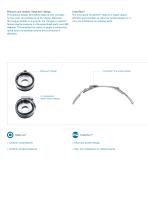
Effective and reliable: StepLess® design This special design eliminates steps and/or overlaps on the inner circumference of the clamp. Because the tongue resides in a groove, the “tongue-in-groove” feature exerts pressure on the assembled parts over 360 degrees. This enables the clamp to apply a continuous radial force completely around the connection’s diameter. CrossTech® The innovative CrossTech® feature is highly spaceefficient and provides an ultra low profile design for a very low imbalance on rotating parts. StepLess® Design CrossTech® low profile design In comparison: “Worm Drive Clamps”...
Open the catalog to page 9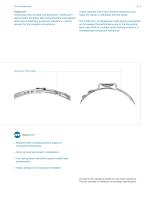
ToothLock® Interlocked with its teeth, the distinctive “ToothLock®” feature offers extremely high and permanent compression rates and outstanding expansion resistance – strong enough for the toughest connections. It also supports shock and vibration resistance and helps the clamp to withstand thermal stress. The ToothLock® is designed as a self-locking mechanism and increases the performance due to the low spring back rate. With its multiple tooth-locking positions, it compensates component tolerances. ToothLock® Technology ToothLock® + Multiple tooth-locking positions adjust to component tolerances...
Open the catalog to page 10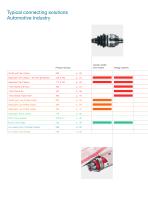
Typical connecting solutions Automotive Industry Cardan shafts/ drive shafts Product Groups ToothLock® Ear Clamp StepLess Ear Clamps – the next generation 1-Ear Clamp with stud ToothLock® Low Profile Clamp StepLess Low Profile Clamp StepLess® Low Profile Clamp StepLess Screw Clamp Worm Drive Clamps Multi Crimp Rings Levi Heavy Duty V-Profile Clamps
Open the catalog to page 11
Typical connecting solutions Automotive Industry Cooling and heating water circuits Steering systems Fuel systems Exhaust systems High pressure systems
Open the catalog to page 12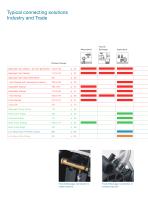
Typical connecting solutions Industry and Trade Food & Beverage Product Groups StepLess® Ear Clamps – the next generation 123 & 193 StepLess Ear Clamp PEX Series 1-Ear Clamps with mechanical interlock Adjustable Clamps Adjustable Clamps StepLess® Screw Clamp Worm Drive Clamp Universal Clamp Worm Drive Clamps Multi Crimp Rings Levi Heavy Duty V-Profile Clamps Levi Heavy Duty Straps Food & Beverage: Connection in
Open the catalog to page 13
Typical connecting solutions Industry and Trade Electronics/ Medical/ Transportations resources & Construction/ Electric Home appliances Pharmaceutical Defense Environment Heavy machinery House & Garden Home appliances: Water supply Medical: Connection in Electronics: Water cooling for washing machine external heart pump in computer
Open the catalog to page 14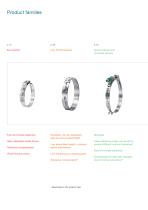
Product families Ear Clamps Low Profile Clamps Screw Clamps and Universal Clamps Fast and simple assembly High, adaptable radial forces Tolerance compensation Visual closure check Low assembled height, minimum space requirement Low imbalance on rotating parts Tolerance compensation* Large clamping range: can be set to several different nominal diameters* Fast and simple assembly Compensate for diameter changes * depending on the product type
Open the catalog to page 15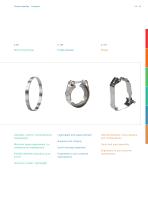
Product families Overview Multi Crimp Rings Profile Clamps Constant, uniform, circumferential compression Lightweight and space efficient Ultimate flexibility: many designs and configurations Superior joint integrity Quick and easy assembly Minimum space requirement, no imbalance on rotating parts Quick and easy assembly Flexible diameter reduction up to 6 mm* Engineered to suit customer requirements Aluminum model – lightweight Engineered to suit customer requi
Open the catalog to page 16All Oetiker catalogs and technical brochures
 Connecting Solutions
128 Pages
 PG 105 & 155
6 Pages
 PG 123 & 193
9 Pages