
- Catalogs
- NTN Europe
- We Get, You Moving !


We Get, You Moving !

We Get, You Moving !
NTN-SNR, a part of NTN Corporation, is a leader in roller bearing manufacturing, offering a wide range of linear technology products since 1985. The company is known for its patented ball chain system and technical innovations, focusing on service, quality, and product diversity.
Linear guides are designed to facilitate the movement of heavy loads using rolling elements. NTN-SNR uses circular arc grooves for standard guides and Gothic arc grooves for miniature guides to enhance load capacity, service life, and rigidity.
This section includes definitions, standards, and methods for calculating service life, considering factors like active load and equivalent loads. It discusses preload, rigidity, precision, and interchangeability.
Guidelines cover surface arrangement, identification, positioning, installation tolerances, and fastening torques to ensure optimal performance of linear guides.
Proper lubrication is essential for maintaining linear guides. The document details various lubricants, methods, and accessories, specifying lubricant volumes and intervals.
NTN-SNR offers accessories like sealing options, rail caps, bellows, and clamping elements to enhance the functionality and longevity of linear guides.
Details on corrosion protection and coating options are provided to ensure durability in various environments.
The catalogue provides an overview of different linear guide models, including specifications and standard lengths, serving as a resource for selecting appropriate guides.
NTN-SNR aims to establish strategic partnerships by offering high-quality, economically efficient products, committed to continuous research and development.
Detailed specifications for linear guide models include dimensions and equivalence factors crucial for calculating service life and load capacity.
Key parameters for service life calculation include stroke length, velocity, acceleration, movement cycles, installation position, mass, and direction of external forces.
The document explains calculating equivalent loads, emphasizing dynamic equivalent load calculations for varying process forces.
Examples illustrate service life and load capacity calculations under different conditions, such as horizontal and vertical positions.
Preload classes enhance system rigidity, affecting performance, driving resistance, and service life.
Precision classes and interchangeability limitations are detailed, focusing on high precision and preload classes.
Error compensation is achieved through special track geometry, improving running accuracy.
Friction in linear guides is influenced by load, preload, and design principles.
NTN-SNR linear guides have a low friction coefficient, with friction forces influenced by internal and external factors. Lubricant properties significantly affect friction.
Driving resistance consists of friction force and sealing resistance, with calculations provided for different conditions.
Installation involves cleaning surfaces, aligning guides, and fastening screws with specified torque values.
Specified tolerances ensure the service life of the linear guide system is not compromised.
Recommended fastening torques are provided for different screw strength classes.
Sufficient lubrication is crucial for reliable operation, preventing wear and corrosion, and ensuring smooth operation.
Various lubricants, including oils and greases, are used to reduce friction, wear, and noise, while providing corrosion protection.
These oils protect guides during storage and transport but are not suitable for operational lubrication.
Used in central lubrication systems, these oils provide continuous supply and conduct friction heat well.
Similar to oils but do not run off easily, making installation position definition unnecessary.
Commonly used for better noise reduction and emergency running properties.
NTN-SNR guides can be lubricated using manual grease guns, automated dispensers, or central systems.
Grease Nipples: Available for manual lubrication.
Lubrication Connection: Central systems or accessible grease nipples require lubricant supply via hoses or pipes.
- Bellows: Protect guides from contamination, available with mounting sets.
- Dimensions: Detailed dimensions for various sizes provided.
- Cover Strip: Used to close rail holes, reducing assembly time.
- Clamping and Braking Elements: Available in manual and pneumatic versions.
- Lubrication System LU1: Designed for grease-lubricated guides, providing continuous oil supply.
- Assembly of Bellows: Involves moving the carriage, assembling the bellow, and fixing it with clamping elements.
- Mounting of Cover Strip: Requires a specific tool for safe installation.
- Corrosion Protection: Options include black chrome, hard chrome, and DURALLOY® TDC coatings.
- Lubrication Features: LU1 system allows for direct mounting of grease nipples and connections.
- NTN-SNR linear guides offer high precision, low friction, and high tolerance compensation.
- Multiple lubrication connections and sealing options available for various applications.
Catalog excerpts

WE GET YOU MOVING... NTN-SNR as part of the NTN Corporation has been one of the most innovative companies in this sector for decades. The NTN Group is one of the largest roller bearing manufacturers in the world. This position allows us to provide our customers with a high level of added value regarding service, quality and product range. As a result, we have been able to build a strong image as a competent partner for our customers. Our companies are characterized by global presence and a consistent quality system. This technical catalogue forms the basis of our discussions with you. Our sales...
Open the catalog to page 2
Table of contents 1. Basics of linear guides. . . . . . . . . . . . . . . . . . . . . 4 1.1 1.2 1.3 1.4 Design principles. . . . . . . . . . . . . . . . . . . . . . . . . . . . . . . . . . . . . . . . . . . . . . . 5 Ball chain technology . . . . . . . . . . . . . . . . . . . . . . . . . . . . . . . . . . . . . . . . . . . 8 Characteristics. . . . . . . . . . . . . . . . . . . . . . . . . . . . . . . . . . . . . . . . . . . . . . . . 12 Selection criteria . . . . . . . . . . . . . . . . . . . . . . . . . . . . . . . . . . . . . . . . . . . . . . 13 Arrangement of the installation surfaces . ....
Open the catalog to page 4
5. Accessories. . . . . . . . . . . . . . . . . . . . . . . . . . 70-73 5.1 Sealing Options. . . . . . . . . . . . . . . . . . . . . . . . . . . . . . . . . . . . . . . . . . . . . . 70 5.1.1 Descriptions. . . . . . . . . . . . . . . . . . . . . . . . . . . . . . . . . . . . . . . . . . . . . . . . . . 70 5.1.2 Combination options. . . . . . . . . . . . . . . . . . . . . . . . . . . . . . . . . . . . . . . . . . . 71 5.1.3 Dimensions . . . . . . . . . . . . . . . . . . . . . . . . . . . . . . . . . . . . . . . . . . . . . . . . . . 72 5.2 Rail caps. . . . . . . . . . . . . . . . . . . . . . ....
Open the catalog to page 5
1. Basics of linear guides Man has moved heavy loads since ancient times using rotation and linear movement or a combination of both. These movements are still found in many machines. The friction bearings initially used have mostly been replaced by roller bearings. Rolling elements in machines were established more than a hundred years ago, while rolling elements for linear movements have only become common in the last few decades. Figure 1.1 Movement of heavy loads Sliding Rolling
Open the catalog to page 6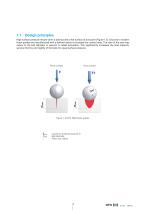
1.1 Design principles High surface pressure results when a ball touches a flat surface at one point (Figure 1.2). Grooves in modern linear guides are manufactured with a defined radius to increase the contact area. The ratio of the race way radius to the ball diameter in percent is called osculation. This significantly increases the load capacity, service life time and rigidity of the balls for equal surface pressure. Point contact Area contact Figure 1.2 NTN-SNR linear guides maximum surface pressure Ó Ball diameter Race way radius
Open the catalog to page 7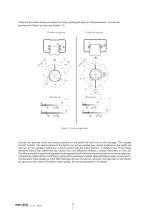
There are two basic design principles for linear guides with balls as rolling elements - circular arc grooves and Gothic arc grooves (Figure 1.3). Circular arc groove Differential slip Differential slip Figure 1.3 Groove geometry Circular arc grooves have one contact surface on the profile rail and one on the carriage. This creates 2-point contact. The special shape of the Gothic-arc groove creates two contact surfaces on the profile rail and two on the carriage, resulting in 4-point contact with the rolling element. A detailed view of the rolling elements shows that differential slip results...
Open the catalog to page 8
The race way configuration is another characteristic of linear guides. The following alternatives are used: DF-configuration and DB-configuration of the race ways, corresponding to the terms used for roller bearing systems (Figure 1.4). Linear guide with DF-configuration Linear guide with DB-configuration Linear guide systems can be exposed to torque stress resulting from installation faults (Figure 1.5). When the distance between the active points is low, the resulting internal loads is low as well. The NTN-SNR linear guides are therefore produced using the DF-configuration. Linear guide with...
Open the catalog to page 9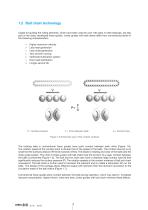
1.2 Ball chain technology Cages for guiding the rolling elements, which have been used for over 100 years in roller bearings, are also part of the newly developed linear guides. Linear guides with ball chains differ from conventional series in the following characteristics: Higher maximum velocity Less heat generation Less noise generation Very smooth running Optimised lubrication system Even load distribution Longer service life F = Force between balls Figure 1.6 Schematic view of the contact surfaces The rotating balls in conventional linear guides have point contact between each other (Figure...
Open the catalog to page 10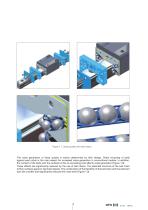
Figure 1.7 Linear guides with ball chains The noise generation of linear guides is mainly determined by their design. Direct knocking of balls against each other is the main reason for increased noise generation in conventional models. In addition, the contact of the balls with the surfaces of the re-circulating hole affects noise generation (Figure 1.8). These effects are significantly reduced by the use of ball chains. The patented structure of the ball chain further contains gaps for lubricant depots. The combination of the flexibility of the ball chain and the lubricant acts like a buffer...
Open the catalog to page 11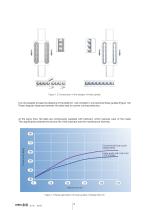
Figure 1.8 Comparison of the designs of linear guides It is not possible to keep the distance of the balls (C1, C2) constant in conventional linear guides (Figure 1.8). These irregular distances between the balls lead to uneven running behaviour. At the same time, the balls are continuously supplied with lubricant, which reduces wear of the metal. This significantly extends the service life of the lubricant and the maintenance intervals. 70 Conventional linear guide LGBXH25FN 60 Linear guide with ball chain LGBCH25FN Velocity (m/min) Figure 1.9 Noise generation of linear guides of Design Size...
Open the catalog to page 12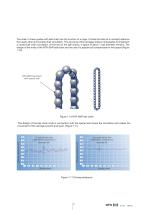
The chain in linear guides with ball chain has the function of a cage. It holds the balls at a constant distance from each other and controls their circulation. The structure of the carriages makes it impossible to implement a closed ball chain circulation. At the end of the ball chains, a space of about 1 ball diameter remains. The design of the ends of the NTN-SNR ball chain and the use of a spacer ball compensate for this space (Figure 1.10). NTN-SNR ball chain with spacer ball Figure 1.10 NTN-SNR ball chain This design of the ball chain ends in connection with the spacer ball closes the circulation...
Open the catalog to page 13All NTN Europe catalogs and technical brochures
 NTN Large Bearings
337 Pages
 TAPERED ROLLER BEARINGS
32 Pages
 Topline
16 Pages
 Megaohm
7 Pages
 KIT ALL IN ONE
14 Pages
 Spherical Roller Bearings
80 Pages
 POLIPUMP
6 Pages
 Hydraulic Nuts
2 Pages
 SmartTEMP
4 Pages
 Deep-Groove Ball Bearings
4 Pages
 Lubrication
44 Pages
 Maintenance Tools
56 Pages
 Linear Motion: Ball Screws
116 Pages
 Linear Motion : Balls Bushings
84 Pages
 Linear Axis Range
2 Pages
 Linear Axis
260 Pages
 Linear Axis AXE
4 Pages
 AXE Linear Axis
100 Pages
 Linear Motion: Range
4 Pages
 Self-Aligning Bearing Units
125 Pages
 Precision Rolling Bearings
327 Pages
 Ball and Roller Bearings
407 Pages
 OUR RANGE FOR YOUR INDUSTRY
32 Pages
 SOLUTIONS FOR MACHINE TOOL
6 Pages
 Needle Roller Bearings
84 Pages
 SNC The Pillow Block Range
88 Pages


Archived catalogs
 CYLINDRICAL ROLLER BEARINGS
5 Pages
- Angular encoder
- Incremental encoder
- NTN steel bearing
- Incremental rotary encoder
- NTN ball bearing
- NTN radial bearing
- Magnetic rotary encoder
- NTN single-row bearing
- Precision bearing
- Bearing unit
- NTN axial bearing
- Greasing system
- Stainless steel bearing
- Miniature bearing
- Steel linear guide
- NTN double-row bearing
- Ball bearing linear guide