
- Catalogs
- NTN Europe
- NTN Large Bearings


NTN Large Bearings

NTN Large Bearings
NTN Corporation offers a one-year warranty to the original purchaser, ensuring the product meets specified drawings and is free from material or fabrication defects. The warranty covers replacement or repair, excluding labor charges, or a refund. It excludes damages from unsuitable installation, misuse, disasters, unauthorized modifications, and shipment damages. Liability is limited to the purchase price, with no additional warranties implied.
The document provides detailed specifications and guidelines for various types of bearings, including deep groove ball bearings, angular contact ball bearings, cylindrical roller bearings, tapered roller bearings, spherical roller bearings, and thrust bearings. It also covers bearings for special applications.
Bearings are subject to compressive stresses leading to material fatigue and eventual failure. The basic rated life is defined statistically, with a 90% reliability model indicating the number of revolutions before failure. The basic dynamic load rating is the load a bearing can sustain for one million revolutions. Adjusted life ratings consider reliability, material, and operating conditions.
This section details the calculation of loads acting on shafts, mean load, and equivalent load, essential for determining bearing performance under various conditions.
Dimensional accuracy, running accuracy, and limits for chamfer and tapered bore are discussed, ensuring proper bearing function and longevity.
Proper interference and fit selection are crucial for bearing performance, preventing issues like slippage or excessive wear.
Internal clearance affects bearing performance, with guidelines provided for selection based on application needs.
Lubrication is critical for bearing longevity, with sections on grease and oil lubrication, including solid grease options. Proper lubrication reduces wear and prevents failure.
The materials used for raceways, rolling elements, and cages are specified, impacting bearing performance and suitability for different applications.
- Static Equivalent Load: The allowable static equivalent load is generally limited by the basic static rated load, but can vary based on friction and operational smoothness requirements. The safety factor (So) is calculated using the formula So = Co/Po, where Co is the basic static rated load and Po max is the maximum static equivalent load.
- Minimum Safety Factor Values: These vary based on operating conditions and bearing types, with specific values provided for different scenarios, such as high rotational accuracy demand and low-speed heavy loading.
- Mean Load: The mean load (Fm) for bearings under fluctuating conditions is calculated using specific formulas for stepped, consecutive series, linear fluctuating, and sinusoidal fluctuating loads.
- Load Factor: Actual shaft load can be greater than theoretical due to vibration or shock, calculated using K = fw・Kc, where fw is the load factor.
- Dynamic Equivalent Load: This is a hypothetical load that gives bearings the same life as if they had only radial or axial loads. It is calculated using specific formulas for radial and axial loads.
- Static Equivalent Load: This load causes the same permanent deformation as actual load conditions and is calculated for radial and axial loads using specific formulas.
- Dimensional and Running Accuracy: Regulated by ISO and JIS B 1514 standards, these tolerances are necessary for installing bearings and define allowable limits for runout during operation.
- Precision Classes: Bearings are classified into precision classes, with JIS Class 0 being normal precision and higher precision as the class number decreases.
Various types of grease are used in rolling bearings, each with specific characteristics. The document outlines the operating temperature ranges, mechanical stability, pressure resistance, and water resistance of different greases. It highlights that aluminum grease and non-soap base greases have excellent characteristics at high temperatures and are suitable for bearings receiving shock loads. However, they are unsuitable for heavy load applications due to low oil film strength.
Mixing different types of greases can alter their consistency and operating temperature range. It is generally advised not to mix greases with different base oils or thickening agents. If mixing is necessary, greases with the same base oil and thickening agent should be used, but changes in consistency and quality should be checked.
The amount of grease used depends on factors like housing size, space limitations, and bearing speed. Typically, housings and bearings should be filled to 30%-60% of their capacity to avoid excessive temperature rise and leakage.
Base oils, either natural mineral or synthetic, determine the properties of grease. Low viscosity oils are suitable for low temperatures and high speeds, while high viscosity oils are better for heavy loads. Thickening agents, either metallic soaps or non-soaps, maintain the semi-solid state of grease and influence its temperature range, mechanical stability, and water resistance.
Additives like anti-oxidants and high-pressure additives enhance grease properties. The consistency of grease, indicated by NLGI values, affects its application, with different consistencies suited for centralized greasing, general use, or high-temperature use.
Solid grease, composed of lubricating grease and ultra-high polymer polyethylene, is used in bearings to minimize leakage and maintain lubrication under vibrations. It is available in spot-pack and full-pack types, suitable for different bearing types.
Oil lubrication is used to dissipate heat from bearings. Various methods include air-oil, oil jet, oil mist, disc, drip, circulating, and oil spray lubrication, each suited for specific applications and conditions.
Viscosity is crucial for lubricating oil efficiency. Oils with appropriate viscosity should be selected based on operating temperature and bearing type. The quantity of oil required depends on the heat generated and dissipated, with guidelines provided for calculating oil quantity.
Oil should be replaced based on operating conditions and temperature. For oil bath lubrication, intervals vary from annually at 50˚C or less to every three months at 80˚C – 100˚C.
Specifications:
The document provides detailed specifications for various tapered roller bearings, categorized by bearing numbers and types. It includes both inch and metric system sizes, with specific dimensions and load ratings.
Procedures:
The document outlines the boundary dimensions and basic load ratings for single row tapered roller bearings. It specifies the dynamic and static load capacities, along with minimal allowable dimensions for chamfer dimensions.
Norms and Standards:
The bearings are categorized according to the ABMA (American Bearing Manufacturers Association) standards, with specific page references for each type.
Recommendations:
For each bearing type, the document provides recommendations on equivalent bearing load calculations, including dynamic and static load factors.
Data Summary:
The document includes tables listing bearing numbers, types, and corresponding ABMA page numbers. It also provides detailed tables with boundary dimensions, basic load ratings, and abutment and fillet dimensions for single row tapered roller bearings.
Key Information:
- The document categorizes bearings into four-row and single-row types.
- It provides detailed specifications for each bearing, including dimensions and load ratings.
- Recommendations for load calculations are provided to ensure proper bearing selection and application.
- The document adheres to ABMA standards, ensuring compatibility and reliability in various applications.
- Specifications: The document provides detailed specifications for spherical roller bearings, including dimensions, load ratings, and bearing numbers. Bearings are categorized by bore size, with specific details on cylindrical and tapered bore types.
- Load Factors: The document outlines the equivalent bearing load calculations, including dynamic and static loads, and provides constant axial load factors for different bearing types.
- Dimensional Details: Boundary dimensions and basic load ratings are provided for various bearing models, with specific notes on chamfer dimensions and tapered bore ratios.
- Classification and Features: Thrust bearings are categorized into thrust ball bearings, cylindrical roller thrust bearings, tapered roller thrust bearings, and self-aligning thrust roller bearings. Each type is described in terms of load support capabilities and structural features.
- Dimensional and Rotation Accuracy: The document references tables for dimensional and rotation accuracy standards for different types of thrust bearings.
- Recommended Fitting and Operating Cautions: Recommendations for fitting and general operating cautions are provided, emphasizing the need for proper loading and lubrication, especially for self-aligning thrust roller bearings.
Catalog excerpts

LARGE BEARINGS
Open the catalog to page 1
Technical Data Deep Groove Ball Bearings Angular Contact Ball Bearings Cylindrical Roller Bearings Tapered Roller Bearings Spherical Roller Bearings Thrust Bearings Bearings for Special Applications Catalog List & Appendix Table
Open the catalog to page 2
Warranty NTN warrants, to the original purchaser only, that the delivered product which is the subject of this sale (a) will conform to drawings and specifications mutually established in writing as applicable to the contract, and (b) be free from defects in material or fabrication. The duration of this warranty is one year from date of delivery. If the buyer discovers within this period a failure of the product to conform to drawings or specifications, or a defect in material or fabrication, it must promptly notify NTN in writing. In no event shall such notification be received by NTN later...
Open the catalog to page 3
LARGE BEARINGS
Open the catalog to page 4
TECHNICAL DATA CONTENTS Bearing life ⋯⋯⋯⋯⋯⋯⋯⋯⋯⋯⋯⋯⋯⋯⋯⋯⋯⋯⋯⋯⋯⋯⋯⋯⋯⋯⋯ABasic rated life and basic dynamic load rating ⋯⋯⋯⋯⋯⋯⋯⋯⋯⋯⋯⋯AAdjusted life rating factor ⋯⋯⋯⋯⋯⋯⋯⋯⋯⋯⋯⋯⋯⋯⋯⋯⋯⋯⋯⋯⋯ABasic static load rating ⋯⋯⋯⋯⋯⋯⋯⋯⋯⋯⋯⋯⋯⋯⋯⋯⋯⋯⋯⋯⋯⋯AAllowable static equivalent load ⋯⋯⋯⋯⋯⋯⋯⋯⋯⋯⋯⋯⋯⋯⋯⋯⋯⋯A- 2. Bearing Load Calculation ⋯⋯⋯⋯⋯⋯⋯⋯⋯⋯⋯⋯⋯⋯⋯⋯⋯⋯⋯A- 8 2.1 Load acting on shafts ⋯⋯⋯⋯⋯⋯⋯⋯⋯⋯⋯⋯⋯⋯⋯⋯⋯⋯⋯⋯⋯⋯A- 8 2.2 Mean load ⋯⋯⋯⋯⋯⋯⋯⋯⋯⋯⋯⋯⋯⋯⋯⋯⋯⋯⋯⋯⋯⋯⋯⋯⋯⋯⋯A- 8 2.3 Equivalent load ⋯⋯⋯⋯⋯⋯⋯⋯⋯⋯⋯⋯⋯⋯⋯⋯⋯⋯⋯⋯⋯⋯⋯⋯⋯A- 9 3. Bearing Tolerances ⋯⋯⋯⋯⋯⋯⋯⋯⋯⋯⋯⋯⋯⋯⋯⋯⋯⋯⋯⋯⋯⋯⋯A-11 3.1 Dimensional accuracy and running accuracy ⋯⋯⋯⋯⋯⋯⋯⋯⋯⋯⋯⋯A-11 3.2 Limits...
Open the catalog to page 6
●Load Rating and Life 1. Load Rating and Life 1.1 Bearing life C : Basic dynamic rated load, N (Cr: radial bearings, Ca: thrust bearings) P : Equivalent dynamic load, N (Pr: radial bearings, Pa: thrust bearings) Even in bearings operating under normal conditions, the surfaces of the raceway and rolling elements are constantly being subjected to repeated compressive stresses which cause flaking of these surfaces to occur. This flaking is due to material fatigue and will eventually cause the bearings to fail. The effective life of a bearing is usually defined in terms of the total number of revolutions...
Open the catalog to page 8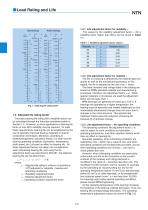
●Load Rating and Life 1.3.2 Life adjustment factor for material a2 The life of a bearing is affected by the material type and quality as well as the manufacturing process. In this regard, the life is adjusted by the use of an a2 factor. The basic dynamic load ratings listed in the catalog are based on NTN's standard material and manufacturing processes, therefore, the adjustment factor a2=1. When special materials or processes are used the adjustment factor can be larger than 1. NTN bearings can generally be used up to 120˚C. If bearings are operated at a higher temperature, the bearing must...
Open the catalog to page 9
Life adjustment value a3 ●Load Rating and Life 1.5 Allowable static equivalent load Generally the static equivalent load which can be permitted (See Section 2.3.2 page A-9) is limited by the basic static rated load as stated in Section 1.4. However, depending on requirements regarding friction and smooth operation, these limits may be greater or lesser than the basic static rated load. In the following formula (1.9) and Table 1.2 the safety factor So can be determined considering the maximum static equivalent load. So =Co/Po…(1.9) where, So : Safety factor Co : Basic static rated load, N (radial...
Open the catalog to page 10
●Bearing Load Calculation 2. Bearing Load Calculation To compute bearing loads, the forces which act on the shaft being supported by the bearing must be determined. These forces include the inherent dead weight of the rotating body (the weight of the shafts and components themselves), loads generated by the working forces of the machine, and loads arising from transmitted power. where: For ball bearings For roller bearings It is possible to calculate theoretical values for these loads; however, there are many instances where the load acting on the bearing is usually determined by the nature of...
Open the catalog to page 11
●Bearing Load Calculation (4) Sinusoidal fluctuating load The mean load, Fm, can be approximated by formulas (2.5) and (2.6). (2) Dynamic equivalent axial load As a rule, standard thrust bearings with a contact angle of 90˚ cannot carry radial loads. However, self-aligning thrust roller bearings can accept some radial load. The dynamic equivalent axial load for these bearings is given in formula (2.8). Pa=Fa+1.2Fr………………(2.8) where, Pa:Dynamic equivalent axial load, N Fa:Actual axial load, N Fr :Actual radial load, N Provided that Fr / Fa ≦ 0.55 only. 2.3.2 Static equivalent load The static equivalent...
Open the catalog to page 12
●Bearing Tolerances 3. Bearing Tolerances Running accuracy Running accuracy constitutes the acceptable values for inner and outer ring radial runout and axial runout, inner ring side runout, and outer ring outer diameter runout. Allowable rolling bearing tolerances have been established according to precision classes. JIS Class 0 corresponds to normal precision class bearings, and precision becomes progressively higher as the class number becomes smaller; i.e., Class 6 is less precise than Class 5, which is less precise than Class 4, and so on. Table 3.1 indicates which standards and precision...
Open the catalog to page 14
●Bearing Tolerances Table 3.3 Tolerance for radial bearings (Except tapered roller bearings) Table 3.3 (1) Inner rings Nominal bore diameter Single radial plane bore diameter variation Single plane mean bore diameter deviation ∆dmp max diameter series 0,1 max diameter series 2,3,4 class class class class class class class class class class class class class class class 0 6 5 4 2 0 6 5 4 2 0 6 5 4 2 1 The dimensional difference ∆ds of bore diameter to applied for class 4 and 2 is the same as the tolerance of dimensional difference ∆dmp of average bore diameter. However, the dimensional...
Open the catalog to page 15
●Bearing Tolerances Mean single plane bore diameter variation Inner ring radial runout Face runout with bore Inner ring axial runout (with side) Inner ring width deviation ∆Bs normal class class class class class 0 6 5 4 2 class class class class class 0 6 5 4 2 class class class 5 4 2 class class class 5 4 2 Inner ring width variation class 2 class 0,6 class 5,4 class class class class class 0 6 5 4 2 2 To be applied to deep groove ball bearing and angular contact ball bearings. 3 To be applied to individual raceway rings manufactured for combined bearing use. Mean single plane outside diameter...
Open the catalog to page 16All NTN Europe catalogs and technical brochures
 TAPERED ROLLER BEARINGS
32 Pages
 Topline
16 Pages
 Megaohm
7 Pages
 KIT ALL IN ONE
14 Pages
 Spherical Roller Bearings
80 Pages
 POLIPUMP
6 Pages
 Hydraulic Nuts
2 Pages
 SmartTEMP
4 Pages
 Deep-Groove Ball Bearings
4 Pages
 Lubrication
44 Pages
 Maintenance Tools
56 Pages
 Linear Motion: Ball Screws
116 Pages
 Linear Motion : Balls Bushings
84 Pages
 We Get, You Moving !
124 Pages
 Linear Axis Range
2 Pages
 Linear Axis
260 Pages
 Linear Axis AXE
4 Pages
 AXE Linear Axis
100 Pages
 Linear Motion: Range
4 Pages
 Self-Aligning Bearing Units
125 Pages
 Precision Rolling Bearings
327 Pages
 Ball and Roller Bearings
407 Pages
 OUR RANGE FOR YOUR INDUSTRY
32 Pages
 SOLUTIONS FOR MACHINE TOOL
6 Pages
 Needle Roller Bearings
84 Pages
 SNC The Pillow Block Range
88 Pages


Archived catalogs
 CYLINDRICAL ROLLER BEARINGS
5 Pages
- Angular encoder
- Incremental encoder
- NTN steel bearing
- Incremental rotary encoder
- Magnetic rotary encoder
- NTN single-row bearing
- Linear motion system
- Precision bearing
- Bearing unit
- NTN axial bearing
- Greasing system
- Stainless steel bearing
- Miniature bearing
- Steel linear guide
- NTN double-row bearing
- Ball bearing linear guide