
- Catalogs
- NTN Europe
- Linear Motion: Ball Screws


Linear Motion: Ball Screws

Linear Motion: Ball Screws
NTN-SNR, in partnership with NTN, has been a prominent player in the linear technology market since 1985, offering a wide range of linear products with a focus on service, quality, and variety. Their global technical sales and application engineers ensure product reliability and performance.
NTN-SNR offers a diverse selection of Ball Screws for applications in machine tools, packaging, printing, aircraft construction, and automation, designed to meet the growing demands of manufacturing automation.
- Comprehensive linear product range
- Production facilities in Europe and Asia
- Advanced technology and production methods
- Customized solutions and economic efficiency
- Efficient logistics for timely delivery
The document details the design principles, manufacturing processes (rolling, whirling, grinding), and features of Ball Screws, including efficiency, nut design types, and ball deflection types. It also covers selection criteria, system technology, and safety instructions.
Instructions for transport, storage, and assembly of Ball Screws are provided, including assembly tolerances and bearing types. Maintenance and lubrication guidelines specify methods and intervals.
Various nut types and options for SNR Ball Screws are described, including compact and standard single and double nuts, cylindrical nuts, and miniature nuts, along with bearing units for different load capacities and standard end machining options.
NTN-SNR's Ball Screws provide versatile, high-quality solutions for industrial applications, supported by extensive production facilities and technical expertise.
Ball screw drives convert rotational movements into linear movements and vice versa, consisting of a threaded spindle, ball screw nut, ball deflection system, sealing elements, and bearing units. Key dimensions include nominal diameter and pitch.
Ball screw spindles are manufactured through rolling, whirling, and grinding, each offering different advantages in terms of speed, flexibility, and accuracy.
Ball screws are highly efficient, reducing drive torque compared to trapezoidal spindles. Various nut designs and ball deflection types are available for different applications.
Selection involves application description, nut type, load determination, system deformation checks, and environmental conditions, ensuring compliance with accuracy and load requirements.
Key definitions include service life time, dynamic load rating, and static load rating, guided by standards such as DIN ISO 3408 and DIN 69051.
Safety guidelines emphasize using ball screws within technical parameters and ensuring compliance with safety regulations.
Compliance with safety and environmental standards is crucial, with appropriate protective equipment and tested load handling devices recommended.
Factors influencing selection include accuracy, rigidity, loads, dynamics, service life, and installation space, with classification by tolerance classes.
Tolerance classes for Ball Screws range from T10 to T0 for transport and P5 to P0 for positioning, with specific tolerances for travel distance deviation.
Requirements for concentricity, axial runout, and parallelism are specified according to DIN ISO3408-3.
Composed of preload and sealing elements, with tolerances specified based on total length and tolerance class.
Preload eliminates axial clearance and increases rigidity, with methods including oversized balls, pitch offset, or spacer elements for double nuts.
Preload methods for ball screws are discussed, emphasizing axial rigidity for positioning accuracy.
The static safety factor prevents excessive plastic deformation under load, with recommendations varying based on operating conditions.
Nominal service lifetime is calculated considering material fatigue, with formulas provided for different units of measurement.
Various bearing arrangements impact critical speed and buckling load, with recommended maximum speeds set at 80% of the critical speed.
Positioning accuracy is influenced by pitch error, axial rigidity, axial clearance, and thermal expansion.
Formulas for calculating drive torque and efficiency are provided, with emphasis on avoiding radial loads during assembly.
Ball screws require careful handling to prevent damage and contamination, with recommendations for storage and handling.
Assembly tolerances include perpendicularity, height offset, and side offset of bearings, with specific values depending on shaft length and preload class.
Guidelines for assembling ball screw nuts, fixed bearings, and bearing units are provided, emphasizing the importance of proper tools and knowledgeable personnel.
Proper alignment and lubrication are essential during installation.
Regular maintenance and adequate lubrication are crucial for reliable operation, with specific lubricant recommendations based on environmental conditions.
Detailed specifications for lubrication oils and greases are provided, highlighting key properties and application areas.
Ball screws can be lubricated manually or through central lubrication systems, with precise and efficient lubrication across multiple points.
Tables specify minimum lubrication amounts required for different ball screw types.
Risk analyses are recommended for applications in the pharmaceutical industry.
Permissible DN values for nuts are determined by the ball deflection system and manufacturing process.
Specifications for various nut types are detailed, including compact, standard, cylindrical, and miniature nuts.
Details on bearing units and type code structure for bearings are provided.
Technical specifications and guidelines for NTN angular contact ball bearings are provided, including dimensions, load ratings, and calculation formulas.
Specifications for various models of NTN angular contact ball bearings and SNR fixed and floating bearing units are listed.
Instructions for calculating static and dynamic equivalent loads are provided.
Recommendations for using SNR precision nuts and following specific assembly instructions are highlighted.
Tables summarize critical data, and figures illustrate bearing arrangements and dimensions.
Rigidity and starting torque are emphasized in ball screw calculations, with detailed type codes for bearing configurations.
Detailed specifications for bearing units and precision nuts are provided, including dimensions, load ratings, and torque requirements.
Installation instructions emphasize following specific guidelines for proper assembly and preload adjustment.
Standard end machining options for bearings are outlined, with additional features like keyways and hexagon sockets.
Use of SNR precision nuts for preload adjustment is recommended, with specific configurations for low and medium load applications.
Tables summarize critical data such as dimensions, load ratings, and torque values, with figures illustrating bearing arrangements.
Tightening torque values, load ratings, and axial spring constants are provided, emphasizing correct installation for optimal performance.
Catalog excerpts

NTN-SNR LINEAR MOTION: NTN BALL SCREWS
Open the catalog to page 1
NTN-SNR THE STRENGTH OF A GROUP We are one of the largest bearing manufacturers in the world in conjunction with the Japanese company NTN. NTN-SNR has been established in the linear technology market since 1985 and strives to offer a complete and competitive product range. This position allows us to provide our customers with a high level of added value regarding service, quality and product variety. Our sales support and applications engineers are always on hand to offer you optimal support. Our sales and application engineers are always available. The consulting and planning service is based...
Open the catalog to page 2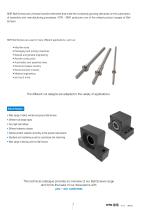
SNR Ball Screws are universal machine elements that meet the constantly growing demands on the automation of assembly and manufacturing processes. NTN - SNR produces one of the widest product ranges of Ball Screws. SNR Ball Screws are used in many different applications, such as: • Machine tools • Packaging and printing machines • Special and general engineering • Aircraft construction • Automation and assembly lines • Wood and paper industry • Semiconductor industry • Medical engineering • and such more Advantages: • Wide range of rolled, whirled and ground Ball Screws • Different nut design...
Open the catalog to page 3
Content 1.______ Ball Screw basics. . . . . . . . . . . . . . . . . . . . . . . . . . . . . . . . . . . . . . . . . . . . . . . . . . 2.______ System technology. . . . . . . . . . . . . . . . . . . . . . . . . . . . . . . . . . . . . . . . . . . . . . . 2.1_________ Definitions . . . . . . . . . . . . . . . . . . . . . . . . . . . . . . . . . . . . . . . . . . . . . . . . . . . . . . . . . . . . . . 2.2_________ Used standards. . . . . . . . . . . . . . . . . . . . . . . . . . . . . . . . . . . . . . . . . . . . . . . . . . . . . . . . . . 2.3_________ Intended use. . . . . . . . . . . . . ....
Open the catalog to page 4
5.______ SNR Ball Screws. . . . . . . . . . . . . . . . . . . . . . . . . . . . . . . . . . . . . . . . . . . . . . . . . . 5.1_________ Versions and options. . . . . . . . . . . . . . . . . . . . . . . . . . . . . . . . . . . . . . . . . . . . . . . . . . . . . . 5.1.1_______ Nut types. . . . . . . . . . . . . . . . . . . . . . . . . . . . . . . . . . . . . . . . . . . . . . . . . . . . . . . . . . . . . . . 5.1.2_______ Main parameter. . . . . . . . . . . . . . . . . . . . . . . . . . . . . . . . . . . . . . . . . . . . . . . . . . . . . . . . . . 5.1.3_______ Correction factors for load ratings...
Open the catalog to page 5
Ball Screw basics Design principles of Ball Screws Ball screw drives are among the most important drive elements for mechanical engineering in linear technology. These drive units consist of a threaded spindle with end machining for the bearings, the ball screw nut with balls, a ball deflection system and sealing elements as well as the bearing units (Figure 1.1). 1 Drive journal 2 Bearing unit (floating or fixed bearing), here fixed bearing 3 Threaded shaft 5 Bearing unit (floating or fixed bearing), here floating Figure 1.1____ Construction of a Ball Screw drive Ball screw drives are used to...
Open the catalog to page 7
Depending on the diameter, pitch and ball size, the threaded spindles can be manufactured as single or multi threaded spindles as well as with right or left-hand helix. The dimensions shown in Figure 1.3 are important for the designation and technical design of Ball Screws Figure 1.3____ Design measures of Ball Screws The size specification of a ball screw is usually made up of the nominal diameter and pitch, although the nominal diameter cannot always be measured directly on the threaded spindle, depending on the manufacturing process. Manufacturing processes of Ball Screw shafts Ball Screw...
Open the catalog to page 8
1.2.2 Whirling Whirling is a machine cutting process with geometrical defined cutting edges 1 . In this process, the very fast, eccentric rotational movement (nwz) of the tool 2 is superimposed on a slow rotation (nws) and feed movement (v1) of the threaded spindle 3 (Figure 1.5). The whirling tool 2 is inclined by the angle α. Depending on the whirling machine used, hardened and non-hardened shafts can be used as the raw material. It is a very flexible manufacturing process with which single-threaded spindles can be manufactured in almost all combinations of spindle diameter, pitch, ball size...
Open the catalog to page 9
1.3 Features 1.3.1 Efficiency Due to the use of rolling balls as transmission elements between the threaded spindle and the nut, Ball Screws are characterized by a very high degree of efficiency. Compared to trapezoidal spindles, the drive torque can be reduced by up to 75%. For this reason, ball screws can convert not only rotary movements into linear movements (Figure 1.7), but also linear movements into rotary movements (Figure 1.8). Ball Screw µ=0,01 Trapezodial Screw µ=0,1 Figure 1.7____ Efficiency when converting rotary to linear movement Ball Screw µ=0,01 Trapezodial Screw µ=0,1 Figure...
Open the catalog to page 10
Typical design typs of Ball Screw nuts are flange nuts (Figure 1.9), cylindrical (Figure 1.10) and screw-in nuts (Figure 1.11). Figure 1.9 ___ Flange type nut Depending on the size and series, flange nuts, but also partly cylindrical nuts, can be designed as single nuts (Figure 1.12), single nuts with pitch offset (Figure 1.13) or double nuts (Figure 1.14). Figure 1.12 ___ Single flange type nut Figure 1.13___ ingle flange type nut wit S pitch offset Figure 1.14 ___ Double flange type nut Depending on the installation space, flange type nuts can be designed in three flange types (Figure 1.15)....
Open the catalog to page 11
Ball deflection types The balls in Ball Screws move in one or more closed ball circuits. The power transmission takes place in the loaded area in which the balls are in contact with the nut and the threaded spindle. The total number of revolutions of the balls around the threaded spindle in the loaded area indicates the number of revolutions. The balls are unloaded in the ball deflection. The balls can be deflected in different ways. The ball deflections are divided into internal and external deflections as well as single and multiple deflections. Internal deflection The most common internal...
Open the catalog to page 12All NTN Europe catalogs and technical brochures
 NTN Large Bearings
337 Pages
 TAPERED ROLLER BEARINGS
32 Pages
 Topline
16 Pages
 Megaohm
7 Pages
 KIT ALL IN ONE
14 Pages
 Spherical Roller Bearings
80 Pages
 POLIPUMP
6 Pages
 Hydraulic Nuts
2 Pages
 SmartTEMP
4 Pages
 Deep-Groove Ball Bearings
4 Pages
 Lubrication
44 Pages
 Maintenance Tools
56 Pages
 Linear Motion : Balls Bushings
84 Pages
 We Get, You Moving !
124 Pages
 Linear Axis Range
2 Pages
 Linear Axis
260 Pages
 Linear Axis AXE
4 Pages
 AXE Linear Axis
100 Pages
 Linear Motion: Range
4 Pages
 Self-Aligning Bearing Units
125 Pages
 Precision Rolling Bearings
327 Pages
 Ball and Roller Bearings
407 Pages
 OUR RANGE FOR YOUR INDUSTRY
32 Pages
 SOLUTIONS FOR MACHINE TOOL
6 Pages
 Needle Roller Bearings
84 Pages
 SNC The Pillow Block Range
88 Pages


Archived catalogs
 CYLINDRICAL ROLLER BEARINGS
5 Pages
- Angular encoder
- Incremental encoder
- NTN steel bearing
- Incremental rotary encoder
- NTN radial bearing
- Magnetic rotary encoder
- NTN single-row bearing
- NTN roller bearing
- Linear motion system
- Precision bearing
- NTN axial bearing
- Greasing system
- Stainless steel bearing
- Miniature bearing
- Steel linear guide
- NTN double-row bearing
- Ball bearing linear guide