
- Catalogs
- NTN Europe
- Linear Axis


Linear Axis

Linear Axis
NTN-SNR is a prominent global manufacturer of bearings, collaborating with the Japanese company NTN. Since 1985, they have been active in the linear technology market, offering a wide range of linear motion products. The company focuses on strategic partnerships, emphasizing product quality, economic efficiency, and user benefits.
- Extensive range of linear products for various industrial sectors.
- Production facilities in Europe and Asia ensure high quality and timely delivery.
- Global support from technical sales and application engineers.
- Advanced technology and production methods.
- Customized solutions tailored to customer needs.
SNR Linear Axis modules are versatile and used in diverse applications such as machine tool manufacturing, packaging, printing, aircraft construction, and automation. Their modular design allows for flexible combinations and customized solutions.
- Technical Basics: Discusses product features, driving and guiding systems, and selection criteria.
- System Technology: Includes safety instructions, intended use, static load capacity, and lifetime considerations.
- Mounting and Start-up: Covers transportation, storage, mounting instructions, and start-up procedures.
- Maintenance and Lubrication: Provides guidelines on lubrication methods, intervals, and replacement of wear parts.
The document details various series of SNR Linear Axis, including AXC and AXF Compact Axis, with specifications on structure, dimensions, load capacities, and drive systems.
NTN-SNR's linear motion solutions are designed to meet the growing demands of automation in installation and manufacturing processes, offering reliability and performance through innovative and customized solutions.
The document provides a comprehensive analysis of the guiding and drive system, focusing on technical aspects such as system deformation, environmental conditions, maintenance intervals, and dynamic and static loads. It also covers configuration versions, safety options, accessories, and lubricants.
Linear Axis are pre-finished units combining precise guiding and driving elements, offering cost efficiency and compactness for machine systems. Selection criteria are supported by experienced sales and application engineers.
The document confirms compliance with essential health and safety requirements according to the machinery directive 2006/42/EG, including protection against mechanical hazards and maintenance.
Details on positioning repeatability, position accuracy, running parallelism, backlash of ball screws, and starting torque are provided to ensure precision and reliability.
Emphasizes the importance of safety instructions and intended use, highlighting residual risks and the need for proper instruction and understanding of potential dangers.
Discusses static and dynamic load capacities, guidelines for maximum permissible loads, and factors affecting the nominal lifetime of Linear Axis.
Rigidity is defined by the correlation between external load and resulting deformation, with factors such as load type, fixation, and length affecting total deformation. Precision is determined by tolerances of aluminum profiles.
Guidelines for selecting gearboxes and calculating drive parameters are provided, considering maximum operating speed, acceleration torque, and nominal torque.
Specific recommendations are made for Linear Axis with toothed belt drives mounted at a 90° tilt to prevent displacement due to gravity.
Outlines specifications for various series of Linear Axis with toothed belt drives, including stroke lengths and the importance of checking the centered run of the toothed belt during operation.
Linear Axis components must be protected from shocks, vibrations, aggressive substances, moisture, and contamination during transportation and storage.
Details the importance of flatness, straightness, and parallelism in mounting surfaces to avoid additional loads and reduce lifespan.
Instructions for mounting Linear Axis include minimizing structure-borne noise and ensuring the number of mounting points matches the application.
Aligning parallel Linear Axis with an assembled crossbar is recommended to minimize tension and interference with lifespan.
Start-up should be performed cautiously to avoid bodily injury or material damage, ensuring permissible loads are not exceeded.
Detailed steps are provided for assembling drives on Linear Axis with toothed belt drives, planetary gearboxes, and screw drives.
Instructions for assembling a deflection belt drive on Linear Axis with screw drives include mounting the housing, inserting toothed belt discs, and tensioning the toothed belt.
Provides detailed specifications for deflection belt drives, including pretension forces, eigenfrequency, torque tensioning screw, and maximum permissible drive torque.
Outlines the mounting process for Beam Axis used in parallel with rack and pinion drives.
Maintenance must be performed with the power off. Proper lubrication is crucial for reliable operation, preventing wear and corrosion.
Several types of lubricants are recommended for different systems, each with specific properties such as wear protection and corrosion resistance.
Manual grease guns, automatic electro-mechanical lubricators, and central lubrication systems are discussed.
Different series of Linear Axis have specific lubrication points marked for ease of access.
Includes tables detailing parameters for deflection belt drives and lubricants, as well as figures illustrating lubrication points and systems.
- Automatic Lubricators: Linear Axis with rack and pinion drives are equipped with automatic lubricators that must be activated during start-up.
- Lubrication Points: Multi-axis systems have centralized lubrication points for easy access.
- Lubricant Types and Amounts: Different guiding systems and drive elements require specific lubricants and amounts.
- Initial Lubrication: Linear Axis systems are pre-lubricated upon delivery.
- Re-lubrication Recommendations: Factors influencing intervals include load and contamination levels.
- Cover Strip Replacement: Detailed steps are provided for replacing cover strips on different series.
- Brush Wiper Replacement: Instructions for replacing brush wipers on the AXC series are included.
- Pollution Levels: The document outlines protection options based on pollution levels.
- Special Applications: For industries like food processing, alternative lubricants may be required.
Details on wear part sets and sealing kits for Linear Axis series AXC and AXDL, including a summary table with ID numbers for wear parts and cover strips.
NTN-SNR offers a wide range of Linear Axis products, emphasizing user-oriented development and high quality. The series includes:
- Compact Axis AXC: Features universal use, various combinations, aluminum profiles, multiple drive versions, and service-friendly design.
- Compact Axis AXF: Optimized for food, pharmaceutical, and semiconductor industries.
- Parallel Axis AXDL: Designed for stiff single-axis use.
- Linear Table Axis AXLT: Suitable for high loads.
- Precision Axis AXBG: For high positioning accuracy.
- Linear Motor Axis AXLM: For high loads and accuracy.
- System Program Axis AXS: For highest loads.
Includes tables detailing main parameters for various Linear Axis types, including:
- Toothed Belt Drive: Parameters such as axis profile, feed constant, allowable dynamic load, guiding system, maximum velocity, and load capacity.
- Screw Drive: Details on ball screw, trapezoidal screw, and sliding screw drives.
- Lifting and Gantry Axis: Parameters for rack and pinion drive systems.
Provides detailed specifications for various linear motor axes, categorized by type and axis cross-section dimensions.
Outlines different drive systems, including toothed belts and racks, and their corresponding guiding levels.
Describes the structure and technical data of the AXC_Z compact axis.
Provides detailed tables of maximum static and dynamic load capacities for various guiding systems.
Covers the structure and technical data of the AXC_S / T compact axis.
Provides detailed technical specifications for various linear guiding systems and drive elements.
- Linear Guides: Specifies linear guides D and B, with track roller guides L for certain models.
- Drive Elements: Includes ball screws and trapezoidal screws with varying diameters and pitches.
- Maximum Velocity: Ranges from 4.4 m/min to 150 m/min depending on the model and drive element.
- Pitch Accuracy: Specified as 52 µm/300mm for most models.
- Dynamic Load Rating: Varies significantly across models.
- Repeatability: Generally around 0.03 mm to 0.07 mm.
- Static and Dynamic Load Capacities: Detailed for each model.
- Load Moments: Provided for different axes.
- Table Lengths and Stroke: Specific lengths and stroke calculations are provided.
- Mass and Inertia: Basic mass, mass per stroke, and moment of inertia are specified for each model.
- Rotational Speed Graphs: Graphs illustrate allowable rotational speeds for ball screws and trapezoidal screws.
- Re-greasing Possibility: Mentioned for several models.
- Optional Configurations: Some models offer optional features or configurations.
1. Mass and Dimensions
Provides detailed specifications for various linear guide systems.
Different drive elements such as toothed belts and ball screws are used.
Both static and dynamic load capacities are detailed for various guiding systems.
Outlines the structure of different systems.
Technical data includes idling speed torque, maximum drive torque, moment of inertia, and repeatability.
Optional features such as re-greasing possibilities are mentioned.
Graphs illustrate allowable rotational speeds for ball and trapezoidal screws.
- Structure: Includes components like deflection unit, toothed belts, guiding levels, operating head, slider unit, and profile.
- Technical Data: Features linear guide systems, toothed belts, maximum velocity of 300-600 m/min, and dynamic load capacities.
- Structure: Comprises guiding system, toothed rack, profile, lubrication pinion, slider unit, and gearbox.
- Technical Data: Includes linear guides, toothed rack drive, maximum velocity of 180-300 m/min, and dynamic load capacities.
- Structure: Consists of shock absorber, toothed rack, pinion, gearbox, slider unit, guiding system, and profile.
- Technical Data: Features linear guides, toothed rack drive, maximum velocity of 198-300 m/min, and dynamic load capacities.
- Structure: Includes guiding levels, toothed rack, base plate, pinion, slider unit, and optional balance cylinder.
- Technical Data: Features linear guides, toothed rack and belt drives, maximum velocity of 300-600 m/min, and dynamic load capacities.
- Maximum velocities range from 180 to 600 m/min across different systems.
- Dynamic load capacities are based on a nominal lifetime of 50,000 km.
- Repeatability is consistently 0.05 mm for precision.
- Guiding System: Linear guide D
- Drive Element: Toothed rack, module 2, and toothed belt 50AT10
- Maximum Velocity: 600 m/min
- Allowable Dynamic Load: 5,800 N
- Stroke per Revolution: 360 mm
- Repeatability: 0.05 mm
- Guiding System: Linear guide D and E
- Drive Element: Toothed rack, module 3, and toothed belt 75AT10
- Maximum Velocity: 600 m/min
- Allowable Dynamic Load: 5,600 N
- Stroke per Revolution: 500 mm
- Repeatability: 0.05 mm
- Guiding System: Linear guide D
- Drive Element: Toothed rack, module 3, and toothed belt 75AT10
- Maximum Velocity: 600 m/min
- Allowable Dynamic Load: 15,000 N
- Stroke per Revolution: 700 mm
- Repeatability: 0.05 mm
- Guiding System: Linear guide D, E, G, and H
- Drive Element: Toothed rack, module 4, and toothed belt 75AT10
- Maximum Velocity: 360 m/min
- Allowable Dynamic Load: 7,650 - 10,000 N
- Stroke per Revolution: 560 mm
- Repeatability: 0.05 mm
- Dynamic load capacities are based on a nominal lifetime of 50,000 km.
- Static and dynamic load capacities are specified for different guiding systems and levels.
- AXS_Y Gantry Axis: Features a lateral toothed belt drive with various guiding systems and load capacities.
- AXS_Z Gantry Axis: Includes a toothed belt drive with specified load capacities and technical data.
- AXS_M Beam Axis: Designed for parallel use with rack and pinion drive, offering detailed technical specifications.
- Technical data includes mass, moment of inertia, maximum velocity, and repeatability for each axis type.
- Guiding systems and drive elements vary across different axis models, affecting their performance and application suitability.
Provides detailed specifications for various linear motor axes, including the AXS and AXLM series.
The AXLM series structure includes components like shock absorbers, guiding systems, slider units, measuring systems, and energy chains.
Detailed tables list the dimensions and mass for each model.
Details both static and dynamic load capacities, with dynamic capacities based on a nominal lifetime of 50,000 km.
Permissible peak and permanent forces are listed alongside velocities for each model.
Explains the force-velocity characteristics, including permissible motor peak force and permanent force with air and water cooling.
Current consumption data is provided for each model.
Describes the connection between the motor and controller.
Outlines available accessories for linear axes, including fastening strips, sliding blocks, and various connection elements.
Different designs of sliding blocks are described, including standard, heavy load, and effective component mounting types.
Provides detailed specifications and dimensions for various components of linear axis systems.
Various types of switches are discussed, including mechanical safety limit switches and inductive proximity switches.
Line splitters are available for field installation of inductive switches.
Details the types and configurations of energy chains available for linear axis systems.
Safety brakes are available for lifting axes designed for higher loads.
Other components such as groove inserts for environments with heavy dirt are also described.
- Type 1: Extension connections with specifications.
- Type 2: Straight tube connections.
- Type 3: Angulate tube connections.
- Standard grease nipples are specified for various types.
- NTN-SNR standard axis systems allow modular two and three-axis configurations.
- Combinations like AXC_Z – AXC_Z – AXC_A are detailed.
- Type codes for single axis and axis systems are provided.
Catalog excerpts

NTN-SNR LINEAR MOTION:
Open the catalog to page 1
NTN-SNR THE STRENGTH OF A GROUP We are one of the largest bearing manufacturers in the world in conjunction with the Japanese company NTN. NTN-SNR has been established in the linear technology market since 1985 and strives to offer a complete and competitive product range. This position allows us to provide our customers with a high level of added value regarding service, quality and product variety. Our sales support and application engineers are always on hand to offer you optimal support. The consulting and planning service is based on many years of interdisciplinary experience. That means...
Open the catalog to page 2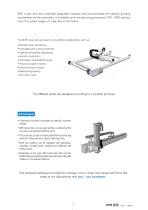
SNR Linear Axis are universally applicable modules that accommodate the steadily growing requirements for the automation of installation and manufacturing processes. NTN - SNR produce one of the widest ranges of Linear Axis in the market. The SNR Linear Axis are used in many different applications, such as: • Machine tool manufacture • Packaging and printing machines • Special and general engineering • Aircraft construction • Automation and assembly lines • Wood and paper industry • Semiconductor industry • Medical engineering • and much more The different series are designed according to a modular...
Open the catalog to page 3
Table of contents 1._________ Technical basics Linear Axis. . . . . . . . . . . . . . . . . . . . . . . . . . . . . . . . . . . . . . . . . . . . . . . . . . 7 1.1_________ Product features . . . . . . . . . . . . . . . . . . . . . . . . . . . . . . . . . . . . . . . . . . . . . . . . . . . . . . . . . . . . . . . . . . . . . . 7 1.2_________ Driving systems. . . . . . . . . . . . . . . . . . . . . . . . . . . . . . . . . . . . . . . . . . . . . . . . . . . . . . . . . . . . . . . . . . . . . . . 9 1.3_________ Guiding systems . . . . . . . . . . . . . . . . . . . . . . . . . . . . . . . . ....
Open the catalog to page 4
4.9.2_______ over strip repalcement for Linear Axis of the series AXDL . . . . . . . . . . . . . . . . . . . . . . . . . . . . . . . . . . . . . 47 C 4.10________ Wear part sets. . . . . . . . . . . . . . . . . . . . . . . . . . . . . . . . . . . . . . . . . . . . . . . . . . . . . . . . . . . . . . . . . . . . . . . 47 48 5.1_________ General view . . . . . . . . . . . . . . . . . . . . . . . . . . . . . . . . . . . . . . . . . . . . . . . . . . . . . . . . . . . . . . . . . . . . . . . . 48 5.1.1_______ Series . . . . . . . . . . . . . . . . . . . . . . . . . . . . . . . . . . . . . . . . ....
Open the catalog to page 5
5.6.1_______ AXBG Precision Axis with screw drive . . . . . . . . . . . . . . . . . . . . . . . . . . . . . . . . . . . . . . . . . . . . . . . . . . . . 115 5.6.1.1_____ Structure. . . . . . . . . . . . . . . . . . . . . . . . . . . . . . . . . . . . . . . . . . . . . . . . . . . . . . . . . . . . . . . . . . . . . . . . . . 115 5.6.1.2_____ Dimensions / Technical data . . . . . . . . . . . . . . . . . . . . . . . . . . . . . . . . . . . . . . . . . . . . . . . . . . . . . . . . . . . 116 5.6.1.3_____ Load ratings. . . . . . . . . . . . . . . . . . . . . . . . . . . . . . . . . . . . . . . ....
Open the catalog to page 6
6.1.2_______ Sliding blocks . . . . . . . . . . . . . . . . . . . . . . . . . . . . . . . . . . . . . . . . . . . . . . . . . . . . . . . . . . . . . . . . . . . . . . 178 6.1.3_______ Hammer screws . . . . . . . . . . . . . . . . . . . . . . . . . . . . . . . . . . . . . . . . . . . . . . . . . . . . . . . . . . . . . . . . . . . . 180 6.1.4_______ Direct connection. . . . . . . . . . . . . . . . . . . . . . . . . . . . . . . . . . . . . . . . . . . . . . . . . . . . . . . . . . . . . . . . . . . . 181 6.1.5_______ Cross connection. . . . . . . . . . . . . . . . . . . . . . . . . . . . . . ....
Open the catalog to page 7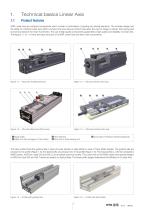
Technical basics Linear Axis Product features SNR Linear Axis are compact components which contain a combination of guiding and driving elements. The modular design and the ability to combine Linear Axis within a product line and various product lines allow the user to design a simple, time-saving and economical solution for linear movements. The use of high quality components guarantees a high quality and reliability of Linear Axis. The figures 1.1 to 1.4 show the basic structure of all SNR Linear Axis and their main components: Figure 1.1 — Structure Toothed belt axis Figure 1.2 — Structure...
Open the catalog to page 9
The slider unit is a complex assembly group which is usually made of an aluminum profile or consists of aluminum components. The carriages or track rollers are mounted to the slider unit. The slider unit also connects the drive elements with the guiding elements of a Linear Axis. At the top side of the slider unit are threaded holes (Figure 1.7) or profile grooves (Figure 1.8) to secure the customer’s extensions. Figure 1.7 — Slider unit with threaded holes Figure 1.8 — Slider unit with profile grooves Depending on the series, various sealing elements (Figures 1.9 and 1.10) and the deflection...
Open the catalog to page 10
Driving systems Depending on the series, SNR Linear Axis, can be be produced with toothed belt drive, screw drive, rack and pinion drive or linear motor drive. Toothed belt drive Linear Axis with toothed belt drive are suitable for fast handling and positioning applications. All axis are equipped with AT or STD toothed belt. These are extruded polyurethane belts with integrated steel cords. The AT toothed belts are carried out in the zero-gap shape. The use of black toothed belts prevents discoloration of the toothed belts under UV - radiation. These toothed belts are also characterized by the...
Open the catalog to page 11
Screw drive Linear Axis with screw drive can be equipped with ball screws (Figure 1.17) and with trapezoidal screws. Screw drives are especially suitable for high requirements for positioning accuracy and repeatability in combination with high rigidity of the driving element. The drive adaption can be done directly by coupling and coupling cone or with a deflection belt drive. Figure 1.17 — Linear Axis with screw drive In order to achieve a high velocity even at longer lengths, it is possible to equip the Linear Axis of the AXC and AXDL series with one or more sets of screw drive support units...
Open the catalog to page 12All NTN Europe catalogs and technical brochures
 NTN Large Bearings
337 Pages
 TAPERED ROLLER BEARINGS
32 Pages
 Topline
16 Pages
 Megaohm
7 Pages
 KIT ALL IN ONE
14 Pages
 Spherical Roller Bearings
80 Pages
 POLIPUMP
6 Pages
 Hydraulic Nuts
2 Pages
 SmartTEMP
4 Pages
 Deep-Groove Ball Bearings
4 Pages
 Lubrication
44 Pages
 Maintenance Tools
56 Pages
 Linear Motion: Ball Screws
116 Pages
 Linear Motion : Balls Bushings
84 Pages
 We Get, You Moving !
124 Pages
 Linear Axis Range
2 Pages
 Linear Axis AXE
4 Pages
 AXE Linear Axis
100 Pages
 Linear Motion: Range
4 Pages
 Self-Aligning Bearing Units
125 Pages
 Precision Rolling Bearings
327 Pages
 Ball and Roller Bearings
407 Pages
 OUR RANGE FOR YOUR INDUSTRY
32 Pages
 SOLUTIONS FOR MACHINE TOOL
6 Pages
 Needle Roller Bearings
84 Pages
 SNC The Pillow Block Range
88 Pages


Archived catalogs
 CYLINDRICAL ROLLER BEARINGS
5 Pages
- Angular encoder
- Incremental encoder
- NTN steel bearing
- Incremental rotary encoder
- NTN ball bearing
- NTN radial bearing
- Magnetic rotary encoder
- NTN single-row bearing
- NTN roller bearing
- Precision bearing
- Bearing unit
- NTN axial bearing
- Greasing system
- Stainless steel bearing
- Miniature bearing
- Steel linear guide
- NTN double-row bearing
- Ball bearing linear guide