- Catalogs
- NSK Europe Ltd.
- Hub unit bearings


Hub unit bearings

Hub unit bearings
- Categories: Hub unit bearings are divided into three generations: Hub I, Hub II, and Hub III. Each generation varies in the integration of bearings and peripheral components, classified by rotation type and application.
- Hub I: Uses double-row angular contact ball bearings and double-row tapered roller bearings, with integral seals and no need for preload adjustments.
- Hub II: Features flanged outer rings, available in ball and tapered roller bearings, with pre-set preload.
- Hub III: Includes flanged inner and outer rings, options for integral ABS sensors, and pre-adjusted preload for all wheel types.
- Overview: Selection is based on vehicle requirements, usage conditions, and mounting specifications, with technical support from NSK.
- Selection Process: Involves determining bearing types, specifications, and axial clearance, considering load capacity, rigidity, and marketability.
- Life Calculation: Service life is calculated using axle load, wheel tread, gravity center height, tire radius, and offset amount.
- Rigidity and Strength: Evaluations include road reaction calculations and bearing load assessments.
- Fit and Preload: Proper fitting and preload are crucial, with recommended measurements and fitting tests provided.
- Seals and Grease: Integral seals and specific grease types are recommended for optimal performance.
- Materials: Materials for raceway rings, rolling elements, and cages are specified for durability.
- ABS Sensors: Hub units with integral ABS sensors and multi-pole magnetic encoders are available.
The document provides formulas and calculations for determining axial and radial loads on bearings and bearing life based on load factors. It includes equations for axial load balance, axial displacement balance, and the relationship between radial and axial loads.
Finite Element Analysis (FEA) is used to calculate deformation of outer and inner rings, considering flange rigidity. The document emphasizes rigidity in hub unit bearings and the use of FEA for optimal design.
Optimization of hub flange design using FEA is discussed to relieve stress concentration and reduce weight, with examples of optimal designs for bore and outboard flanges.
Axial clearance and fit are crucial for optimal preload, with recommended fitting measurements and fitting tests specified.
NSK offers various seal options, ranked by performance, and specific grease recommendations based on transportation conditions.
The document details materials used for raceway rings and rolling elements, emphasizing the importance of material selection for extending bearing life and performance.
Hub unit bearings with integral ABS sensors are discussed, highlighting their lightweight and compact design, and the use of multi-pole magnetic encoders for ABS.
Catalog excerpts

MOTION & CONTROL™ Intelligently and reliably meeting the needs of a wide range of vehicle models.
Open the catalog to page 1
1. Types and Features of Hub Unit Bearings 1-1. Categories of hub unit bearings·····································3 1-2. HUB I ·············································································5 1-3. HUB II ············································································7 1-4. HUB III ···········································································9 2. Selection of Hub Unit Bearings 2-1. Overview of selection···················································11 2-2. Selection of bearing types ···········································14 2-3. Types and characteristics...
Open the catalog to page 2
1. Types and Features of Hub Unit Bearings 1-1. Categories of hub unit bearings Hub unit bearings for automobile wheels are comprised of bearing rings, rolling elements, and cages, similar to general-purpose rolling bearings. The first-generation hub unit (Hub I), second-generation hub unit (Hub II), and third-generation hub unit (Hub III) vary according to the integration of the bearings and their peripheral components. In addition, the forms are categorized by usage condition (rotations of outer rings or inner rings) and component location (for driven wheels or non-driven wheels). For driven...
Open the catalog to page 3
1-2. HUB I For HUB I, NSK uses proprietary bearing-type designations such as “BWD” for ball bearings and “KWD” for tapered roller bearings. The HUB I units are double-row angular contact ball bearings (BWD) and double-row tapered roller bearings (KWD) with back-to-back duplex outer rings. No preload adjustments (including dimensional adjustments by shims) are required on the assembly line. The initial axial clearance is properly pre-set for the preload to fall within the specified range after mounting. In addition, the integral seal eliminates the need for automotive makers to externally apply...
Open the catalog to page 4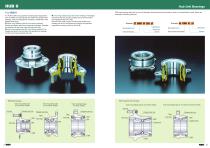
1-3. HUB II For HUB II, NSK uses proprietary bearing-type designations such as “BWK” for ball bearings and “KWH” for tapered roller bearings. HUB II configurations are BWD or KWD HUB I with flanged outer rings. Outer ring rotation type (for non-driven wheels): Wheels and brake disks are mounted at the flanges. Spindles are inserted into the inner rings and fixed with nuts. Inner ring rotation type (for non-driven wheels): The flanges are fixed to the car body. Hub spindles are pressed into the inner rings and fixed with nuts. Inner ring rotation type (for driven wheels): The flanges are fixed to the axle...
Open the catalog to page 5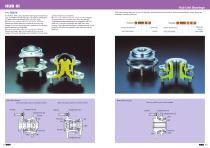
1-4. HUB III For HUB III, NSK uses proprietary bearing-type designations such as “BWKH” for ball bearings. The HUB III configuration is a BWD HUB I with flanged inner and outer rings. Outer ring rotation type (for non-driven wheels): Wheels and brake disks are mounted at the outer ring flanges. The inner ring flanges are mounted on the car body, and the preload is pre-adjusted. Inner ring rotation type (for non-driven wheels): Wheels and brake disks are mounted at the inner ring flanges. The outer ring flanges are mounted on the car body, and the preload is pre-adjusted. Inner ring rotation type (for...
Open the catalog to page 6
2. Selection of Hub Unit Bearings 2-1. Overview of selection While higher performance is demanded for hub unit bearings, the constraints and conditions of their application are becoming increasingly diverse. The selection of optimum bearing types satisfying such constraints and conditions requires the examination of various aspects. Please contact NSK for comprehensive technical services, such as functional evaluation, or technical consultations on design specifications in the development process, costs, and scheduling, for suitable selection of hub unit bearings. Fig. 1 shows the sample selection...
Open the catalog to page 7All NSK Europe Ltd. catalogs and technical brochures
 Ball Screws - BSS Series
1 Page
 BNEQARTET Bearings
1 Page
 TF Series Bearings
1 Page
 HMS series
1 Page








Archived catalogs
 ROBOT MODULE™ MR SERIES
44 Pages
 Precision Machine Components
55 Pages
 Disc Harrow Bearings
2 Pages
 ROLLING BEARINGS
707 Pages
 TECHNICAL INSIGHT
2 Pages
 CONDITION MONITORING
6 Pages
 BEARING MOUNTING TOOLS
28 Pages
 Automotive Products
48 Pages
 NSK IN EUROPE
6 Pages
 Linear Guides Standard Items
62 Pages
 Bearings for the Steel Industry
44 Pages
 Corporate Brochure
24 Pages
 Molded Oil™- Bearings
9 Pages
 Bearing Replacement Guide
264 Pages
 Bearing Doctor
44 Pages
 Self-Lube Hand book
160 Pages
 ROLLING BEARINGS
283 Pages
 Bearings for the Cement Industry
20 Pages
 Added Value Training
12 Pages
 Authorised Distributor
7 Pages
 Bearings for Quarry and Mining
20 Pages
 Handling Instructions
48 Pages
 Double Row Ball Bearing
44 Pages
 Pocket Guide Linear Motion
44 Pages
 Deep Groove Ball Bearings
12 Pages
 Plummer Blocks
52 Pages
 Guide to RHP Self-Lube
12 Pages
 Corporate Precision Components
24 Pages
 Agri Disc Hub
1 Page
 Troubleshooting poster
1 Page
 Super Precision Bearings
120 Pages
 Ball Screw Support Bearings
44 Pages
 Asset improvement programme
6 Pages
 Bearings for Pumps & Compressors
24 Pages