- Catalogs
- NSK Europe Ltd.
- Ball Screw Support Bearings


Ball Screw Support Bearings

Ball Screw Support Bearings
NSK, a leading manufacturer of rolling bearings, emphasizes the importance of proper bearing handling and maintenance to prevent premature failure. The document outlines the causes of bearing failure, such as poor lubrication and improper handling, and stresses the need for regular inspection to extend bearing life.
Precautions for Handling: Bearings must be handled with care to avoid damage. Key precautions include keeping the environment clean, using proper tools, and protecting bearings from corrosion.
Mounting: Proper mounting is crucial for bearing performance. Steps include cleaning parts, checking dimensions, and ensuring correct lubrication.
Check the Operation: After mounting, perform operational tests to ensure proper installation. Regular inspections are necessary to determine lubricant replenishment intervals and bearing replacement periods.
Bearing Noise: Noise detection instruments can identify unusual sounds indicating bearing damage.
Bearing Vibration: Vibration analysis helps determine the cause of irregularities. A frequency spectrum analyser is used to measure vibration magnitude and frequency distribution.
Bearing Temperature: Monitoring bearing temperature is essential for assessing operating conditions.
Regular inspection of bearings during machine maintenance is vital. This includes checking raceway conditions and determining if bearings can be reused or need replacement.
The document details various types of bearing damage, such as flaking, peeling, scoring, and smearing, along with their causes and countermeasures. For example, flaking is often due to fatigue, while peeling can result from improper lubrication.
The appendix provides a diagnostic chart to help identify and address specific bearing issues based on observed symptoms.
Bearings typically reach a steady state temperature 1-2 hours after operation begins. This temperature is influenced by load, speed, and heat transfer properties. Rapid temperature increases may indicate insufficient lubrication or improper mounting, necessitating immediate corrective action.
Lubrication minimizes friction and wear, extends fatigue life, dissipates heat, and prevents rust. Proper lubrication is crucial for maintaining bearing performance and longevity.
Lubrication methods include grease and oil lubrication, chosen based on application conditions. Grease is suitable for simpler applications, while oil is preferred for high-speed or high-temperature conditions.
Regular replenishment and replacement of lubricants are necessary to maintain bearing performance. The interval depends on temperature, load, and lubricant type.
Running traces indicate loading conditions and can help diagnose bearing issues. Observing these traces can reveal radial, axial, or moment loads and potential misalignments.
Proper lubrication, regular inspection, and understanding of running traces are critical for maintaining bearing performance and preventing premature failure. The document provides guidelines and tables for selecting appropriate lubrication methods and intervals.
The document provides an analysis of various types of bearing damage, their symptoms, causes, and recommended countermeasures. The focus is on flaking, peeling, scoring, smearing, fractures, cracks, cage damage, denting, pitting, wear, and fretting.
- Flaking: Caused by rolling fatigue, often due to excessive load or poor lubrication. Countermeasures include improving mounting methods and lubrication.
- Peeling: Appears as dull spots with tiny cracks, often due to poor lubrication. Recommendations include selecting proper lubricants.
- Scoring: Results from small seizures due to improper lubrication. Solutions involve adjusting preload and improving lubrication methods.
- Smearing: Occurs from small seizures between components, often due to oil film rupture. Countermeasures include using lubricants with good oil film formation.
- Fracture: Occurs due to excessive or shock loads. Recommendations include improving mounting methods.
- Cracks: Can lead to larger fractures if not addressed. Solutions involve correcting interference and improving mounting methods.
- Cage Damage: Includes deformation and wear, often due to misalignment. Countermeasures include checking mounting methods.
- Denting: Occurs when debris is caught in the rolling contact zone. Solutions include washing the housing.
- Pitting: Characterized by a dull luster on surfaces, often due to debris in lubricant. Recommendations include improving sealing.
- Wear: Results from sliding friction, often due to debris entry. Solutions involve improving sealing.
- Fretting: Occurs due to repeated sliding, often with poor lubrication. Countermeasures include using proper lubricants.
- False Brinelling: Hollow spots due to vibration and swaying. Countermeasures include securing components during transport.
- Creep: Relative slipping at fitting surfaces causing clearance. Countermeasures include checking interference.
- Seizure: Overheating leading to discoloration and deformation. Countermeasures include improving lubrication.
- Electrical Corrosion: Arcing and burning due to electric current. Countermeasures include insulating bearings.
- Rust and Corrosion: Pits on surfaces due to corrosive elements. Countermeasures include improving sealing.
- Mounting Flaws: Scratches during mounting or dismounting. Countermeasures include using appropriate tools.
- Discoloration: Reaction with lubricant and high temperature causing discoloration. Countermeasures include improving lubrication methods.
Catalog excerpts

NEW Bearing Doctor Mainten ance of Bearings
Open the catalog to page 1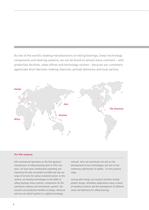
2 NSK commenced operations as the first Japanese manufacturer of rolling bearings back in 1916. Ever since, we have been continuously expanding and improving not only our product portfolio but also our range of services for various industrial sectors. In this context, we develop technologies in the fields of rolling bearings, linear systems, components for the automotive industry and mechatronic systems. Our research and production facilities in Europe, Americas and Asia are linked together in a global technology network. Here we concentrate not only on the development of new technologies, but...
Open the catalog to page 2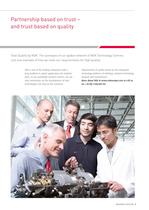
Bearing doctor 3 Total Quality by NSK: The synergies of our global network of NSK Technology Centres. Just one example of how we meet our requirements for high quality. Partnership based on trust – and trust based on quality NSK is one of the leading companies with a long tradition in patent applications for machine parts. In our worldwide research centres, we not only concentrate on the development of new technologies, but also on the continual improvement of quality based on the integrated technology platform of tribology, material technology, analysis and mechatronics. More about NSK at www.nskeurope.com...
Open the catalog to page 3
6 Introduction Generally, bearing inspection or housing inspection can identify the cause of the problem. Often the cause is attributable to poor lubrication, improper handling, selecting the wrong bearing, or not enough study of the shaft and housing. Usually the cause can be determined by considering operation of the bearing before the failure, investigating the lubrication conditions and the mounting condition, and carefully observing the damaged bearing itself. Sometimes bearings are damaged and fail both quickly and unexpectedly. Such premature failure is different from fatigue failure which...
Open the catalog to page 6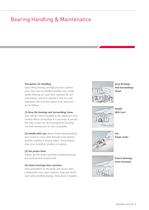
Bearing doctor 7 Bearing Handling & Maintenance Precautions for Handling Since rolling bearings are high precision machine parts, they must be handled carefully. Even if high quality bearings are used, their expected life and performance cannot be attained if they are used improperly. The main precautions to be observed are as follows: (1) Keep the bearings and surroundings clean: Dust and dirt, even if invisible to the naked eye, have harmful effects on bearings. It is necessary to prevent the entry of dust and dirt by keeping the bearings and their environment as clean as possible. (2) Handle...
Open the catalog to page 7
8 Mounting It is advisable to study the bearing mounting thoroughly since the quality of the bearing mounting influences the bearing’s running accuracy, life and performance. It is recommended that the mounting method includes the following steps. ›› Clean the bearing and surrounding parts. ›› Check the dimensions and finish conditions of related parts. ›› Follow mounting procedure. ›› Check if the bearing is mounted correctly. ›› Supply with correct kind and quantity of lubricant. Since most bearings rotate with the shaft, the bearing mounting method is generally an interference (tight) fit...
Open the catalog to page 8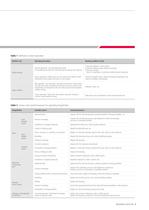
Bearing doctor 9 Machine size Operating procedure Bearing condition checks Small machine Manual operation. Turn the bearing by hand. If no problems are detected, then proceed to operate the machine. ››Stick-slip (Debris, cracks, dents) ››Uneven rotating torque (Faulty mounting) ›› Excessive torque (Error in mounting or insufficient radial internal clearance) Power operation. Initially start at a low speed and without a load. Gradually increase speed and load to reach rating. Check for irregular noise. Check for bearing temperature rise. Lubricant leakage. Discoloration. Large machine Idle operation....
Open the catalog to page 9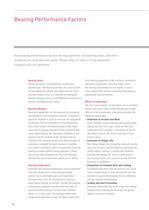
10 Bearing Performance Factors Bearing Noise During operation, sound detection instruments (stethoscope, NSK Bearing Monitor, etc.) can be used to investigate the volume and characteristics of the bearing rotation noise. It is possible to distinguish bearing damage such as small flaking by means of its unusual yet characteristic noise. Bearing Vibration Bearing irregularities can be analyzed by measuring the vibrations of an operating machine. A frequency spectrum analyser is used to measure the magnitude of vibration and the distribution of the frequencies. Test results enable the determination...
Open the catalog to page 10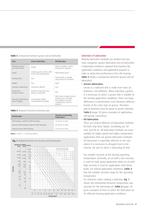
Bearing doctor 11 Selection of Lubrication Bearing lubrication methods are divided into two main categories: grease lubrication and oil lubrication. A lubrication method is adopted that matches the application conditions and application purpose in order to attain best performance from the bearing. Table 3 shows a comparison between grease and oil lubrication. ›› Grease lubrication Grease is a lubricant that is made from base oil, thickener, and additives. When selecting a grease, it is necessary to selecta grease that is suitable to the bearing application conditions. There are large differences...
Open the catalog to page 11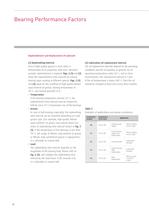
12 Bearing Performance Factors Replenishment and Replacement of Lubricant (1) Replenishing Interval Even if high-quality grease is used, there is deterioration of its properties with time; therefore, periodic replenishment is required. Figs. 2 (1) and (2) show the replenishment time intervals for various bearing types running at different speeds. Figs. 2 (1) and (2) apply for the condition of high-quality lithium soap-mineral oil grease, bearing temperature of 70° C, and normal load (P/C=0.1). ›› Temperature If the bearing temperature exceeds 70° C, the replenishment time interval must be reduced...
Open the catalog to page 12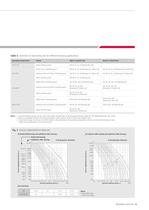
Bearing doctor 13 Operating temperature Speed Light or normal load Heavy or shock load –30 to 0°C Below limiting speed ISO VG 15, 22, 32 (Refrigerator oil) — 0 to 50°C Below 50% of limiting speed ISO VG 32, 46, 68 (Bearing oil, Turbine oil) ISO VG 46, 68, 100 (Bearing oil, Turbine oil) Between 50% and 100% of limiting speed ISO VG 15, 22, 32 (Bearing oil, Turbine oil) ISO VG 22, 32, 46 (Bearing oil, Turbine oil) Above limiting speed ISO VG 10, 15, 22 (Bearing oil) — 50 to 80°C Below 50% of limiting speed ISO VG 100, 150, 220 (Bearing oil) ISO VG 150, 220, 320 (Bearing oil) Between 50% and 100%...
Open the catalog to page 13All NSK Europe Ltd. catalogs and technical brochures
 Ball Screws - BSS Series
1 Page
 BNEQARTET Bearings
1 Page
 TF Series Bearings
1 Page
 HMS series
1 Page








Archived catalogs
 ROBOT MODULE™ MR SERIES
44 Pages
 Precision Machine Components
55 Pages
 Disc Harrow Bearings
2 Pages
 ROLLING BEARINGS
707 Pages
 TECHNICAL INSIGHT
2 Pages
 Hub unit bearings
23 Pages
 CONDITION MONITORING
6 Pages
 BEARING MOUNTING TOOLS
28 Pages
 Automotive Products
48 Pages
 NSK IN EUROPE
6 Pages
 Linear Guides Standard Items
62 Pages
 Bearings for the Steel Industry
44 Pages
 Corporate Brochure
24 Pages
 Molded Oil™- Bearings
9 Pages
 Bearing Replacement Guide
264 Pages
 Bearing Doctor
44 Pages
 Self-Lube Hand book
160 Pages
 ROLLING BEARINGS
283 Pages
 Bearings for the Cement Industry
20 Pages
 Added Value Training
12 Pages
 Authorised Distributor
7 Pages
 Bearings for Quarry and Mining
20 Pages
 Handling Instructions
48 Pages
 Double Row Ball Bearing
44 Pages
 Pocket Guide Linear Motion
44 Pages
 Deep Groove Ball Bearings
12 Pages
 Plummer Blocks
52 Pages
 Guide to RHP Self-Lube
12 Pages
 Corporate Precision Components
24 Pages
 Agri Disc Hub
1 Page
 Troubleshooting poster
1 Page
 Super Precision Bearings
120 Pages
 Asset improvement programme
6 Pages
 Bearings for Pumps & Compressors
24 Pages