
- Catalogs
- Novus Automation
- pressure transmitter np785


- Company
- Products
- Catalogs
- News & Trends
- Exhibitions
pressure transmitter np785

pressure transmitter np785
The NP785 is an ultra-low differential pressure transmitter designed for industrial environments, clean rooms, HVAC systems, filtration systems, and pressurized stairwells. It measures small over-pressure, under-pressure, and differential pressure in neutral, non-corrosive gaseous media. The device provides a pressure-proportional linear signal output with a configurable measuring range via USB using configuration software.
- Measurement Range: Configurable from -50 to 50 Pa up to -68 to 68 mbar.
- Proof Pressure: Up to 6800 Pa for lower ranges and up to 136 mbar for higher ranges.
- Burst Pressure: Ranges from 20000 Pa to 2000 mbar depending on the model.
- Accuracy: Varies from 0.5% to 1.5% of the maximum range.
- Effective Sensor Resolution: Ranges from 0.002% to 0.032% F.S.
- Operating Temperature: -20 to 70 °C for most models.
- Power Supply Voltage: 12 Vdc to 30 Vdc via PWR terminals, 4.75 Vdc to 5.25 Vdc via USB.
- Consumption: 45 mA ± 10% @ 24Vdc.
- Protection Rating: IP20.
- Dimensions: 19 x 77.9 x 72 mm.
- Housing: ABS + PC.
- EMC Compliance: EN/IEC 61326-1.
- Certification: CE.
- Bi-directional operation for measuring differential pressure from vacuum to positive pressure.
- DIN rail mountable ABS/PC enclosure with nickel-plated brass fittings for pneumatic hoses.
- Analog output options: 0-10 V or 4-20 mA.
- RS485 port with Modbus RTU communication protocol.
- Temperature compensation for long-term stability.
- Auto-zero key and diagnostic LED for ease of use.
The NP785 is suitable for a wide range of applications due to its robustness and reliability, including HVAC systems, industrial environments, and clean rooms.
Catalog excerpts
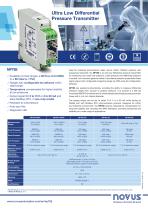
Ultra Low Differential Pressure Transmitter Ideal for industrial environments, clean rooms, HVAC, filtration systems, and pressurized stairwells, the NP785 is an ultra low differential pressure transmitter for measuring very small over-pressure, under-pressure and differential pressure in neutral, non-corrosive gaseous media. It provides a pressure proportional linear signal output with configurable measuring range via USB using the configuration software. ✓ Available nominal ranges: ± 50 Pa (± 0.2 inH2O) to ± 68 mbar (± 1 Psi) ✓ Ranges fully configurable by software within rated range ✓ Temperature compensated for higher stability at low pressures ✓ Output signal DC 0 to 10 V or 4 to 20 mA and slave Modbus RTU, in one-only-model ✓ Resistant to overpressure ✓ Auto-zero Key ✓ Diagnostic LED NP785 can operate bi-directionally, providing the ability to measure differential pressure ranges from vacuum to positive pressure. It is housed in a DIN rail mountable ABS/PC enclosure and its nickel plated brass fittings accept pneumatic hoses with 4 or 6 mm internal diameter. The analog output can be set to either 0-10 V or 4-20 mA while having an RS485 port with Modbus RTU communication protocol. Designed for HVAC and industrial environment, the NP785 ensures temperature compensation for long-term stability and complies with EMC standards, providing robustness and reliability for a wide range of applications. Measurement Range Proof Pressure* Burst Pressure Line Pressure Accuracy Effective sensor resolution Operating Temperature Power Supply Voltage PWR terminals: 12 Vdc to 30 Vdc USB cable power: 4.75 Vdc to 5.25 Vdc Internal protection against reverse polarity Dimensions Housing * Proof Pressure is defined as the maximum pressure at which the device can be subjected and which still maintains its performance within specifications after returning to the operating range. ** Maximum Range at 25°C.
Open the catalog to page 1All Novus Automation catalogs and technical brochures
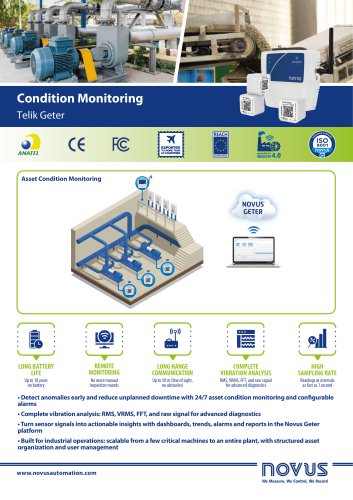 Telik Geter Vibration Sensor
2 Pages
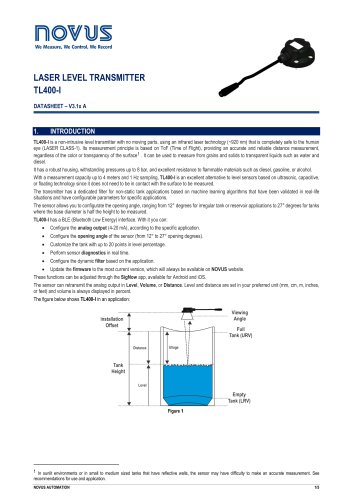 Datasheet - TL400
5 Pages
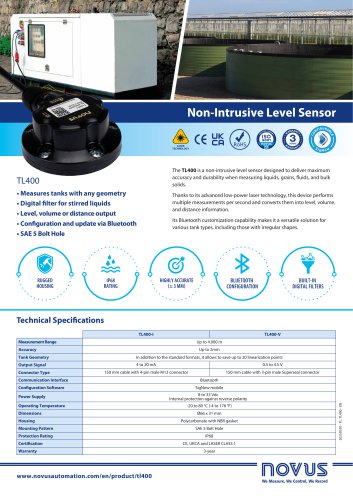 Commercial Flyer - TL400
1 Page
 NOVUS General Catalog
36 Pages
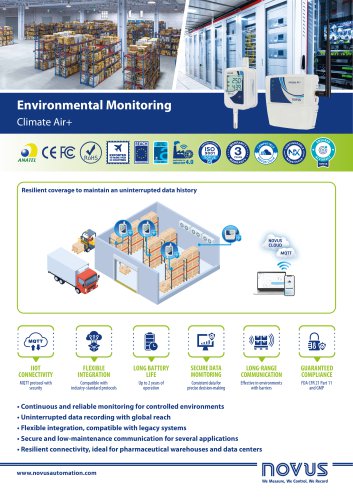 Climate Air+
2 Pages
 TxBlock-USB
2 Pages
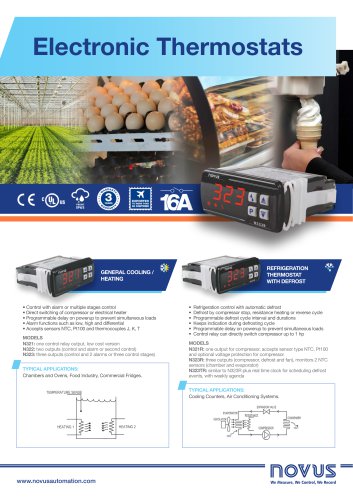 Electronic Thermostats
2 Pages
 RHT-Air
2 Pages
 NXperience Trust Flyer
2 Pages
 Novus Cloud Flyer
1 Page
 LogBox Wi-Fi Flyer
2 Pages
 LogBox LTE Flyer
2 Pages
 DigiRail IoT Flyer
2 Pages
 NP640
NP6401 Page
 N1200
N12002 Pages
 N1500
N15002 Pages
 N1030
N10302 Pages
 DigiRail OEE
2 Pages
 Temperature Transmitters
2 Pages
 FieldLogger
3 Pages
 N1540
N15402 Pages
 AirGate-4G
2 Pages
 Modular Controller Flyer
2 Pages
 LogBox Wi-Fi
2 Pages
 NP600
NP6001 Page
 Egg Incubator
2 Pages
 AirGate-Modbus NOVUS
2 Pages
 NOVUS ISO 9001
2 Pages
 Novus Reach Declaration
1 Page
 TxBlock & TxRail
2 Pages
 NOVUS Cloud
2 Pages
 PROCESS INDICATOR - N1040i
2 Pages
 Flyer TxRail-USB
1 Page
 Flyer DigiGate Profibus
2 Pages
 Flyer N323RHT
1 Page
 Flyer RHT Climate
2 Pages
 Data Logger LogBox-RHT-LCD
2 Pages
 N 480
N 4801 Page
 NT 240
1 Page
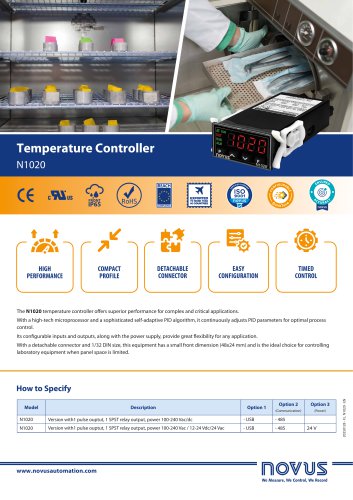


Archived catalogs
 AirGate Catalog
2 Pages
 DigiRail Signal Conditioner
2 Pages
- DC power supply
- AC/DC power supply
- Temperature probe
- Measuring device
- NOVUS data-logger
- Resistance temperature sensor
- Analysis software solution
- Digital I/O
- Windows software
- CE power supply
- Cloud-based software
- Analog pressure transmitter
- Level probe
- Temperature datalogger
- NOVUS digital temperature control
- Switching relay
- Liquid level sensor
- Single-output power supply