
- Catalogs
- Norton Abrasives
- Cylindrical wheel 2010


Cylindrical wheel 2010

Cylindrical wheel 2010
- Burn or Cracks on Workpiece: Possible causes include a wheel that is too hard, improper dressing, incorrect coolant flow, or inappropriate speeds. Suggested corrections involve using a softer wheel, adjusting speeds, and redirecting coolant flow.
- Chatter Marks: Causes may include loose spindle or work drive faults. Solutions include checking spindle assembly and using a softer grade wheel.
- Poor Quality Finish: This can result from poor dressing or misalignment. Recommendations include reducing the final depth of dress and ensuring proper alignment.
- Plunge Grinding: The wheel is thrust into the part.
- Traverse Grinding: The wheel moves across the part.
- Angular Grinding: The wheel contacts the part at an angle.
- Shapes: Type 01 Straight and Type 07 Recessed 2 Sides.
- Size Range: 16" to 30" diameter.
- Abrasive Grain: Aluminum Oxide.
- To Make a Wheel Act Softer: Increase work speed, traverse speed, and infeed; decrease wheel speed.
- To Make a Wheel Act Harder: Decrease work speed, traverse speed, and infeed; increase wheel speed.
- Norton 32A: Best for medium to heavy stock removal with sharp monocrystalline aluminum oxide grain.
- Norton 86A: Offers longer wheel life with a premium abrasive and superior bond system.
- Norton 64A: Provides versatile performance at an economical price.
Catalog excerpts

224 NORTON – THE MUSCLE BEHIND THE MACHINE CYLINDRICAL WHEELS PROBLEM POSSIBLE CAUSES SUGGESTED CORRECTION Burn or cracks on workpiece Wheel too hard Try softer wheel or make wheel act softer (see the following Tech Tip) Dress is too fine Dress faster Nozzle not directing coolant properly Redirect flow Work speed too slow or wheel speed too fast Adjust speeds Wheel feed too slow causing excess Increase feed rate contact time Chatter marks on workpiece Loose spindle, end play, bearing failure Check wheel spindle on assembly Work drive faults, out-of-truth plate Check gear action, truth, drive on pin pressure Wheel too hard, poor truing, poor mounting Use softer grade; dress wheel correctly; secure mounting Poor quality finish Poor quality dressing Reduce final depth of dress on wheel Diamond insecurely held Check and replace diamond and secure properly Misalignment of head and tail stocks Check for properly aligned workpiece Dirty coolant Clean coolant frequently; use efficient filter Scored workpiece centers Check and lap center holes as required Cylindrical wheels are used most often when the part is held between centers and in chucks. There are three methods of cylindrical grinding: plunge, traverse, and angular • Plunge grinding – wheel is thrust or plunged into the part • Traverse grinding – wheel moves across the part • Angular grinding – wheel contacts the part at an angle TYPICAL INDUSTRIES: Automotive, shipbuilding, engine building, bearing, turbine blades – land- and air-based – and toolroom SHAPE: Type 01 Straight and Type 07 Recessed 2 Sides SIZE RANGE: 16", 18", 20", 24" and 30" diameter ABRASIVE GRAIN: Aluminum Oxide CATEGORY DEFINITION STATIONARY DRESSING TOOL RECOMMENDATIONS FOR CYLINDRICAL WHEELS SINGLE POINT MULTI-POINT (GRIT) GRINDING DIAMOND TOOL TOOL TOOL WHEEL CARAT PRODUCT/PART NO. PRODUCT/PART NO. PRODUCT/PART NO. DIAMETER WEIGHT 0° ANGLE 0° ANGLE SHAPE 15° ANGLE SHAPE 16" - 20" 3/4 BC7M7 66260195007 BC62 66260195012 1/4 x 1/2 Rect. BC63 66260195013 1/4 x 1/2 Rect. NS7M7 66260195132 2A6D7 66260195046 2A6E7 66260195049 21" + 1 BC10M7 66260195009 BC61 66260195011 1/4 x 3/4 Rect. BC60 66260195010 1/4 x 3/4 Rect. NS10M7 66260195137 1A6A7 66260195031 1A6C7 66260195039 NS SINGLE POINT DIAMOND TOOLS ARE RESETTABLE. BC DIAMOND TOOLS ARE NOT RESETTABLE. ALL TOOLS SPECIFIED ABOVE HAVE 7/16" DIAMETER SHANKS. TROUBLESHOOTING GUIDE GAGE GRINDING WHEEL WORKPIECE CHUCK GRINDING WHEEL WORKPIECE CENTER DRIVE PIN HEADSTOCK DOG 60º FOOTSTOCK GRINDING WHEEL CYLINDRICAL PLUNGE GRINDING CYLINDRICAL ANGULAR APPROACH CYLINDRICAL TRAVERSE GRINDING
Open the catalog to page 1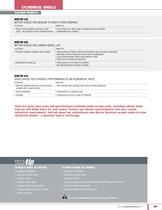
www.nortonabrasives.com 225 CYLINDRICAL WHEELS TO MAKE A WHEEL ACT SOFTER: • Increase work speed • Increase traverse speed • Increase infeed • Decrease wheel speed • Increase dresser traverse rate • Increase depth of dress per traverse • Dress more often TO MAKE A WHEEL ACT HARDER: • Decrease work speed • Decrease traverse speed • Decrease infeed • Increase wheel speed (do not exceed MAX RPM marked on wheel) • Dress at slower traverse rate • Decrease depth of dress per traverse It is the user’s responsibility to refer to and comply with ANSI B7.1 There are many more sizes and specifications available...
Open the catalog to page 2All Norton Abrasives catalogs and technical brochures
 DIY & HARDWARE
93 Pages
 THE WOOD RANGE
17 Pages
 SEAM flyer
2 Pages
 Spot Repair Done Right
4 Pages
 FULL-LINE STOCK CATALOG
364 Pages
 CNC Dressing Discs
12 Pages
 DDS Cut & Plus
8 Pages
 Norton MeshPower
2 Pages
 Norton Industrial Catalogue 2019
379 Pages
 Catalog - Sharpening Stones
15 Pages
 Catalog - Blank Wheel Stock
4 Pages
 Catalog - Bench and Pedestal
3 Pages
 Catalog - Narrow Belts
6 Pages
 Catalog - Wide Belts
3 Pages
 Flap Wheels
12 Pages
 Catalog - Flap Discs
10 Pages
 Catalog - Portable Belts
2 Pages
 Catalog - Cloth PSA Discs
3 Pages
 Catalog - Wire Brushes
4 Pages
 Catalog - Sharpening Stones
15 Pages
 Cut-of-wheel
15 Pages
 Non-Woven disc 2010
8 Pages
 Diamond and cBN 2010
40 Pages
 Abrasive specialities 2010
13 Pages


Archived catalogs
 DIY & HARDWARE 2020
109 Pages
 AUTOMOTIVE AFTERMARKET 2020
113 Pages
 PRECISION TECHNOLOGY TOOL GRINDING
161 Pages

- Metal sawing line
- Circular sawing machine
- Drilling rig
- Saw blade
- Sanding machine
- Rotary drilling rig
- Surface treatment brush
- Cut-off saw
- Washing brush
- Sanding disc
- Vertical saw
- Electric sander
- Metal brush
- Circular saw blade
- Circular brush
- Surface treatment wheel
- Cut-off disc
- Electric saw
- Cutting saw blade
- Multifunction drilling rig