
- Catalogs
- Northrop Grumman SYNOPTICS
- Neodymium: Yttrium Lithium Fluoride - Nd:YLF


Neodymium: Yttrium Lithium Fluoride - Nd:YLF

Neodymium: Yttrium Lithium Fluoride - Nd:YLF
- Dopant concentration is ± 0.2 at % of the specified amount, with a standard of 1.0 at % and up to 2.0 at % available.
- Available dopants include Nd, Er, Tm, Ho, Pr, with others upon request.
- Nd doped lasing wavelengths are 1053, 1047, and 1313 nm.
- Wavefront distortion is greater than λ / 4 per inch of rod length (λ = 632 nm).
- Extinction ratio is a minimum of 25 dB.
- Rod axis orientation is within 5˚ of the crystal “a” axis.
- Diameter tolerance is +.000” / -.002”.
- Length tolerance is +.040” / -.000”.
- Rod end polished flatness is λ / 10 @ 633 nm.
- End face parallelism is within 10 arc seconds.
- End face perpendicularity is within 5 arc minutes.
- Chamfer is 0.005” ± 0.003” @ 45˚.
- Surface quality is 10 - 5 scratch-dig per MIL-O-1 3830A.
- Rod OD is fine ground to 25 ± 5 µinches.
- Growth direction is a-axis [100].
- Crystal structure is tetragonal.
- Molecular weight is 171.8.
- Density is 3.95 g/cc.
- Moh hardness is 4 - 5.
- Melting point is 825°C.
- Refractive index at 0.633 µm: no = 1.453, ne = 1.475; at 1.05 µm: no = 1.448, ne = 1.470.
- Thermal conductivity is 0.06 watts cm-1°C-1.
- Thermal expansion is 13 x 10-6 / °C along “a” axis and 8 x 10⁻⁶ / °C along “c” axis.
- Young’s modulus is 7.5 x 10¹¹ dynes cm-2.
- Tensile strength is 3.3 x 10⁸ dynes cm-2.
- Thermal heat capacity is 0.79 J g-1K-1.
Catalog excerpts

Neodymium: Yttrium Lithium Fluoride - Nd:YLF SYNOPTICS currently manufactures Nd:YLF as a standard product and produces YLF doped with other rare earths as required. YLF offers an alternative to the more common YAG host for near IR operation. YLF is grown utilizing a modified Czochralski technique. The as-grown crystals are then processed into laser rods or slabs, coated in house, and inspected per customer specifications. Advantages Of YLF Include: High power, low beam divergence, efficient single mode operation. High average power Q-switched at a moderate repetition rate. Linear polarized resonators for Q-switching and frequency doubling. Potential uniform mode for large diameter rods or slabs. Stimulated emission cross section and lifetime product is favorable for low CW threshold. 1.053 µm output matches gain curves of Nd:Glass and performs well as an oscillator and pre-amplifier for this host. The combination of weak thermal lensing, large fluorescence line width and naturally polarized oscillation makes Nd:YLF an excellent material for CW, modelocked operation.
Open the catalog to page 1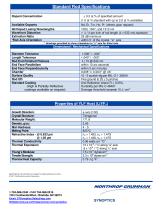
Standard Rod Specifications Dopant Concentration ± 0.2 at % of specified amount (1.0 at % standard with up to 2.0 at % available) Available Dopants Nd, Er, Tm, Ho, Pr (others upon request) Nd Doped Lasing Wavelengths Wavefront Distortion Extinction Ratio *Rod Axis Orientation 1053, 1047, and 1313 nm > λ / 4 per inch of rod length (λ = 632 nm) standard 25 dB minimum within 5˚ of the crystal “a” axis * drawings provided to show orientation to “c” axis for tilted rods Dimensional / Mechanical Specifications Diameter Tolerance Length Tolerance Rod End Polished Flatness End Face Parallelism End Face...
Open the catalog to page 2All Northrop Grumman SYNOPTICS catalogs and technical brochures
 Air Spaced Polarizer
2 Pages
 Ruby ? Cr3+: Al2O3
2 Pages
 Alexandrite
2 Pages
 Contract Crystal Growth
1 Page
 Chandra X-Ray Observatory
2 Pages
 Advanced EHF Payloads (AEHF)
2 Pages
 Fire Scout Navy Brochure
6 Pages
 MQ-8B Fire Scout
6 Pages
 B-2 Spirit Bomber
2 Pages
 X-47B UCAS
2 Pages
 E-8C
E-8C2 Pages
 E-2D Advanced Hawkeye
6 Pages
 E-2C Hawkeye 2000
6 Pages


