
- Catalogs
- Northrop Grumman SYNOPTICS
- James Webb Space Telescope (JWST)


James Webb Space Telescope (JWST)

James Webb Space Telescope (JWST)
The James Webb Space Telescope (JWST) is designed to explore cosmic history by observing the formation of stars and galaxies. Scheduled for launch in 2014, it aims to capture images and spectra of galaxies formed billions of years ago using infrared instruments. The telescope will also study planetary systems, analyze the atmospheres of extrasolar planets, and image Jupiter-sized planets around nearby stars. Identified as a top priority by the National Research Council, JWST is crucial for NASA and the scientific community in addressing questions about our origins and the possibility of life elsewhere.
To observe distant objects, the JWST features a 6.5-meter diameter primary mirror made of 18 hexagonal segments, allowing it to collect light from faint objects. The telescope's optics and detectors operate at extremely low temperatures, around 45 Kelvin, to detect infrared wavelengths. A five-layer sunshield, the size of a tennis court, will protect the telescope from sunlight, enabling it to detect starlight from newly forming stars and planets. The primary mirror is designed to fold for launch and unfold in space, marking it as the first segmented optical system deployed in space.
- Primary mirror: 6.5-meter diameter aperture
- Wavelength coverage: 0.6 to >27 microns
- Diffraction limit: 2.0 microns
- One-year sky coverage: 100%
- Orbit: L2 (Second Sun-Earth Lagrange Point), 1,500,000 km from Earth
- Mission lifetime: 5 years (10-year goal)
- Telescope operating temperature: ~45 Kelvin (-380˚F)
- Mass: Approximately 6,500 kg
Catalog excerpts
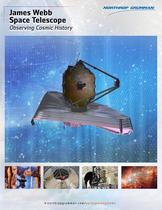
James Webb Space Telescope Observing Cosmic History
Open the catalog to page 1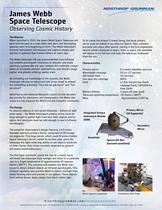
©2010 Northrop Grumman Corp. • All Rights Reserved • Printed in USA • Aerospace Systems Marketing Communications • 09-2452 • 500 • SL • 3/10 James Webb Space Telescope Observing Cosmic History The Mission When launched in 2014, the James Webb Space Telescope will peer into the past to a time when new stars and developing galaxies were first beginning to form. The Webb telescope’s infrared instruments will measure and capture images and spectra of galaxies that formed billions of years ago. The Webb telescope will use unprecedented near-infrared instruments and angular resolution to discover and...
Open the catalog to page 2All Northrop Grumman SYNOPTICS catalogs and technical brochures
 Air Spaced Polarizer
2 Pages
 Ruby ? Cr3+: Al2O3
2 Pages
 Alexandrite
2 Pages
 Contract Crystal Growth
1 Page
 Chandra X-Ray Observatory
2 Pages
 Advanced EHF Payloads (AEHF)
2 Pages
 Fire Scout Navy Brochure
6 Pages
 MQ-8B Fire Scout
6 Pages
 B-2 Spirit Bomber
2 Pages
 X-47B UCAS
2 Pages
 E-8C
E-8C2 Pages
 E-2D Advanced Hawkeye
6 Pages
 E-2C Hawkeye 2000
6 Pages


