
- Catalogs
- Northrop Grumman SYNOPTICS
- Earth Observing System - Aura


Earth Observing System - Aura

Earth Observing System - Aura
Catalog excerpts
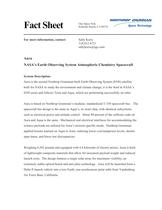
Fact Sheet One Space Park Redondo Beach, CA 90278 For more information, contact: Sally Koris 310.812.4721 [email protected] Aura NASA’s Earth Observing System Atmospheric Chemistry Spacecraft System Description: Aura is the second Northrop Grumman-built Earth Observing System (EOS) satellite built for NASA to study the environment and climate change; it is the third in NASA’s EOS series and follows Terra and Aqua, which are performing successfully on orbit. Aura is based on Northrop Grumman’s modular, standardized T-330 spacecraft bus. The spacecraft bus design is the same as Aqua’s, its sister ship, with identical subsystems such as electrical power and attitude control. About 80 percent of the software code on Aura and Aqua is the same. Mechanical and electrical interfaces for accommodating the science payloads are tailored for Aura’s mission specific needs. Northrop Grumman applied lessons learned on Aqua to Aura, realizing lower cost/manpower levels, shorter span times, and fewer test discrepancies. Weighing 6,542 pounds and equipped with 4.4 kilowatts of electric power, Aura is built of lightweight composite materials that allow for increased payload weight and reduced launch costs. The design features a single solar array for maximum visibility, an extremely stable optical bench and anti-jitter technology. Aura will be launched from a Delta II launch vehicle into a low-Earth, sun-synchronous polar orbit from Vandenberg Air Force Base, California.
Open the catalog to page 1
Designed to study the Earth’s ozone, air quality and climate, Aura will conduct research exclusively on the composition, chemistry and dynamics of the Earth’s upper and lower atmosphere with four science instruments. The satellite’s orbit will allow measurements to be taken at all latitudes; instruments will make continuous scans at altitudes ranging from the stratosphere down through the troposphere. Aura’s instruments include the Microwave Limb Sounder, built by NASA’s Jet Propulsion Laboratory; the Tropospheric Emission Spectrometer, also built by the Jet Propulsion Laboratory; High Resolution...
Open the catalog to page 2
Three of Aura’s four instruments will scan the horizon, providing data on the vertical distribution of gases. This data will is important because a gas such as ozone can protect or harm life on Earth, depending on where it resides in the atmosphere. High in the atmosphere, ozone acts as a shield to protect Earth’s surface from the sun’s harmful ultraviolet radiation. Closer to Earth, in the air we breathe, ozone is a harmful pollutant that causes damage to lung tissue and plants. Aura will also have the ability to probe the Earth's upper troposphere, which is the region of the atmosphere just...
Open the catalog to page 3
There will also be an ambitious validation program for Aura’s data, which will employ ground, balloon, aircraft and other satellite data. Data from Aura’s instrument will be compared to or correlated with measurements from other instruments whose performance is well known. ###
Open the catalog to page 4All Northrop Grumman SYNOPTICS catalogs and technical brochures
 Air Spaced Polarizer
2 Pages
 Ruby ? Cr3+: Al2O3
2 Pages
 Alexandrite
2 Pages
 Contract Crystal Growth
1 Page
 Chandra X-Ray Observatory
2 Pages
 Advanced EHF Payloads (AEHF)
2 Pages
 Fire Scout Navy Brochure
6 Pages
 MQ-8B Fire Scout
6 Pages
 B-2 Spirit Bomber
2 Pages
 X-47B UCAS
2 Pages
 E-8C
E-8C2 Pages
 E-2D Advanced Hawkeye
6 Pages
 E-2C Hawkeye 2000
6 Pages


