
- Catalogs
- Norsonic AS
- Nor1209

Nor1209

Nor1209
The Nor1209 microphone preamplifier is designed for use with sound level meters, general purposes, and laboratory and field measurements. It is compatible with most ½” condenser microphones of type WS2 or LS2 as per IEC 61094-4 standards.
Features
Key features include low noise, high input impedance, wide dynamic and frequency ranges, low output impedance, a system check facility, a large supply voltage range, and a detachable preamplifier cable.
Specifications
- Frequency response: 20 Hz to 20 kHz with ±0.1 dB accuracy.
- Gain: Typically -0.1 dB.
- Input impedance: 10 GΩ, 1.4 pF.
- Output impedance: 50 ohms typical.
- Noise: A-weighted < 2.2μV, Lin <6 μV.
- Power supply: Single 28 V to 120 V, Dual ±14 V to ±60 V.
- Maximum signal output voltage: ±10 to ±50 V.
- Operating temperature: -25°C to +70°C.
- Relative humidity: 0 – 90%.
- Dimensions: Length 83 mm, Diameter 12.7 mm (body), 18 mm (ring).
- Weight: 36 g.
System Check Facility
The preamplifier includes a system check facility that allows testing of the microphone's capacitance and the entire signal chain.
Cables
Long cables may limit the slew-rate of the output signal, affecting the upper frequency response for signals with large voltage swings. A table provides maximum frequency for linear operation based on cable length and level.
Noise Considerations
The document includes a frequency spectrum graph of the inherent noise of the preamplifier in one-third octave bands, showing A- and Z-weighted levels.
Additional Information
The preamplifier can be mounted directly on a sound level meter like Nor140 or connected via a suitable cable. It supports both pre-polarized and externally polarized microphones up to 200 V.
Catalog excerpts

Product Data 1/2” Microphone Preamplifier Nor1209 Applications • Sound level meters • General purpose • Laboratory and eld measurements Low noise High input impedance Wide dynamic range Wide frequency range Low output impedance System Check facility Large supply voltage range Detachable preamplier cable The microphone preamplifier Nor1209 has been designed for general use with most ½” condenser microphone of type WS2 or LS2 according to IEC 61094-4: Measurement microphones - Part 4: Specifications for working standard microphones. The microphones may be pre-polarized or use externally supplied polarization voltage up to 200 V. By the use of adaptors, the preamplifier may be used for other microphone sizes. The frequency response covers the range from below 1 Hz to above 200 kHz. The Nor1209 preamplifier may be mounted directly on a sound level meter like Nor140, or may be connected to the instrument by a suitable cable. The preamplifier is equipped with the system check facility. By supplying a test signal voltage on one of the terminals, the capacitance of the microphone as well as the complete signal chain from the microphone cartridge to the indication of by the sound level meter may be checked. The voltage gain of the preamplifier is very close to one or correspondingly 0 dB. As the input impedance is 10 GΩ, the attenuation due to loading of the source will mainly be determined by the low input capacitance.
Open the catalog to page 1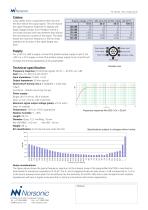
Cables Long cables have a capacitance that may limit the slew-rate of the output signal. This will reduce the upper frequency response for signals with large voltage swings. Such limitation will be a non-linear process and may therefore also disturb the low-frequency content of the signal. The table shows the maximum frequency in kHz for linear operation as function of the cable length and level. For +120 V or ±60 V supply, connect the positive power supply to pin 6. For +28 V or ±15 V supply, connect the positive power supply to pin 5 as this will 3 Polarization voltage 7 Power supply - increase...
Open the catalog to page 2All Norsonic AS catalogs and technical brochures
 Product Range Catalogue
36 Pages
 Nor1216 /Nor1217
4 Pages
 Nor1210A and Nor1210C
2 Pages
 Nor1207 and Nor1207/BNC
2 Pages
 Microphone Preamplifier
2 Pages
 Microphone Cartridges
2 Pages
 Nor1292
2 Pages
 Nor1530 Compact NMT
4 Pages
 Nor277 Tapping machine
2 Pages
 Acoustic Camera
8 Pages
 Measuring Noise
2 Pages
 Nor131 & Nor132
8 Pages
 Nor 121
12 Pages
 Nor 140
20 Pages
 noise at work Nor 130
2 Pages
 Nor 130
8 Pages
 Noise excitation for BA
8 Pages
 Sound Calibrators
4 Pages
 Microphone Cartridges
2 Pages
 Nor850 Product Data English
8 Pages
 Product Range Catalogue 2011
52 Pages


- Visible imager
- Analysis software solution
- Full-color camera system
- Monitoring camera system
- Calibration system
- Acceleration sensor
- Piezoelectric accelerometer
- Single-axis accelerometer
- Triaxial acceleration sensor
- CCD video camera
- Digital sound level meter
- Acoustic camera
- Geophone
- Integrating sound level meter
- Basic sound level meter
- Acoustic calibrator
- Data logging sound level meter
- Class 1 sound level meter