
- Catalogs
- norelem - Éléments standard mécaniques
- Drive technology


- Company
- Products
- Catalogs
- News & Trends
- Exhibitions
Drive technology

Drive technology
The document outlines specifications for toothed belts made from abrasion-resistant polyurethane with high-tensile steel reinforcement. These belts are designed for smooth, synchronous power transmission, are maintenance-free, and cost-efficient.
Proper installation requires parallel axle alignment and precise pulley alignment using a straight edge or laser. The use of large toothed pulleys, with at least one having rim flanges, is recommended. Pre-planning for mounting and setting correct belt tension is essential.
Correct alignment and tensioning are crucial for longevity and low-noise operation. Idlers should be used on drives with fixed center distances to set belt tension accurately.
Belts should not be bent and must be stored away from direct sunlight and chemicals.
Performance tables for belt profiles (T5, T10, AT5, AT10) include power, torque, and speed parameters.
Key data for drive calculation include drive output, speed, motor starting torque, center distance, and maximum permissible pulley diameter. Safety factors and formulas for speed ratio, belt width, and permissible tension are provided.
Selection diagrams assist in pre-selecting belt profiles. The document recommends selecting the largest permissible pulley and provides a calculation example for belt length and width.
Pulleys are made of aluminum with steel rim flanges, conforming to DIN 7721 T2 standards. Various order numbers and dimensions for different belt widths and profiles are listed.
The document provides specifications and ordering information for toothed belts (T10, T5, AT5, AT10) made from polyurethane with steel cord reinforcement, suitable for precise power transmission.
Order numbers for belts of different widths and lengths are categorized by profile type, including the number of teeth and effective length.
Belts are made from polyurethane with steel cord reinforcement, offering high strength and minimal extension, suitable for small diameter pulleys.
Belts are maintenance-free, provide high-power transmission, and are resistant to chemicals, oils, greases, and fuels, operating from -30°C to +90°C.
Intended for linear drives, low-power transmission, and transport applications requiring precision and safety, especially in chemically resistant environments.
Sample order numbers are provided, with options for custom lengths up to 100 meters.
Formulas for calculating transmissible longitudinal force are included, noting that welded belts have reduced power transmission by about 50%.
Specifications for toothed belts and V-belt pulleys include order numbers, belt widths, and effective lengths. Toothed belts are made from CR material, Glascord, and polyamide, while V-belt pulleys are made from grey cast iron.
Sample orders for toothed belts and V-belt pulleys indicate the format for ordering specific sizes and types.
Toothed belts conform to ISO 13050, and V-belt pulleys are based on DIN 2211 or DIN 2217 standards.
Benefits include reduced noise, robustness, versatility, and chemical resistance. Taper clamping bushes should be ordered separately for V-belt pulleys.
Toothed belts operate from -20°C to +100°C, with a maximum speed of 50 m/s, transmitting power up to 99.1 kW. V-belt pulleys have a maximum speed of 35 m/s.
Tables list order numbers, belt widths, lengths, and dimensions for selecting appropriate products.
Specifications for V-belts according to DIN 2215 standards include order numbers, belt types, dimensions, and lengths.
Order numbers, belt width, and lengths (external, internal, effective) are provided for each belt type.
Details for belt types 10/Z, 13/A, and 17/B, including belt width and external lengths.
Comprehensive range of V-belts for various industrial needs, with specific dimensions ensuring precise application.
V-belts according to DIN 2215 and DIN 7753 standards are made from neoprene with polyester tensile cords, electrically conductive as per ISO 1813.
V-belts are endless, comply with DIN 7753 standards, and have limited oil resistance.
Operational temperature range is -55°C to +70°C, with limited oil resistance.
Belts require tensioning after installation and re-tensioning after initial run time. Entire sets should be replaced if one belt needs replacement.
Various V-belt models with specific dimensions are listed under types SPZ and SPA.
Proper tensioning and avoiding prolonged exposure to high temperatures and oils are crucial for longevity.
Specifications and technical data for V-belts, belt tension meters, line lasers, and tension pulleys are provided, along with roller chains maintenance guidelines.
Multiple V-belt models under types SPA and SPB conform to DIN 7753 standards.
Designed for pre-tension testing using frequency measurement, with precautions for safe use.
Used for aligning drive pulleys, with safety precautions for laser use.
Ready-to-install tension pulleys with ball bearings, maintenance-free.
Guidelines for chain selection, lubrication, and maintenance are provided.
Proper lubrication is crucial, with recommendations based on operating conditions.
Specifications for roller chains and sprockets according to DIN ISO 606 standards are provided.
Chains are packaged in 5-meter units, with connecting links ordered separately.
Chains conform to DIN ISO 606, with sprockets ready to install.
Mount spring clips with the closed end pointing in the direction of travel.
Tables provide measurements for chain types, including pitch and break force.
Sprockets are made from low-carbon steel, designed for use with DIN ISO 606 roller chains.
Specifications include pitch and dimensions for various order numbers.
Detailed specifications for various triplex sprockets are provided.
Tables with order numbers and dimensions are crucial for selecting appropriate sprockets.
Specifications for C profiles used for system substructure fastening are provided.
Specifications for steel spur gears with milled toothing and straight teeth are provided.
Spur gears made from Steel 1.0503 (C45) and plastic materials are detailed.
Various spur gear models categorized by module sizes are listed.
Steel gears are available with up to 48 teeth with a hub, and plastic gears are noted for their high hardness and low friction.
Torque specifications for plastic gears are provided, with considerations for overlap in gear design.
Plastic gears have a temperature range of -40°C to +140°C.
Polyacetal and Polyketone materials are highlighted for gear wheels, with zinc used for bevel gears.
Gear wheels are injection-moulded with straight teeth, and bevel gears require a mating gear for a complete set.
Operational temperature ranges for materials are provided, with torque specifications related to toothing.
Polyacetal is recommended for standard applications, while Polyketone is suited for high wear resistance.
Sample orders for various gear types are provided.
Specifications for gear racks and bevel gears made of steel 1.0503 (C45) are provided.
Installation procedures for worm gears are outlined.
Tolerances for gear dimensions and lubrication recommendations are specified.
Technical information for worm gears, including efficiency and self-locking characteristics, is provided.
Tables list order numbers, transmission ratios, and dimensions for various gear configurations.
Specifications and ordering information for worm gears, including worm screws and wheels, are provided.
Worm screws are made of steel and case-hardened, with worm wheels made from CuZn37Mn3Al2PbSi-S40.
Worm wheels and screws must have the same center distance and transmission ratio.
Permissible output torques for different transmission ratios and lubrication types are specified.
Tables list order numbers, transmission ratios, and dimensions for worm gear configurations.
Worm gears are designed for applications requiring large speed reductions.
Specifications and ordering information for right-hand worm gears with varying center distances are provided.
Worm gears are available with specific center distances and materials.
Various transmission ratios and corresponding output torques are listed.
Sample order numbers for each configuration are provided.
Worm gears feature a flank shape K with an engagement angle of 15°.
Permissible output torques are highlighted, with suitability for continuous operation.
Specifications for worm gears, bevel gears, and planetary gearing systems are provided.
Sample orders and assembly notes are provided for each gear type.
Technical data such as transmission ratios and output torques are included.
Gears are designed for various applications, with features like smooth power transmission and maintenance-free operation.
Critical parameters such as radial and axial forces, torsional backlash, and efficiency percentages are outlined.
Catalog excerpts

Drive technology
Open the catalog to page 1
Technical Information for toothed belts 22052, 22054, 22057 and 22059 General Our toothed belts are made of abrasion-resistant polyurethane and reinforced with hightensile steel cording. They allow for a smooth and synchronous transmission of power. They are maintenance-free and extremely cost-efficient. Drive installation Diagrams and performance tables are available on these pages for selecting the size. The axles must be parallel to one another. It is possible to align the toothed pulleys very precisely using a straight edge or laser. Use the largest possible toothed pulleys. Make sure that...
Open the catalog to page 2
Technical information for toothed belts 22052 and 22057 12 for calculating max. permissible engaging teeth Nr. of teeth of small gear wheel Belt width [cm] Centre distance [mm] Power [kW] Torque [Nm] Specific power Specific torque Engaging teeth of small gear wheel Specific tooth force Output “P” and torque “M” to be transferred via the belt are calculated using the following formulas: P spez M spez [ Ncm/cm ] [ W/cm ] M spez P spez [ Ncm/cm ] [ W/cm ] M spez P spez [ Ncm/cm ] [ W/cm ] M spez P spez [ Ncm/cm ] [ W/cm ] M spez P spez [ Ncm/cm ] [ W/cm ] M spez P spez [ Ncm/cm ] [ W/cm ] M spez...
Open the catalog to page 3
Technical information for toothed belts 22052 and 22057 b Belt width Belt length Number of belt teeth Centre distance Effective centre distance Outer diameter Outer diameter of small pulley Pulley width Effective diameter of small pulley Effective diameter of large pulley Effective diameter Outer diameter of large pulley Pre-tensioning force per belt Maximum permissible belt tension Peripheral force Acceleration time Deceleration time Speed / peripheral speed Number of teeth in mesh Number of teeth on small pulley Number of teeth on large pulley Static shaft power Drive pulley speed Angular speed...
Open the catalog to page 4
Technical information for toothed belts 22052 and 22057 Calculating the number of teeth in mesh For speed step-up ratios a c2 acceleration factor must be anticipated: i = from 0.66 to 1.0 c2 = 1.1 i = from 0.40 to 0.66 c2 = 1.2 i < 0.40 c2 = 1.3 The overall service factor is: c0 = c1 x c2 Belt and washer selection Use the selection diagram for belt pre-selection. Selecting the largest permissible pulley is recommended. Calculating speed ratio i n1 with ˆ [°] = wrap angle t ˘ (z g - zk ) ˆ = 2 ˘ arccos ˘ 2˘ ˘A Determining the belt width b = Checking the permissible belt tension The permissible...
Open the catalog to page 5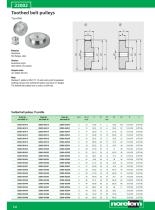
22002 Toothed belt pulleys T profile A Material: Aluminium. Rim flanges, steel. Version: Aluminium bright. Steel electro zinc-plated. Sample order: nlm 22002-051010 Note: Standard T-profile to DIN 7721 T2 with metric pitch (trapezoidal toothing). At least one toothed belt pulley must have rim flanges. The toothed belt pulleys have a centre or pilot hole. Toothed belt pulleys, T5 profile Order No. belt width 10 Order No. belt width 16 Order No. belt width 25
Open the catalog to page 6
22002 Toothed belt pulleys Toothed belt pulleys, T10 profile Order No. Form belt width 32 - Order No. Order No. belt width 16 belt width 25
Open the catalog to page 7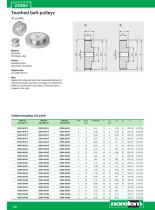
22003 Toothed belt pulleys AT profile A Material: Aluminium. Rim flanges, steel. Version: Aluminium bright. Steel electro zinc-plated. Sample order: nlm 22003-051012 Note: Standard AT profile with metric pitch (trapezoidal toothing). At least one belt pulley must have a rim flange. The toothed belt pulleys are centre bored or pre-drilled. The pulleys may be recessed on the sides. Toothed belt pulleys, AT5 profile Order No. belt width 10 Order No. belt width 16 Order No. belt width 25
Open the catalog to page 8
22003 Toothed belt pulleys Toothed belt pulleys, AT10 profile Order No. Order No. belt width 16 belt width 25 Order No. Form belt width 32
Open the catalog to page 9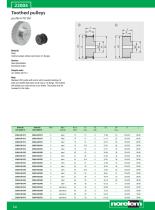
22004 Toothed pulleys profile HTD 5M G Material: Steel. Toothed pulleys without aluminium rim flanges. Version: Steel phosphated. Aluminium bright. Sample order: nlm 22004-051512 Note: Standard HTD profile with metric pitch (rounded toothing). At least one toothed belt pulley must have a rim flange. The toothed belt pulleys are centre bored or pre-drilled. The pulleys may be recessed on the sides. Order No. belt width 15 Order No. belt width 25 Main material
Open the catalog to page 10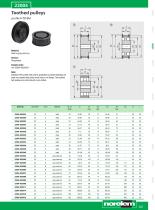
22004 Toothed pulleys profile HTD 8M Material: Steel or grey cast iron. Version: Phosphated Note: Standard HTD profile with metric graduation (rounded toothing). At least one toothed belt pulley must have a rim flange. The toothed belt pulleys are centre bored or pre-drilled. belt width grey cast iron grey cast iron grey cast iron grey cast iron grey cast iron grey cast iron grey cast iron grey cast iron grey cast iron grey cast iron grey cast iron grey cast iron grey cast iron
Open the catalog to page 11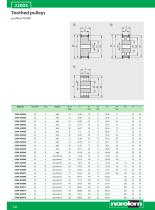
22004 Toothed pulleys profile HTD 8M B belt width grey cast iron grey cast iron grey cast iron grey cast iron grey cast iron grey cast iron grey cast iron grey cast iron grey cast iron grey cast iron grey cast iron grey cast iron grey cast iron
Open the catalog to page 12
22004 Toothed pulleys profile HTD 8M I belt width grey cast iron grey cast iron grey cast iron grey cast iron grey cast iron grey cast iron grey cast iron grey cast iron grey cast iron grey cast iron grey cast iron grey cast iron grey cast iron
Open the catalog to page 13
22005 Toothed pulleys profile HTD 5M, for assembly with taper clamping bushes L Material: Steel or grey cast iron. Version: Phosphated Note: Standard HTD profile with metric pitch (rounded toothing). At least one toothed belt pulley must have a rim flange. Conical hole for taper clamping bushes. The taper clamping bushes must be ordered separately and are available for various shaft diameters. Pulleys with a taper hole are statically balanced as per ISO 1940 grade G16. Accessories: Taper clamping bushes 23200. belt width Main material grey cast iron grey cast iron grey cast iron grey cast iron...
Open the catalog to page 14
22005 Toothed pulleys profile HTD 8M, for assembly with taper clamping bushes B Material: Cast Iron. Note: Standard HTD profile with metric pitch (rounded toothing). At least one toothed belt pulley must have a rim flange. Conical hole for taper clamping bushes. The taper clamping bushes must be ordered separately and are available for various shaft diameters. Pulleys with a taper hole are statically balanced as per ISO 1940 grade G16. Version: Phosphated Accessories: Taper clamping bushes 23200.
Open the catalog to page 15All Norelem - Éléments standard mécaniques catalogs and technical brochures
 Assembly system
72 Pages
 Pneumatic cylinder
9 Pages
 Tube connectors - Tube columns
59 Pages
 Concentricity elements
10 Pages
 Connectors Energy chains
18 Pages
 Power supply units
3 Pages
 Sensor technology
4 Pages
 Motors - Lifting columns
11 Pages
 Material handling and transport
45 Pages
 technoshop
38 Pages
 BROCHURE TELESCOPIC SLIDES 2021
88 Pages
 PRODUCT OVERVIEW EDITION 2022
43 Pages
 THE BIG GREEN BOOK edition 2022 vol.2
1336 Pages
 THE BIG GREEN BOOK edition 2022 vol.1
1380 Pages
 Guide rails norelem
20 Pages
 ALUMINIUM PROFILES
104 Pages






Archived catalogs
 01148 Subplates
1 Page
 01250
012502 Pages
 THE BIG GREEN BOOK 2018
1767 Pages
 THE BIG GREEN BOOK edition 2019
1986 Pages
 Norelem Edition 2019
1986 Pages
 BGB
BGB1456 Pages
 BIG GREEN BOOK 2017
1590 Pages
 01060 Steel base plates
1 Page
 01148 Pallets
1 Page
 01127 Base plates
1 Page
 BIG GREEN BOOK
1 Page


