
- Catalogs
- Nordson Adhesive Dispensing
- ProBlue® ATS Melters


ProBlue® ATS Melters

ProBlue® ATS Melters
- Quick installation with compact design and patented manifold for flexible hose routing.
- Quick-disconnect power and I/O plugs, and a quick-release base for simplified setup.
- Modular design allows for easy addition or removal of hoses and guns.
- Disposable filter to prevent debris and contaminants.
- Integrated precision gear flow meter for direct adhesive volume measurement.
- Automatic pressure discharge valve for enhanced operator safety.
- Real-time monitoring and control via optional Ethernet IP & Fieldbus, with historical data download via USB.
- Non-circulating tank system with a maximum pump rate of 32.7 kg/hr.
- Temperature range from 40 to 204ºC with control stability of ±0.5ºC.
- Flow meter range from 0.5 cc to 500 cc/min, suitable for viscosities between 600 to 10,000 cps.
- Electrical service options include 200 to 240 VAC and 400/230 VAC, with optional transformer for 400 or 480 VAC.
- Holding capacities of 3.9 kg, 6.8 kg, and 9.7 kg for the 4, 7, and 10-liter models respectively.
- Maximum system power capacity varies with the number of hoses/guns, up to 8200 watts for the 10-liter model.
Catalog excerpts
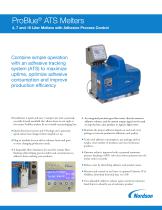
Combine simple operation with an adhesive tracking system (ATS) to maximize uptime, optimize adhesive consumption and improve production efficiency ■ Installation is quick and easy. Compact size and a patented, centrally located manifold that allows hoses to run right or left means ProBlue melters fit on virtually any packaging line. ■Quick-disconnect power and I/O plugs and a patented, quick-release base design further simplify set up. ■ Plug-in modules let you add or subtract hoses and guns to meet changing production needs. ■ A disposable filter eliminates the need for routine filter flushing while helping prevent debris and contaminants in adhesive from reaching your products. ■ An integrated precision gear flow meter directly measures adhesive volume, and the system output signal can be used to stop the line, eject product or signal a light tower. ■ Maintain the proper adhesive deposit on each and every package to increase production efficiency and quality. ■Track total adhesive consumption, per package add-on weight, total number of products and out-of-tolerance products. ■ Operator safety is improved with a patented automatic pressure discharge (APD) valve that relieves pressure into the melter tank in seconds. ■ Reduce costs by identifying adhesive and product waste. ■Monitor and control in real time via optional Ethernet IP & Fieldbus; download historical data via USB ■User adjustable adhesive volume upper and lower tolerance band limits to identify out-of-tolerance product
Open the catalog to page 1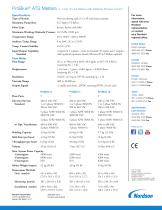
4, 7 and 10 Liter Melters with Adhesive Process Control ProBlue® ATS Melters Specifications Type of System Non-circulating tank (15:1 SP-style piston pump) Maximum Pump Rate 32.7 kg/hr (72 lb/hr) Filter Type Saturn® basket-style filter Maximum Working Hydraulic Pressure 10.3 MPa (1500 psi) 40 to 204°C (100 to 400°F) 0 to 50°C (32 to 122°F) ±0.5°C (1°F) 4 inputs & 3 outputs - come as standard; 10 inputs and 7 outputs with optional expansion board; Ethernet IP & Fieldbus optional 0.5 cc to 500 cc/min (0.03—29.9 kg/hr or 0.07—65.9 lb/hr) (assuming SG = 1.0) 1.0 cc/rev = 1 g/rev = 0.001...
Open the catalog to page 2All Nordson Adhesive Dispensing catalogs and technical brochures
 Automated Dispensing Systems
15 Pages
 VersaBlue® XC / XN Series
2 Pages
 Unity™ Pro Series
2 Pages
 Series AD-41
2 Pages
 Walcom™ LV 227 Pneumatic Gun
2 Pages
 e.dot+™ Electric Guns
2 Pages
 EP11 Sériés Slot Guns
2 Pages
 VersaDrum™
2 Pages
 Its-a-wrap
4 Pages
 Saturn® In-Line Filter
2 Pages
 DuraBraid™ Hoses
2 Pages
 ProBlue Liberty™ ATS
2 Pages
 AltaSpray Plus Applicators
2 Pages
 AltaSlot Applicators
2 Pages
 Series AD-31 Handgun
2 Pages
 Saturn Solenoind Valves
2 Pages
 Process Air Control Kit
2 Pages
 Adhesive Storage Containers
2 Pages
 DuraPail ® Bulk Melters
2 Pages
 LA 825 RC
2 Pages
 H-20
H-202 Pages
 TRIO
TRIO2 Pages
 DWP series
2 Pages
 Saturn® Solenoid Valves
2 Pages
 Vantage English
2 Pages
 Prodigy English
4 Pages
 Nordson Filter Solutions
4 Pages
 Liquid Catalogue 2014 EN
16 Pages
 EFD- Product-Catalog
112 Pages
 Nozzle Catalog
202 Pages
 LA 310 Piston Pump Systems
2 Pages
 LA 300 Piston Pumps
2 Pages
 8-Hose/Gun Expansion Base
2 Pages
 Nitrogen Generation System
2 Pages
 DuraDrum ® Bulk Melters
2 Pages
 DuraBlue ® Adhesive Melters
2 Pages
 DuraBlue L Series
2 Pages
 AltaBlue TT adhesive melter
2 Pages
 AltaBlue TT adhesive melter
2 Pages
 Altablue touch series melter
2 Pages
 EEX Extruder System
2 Pages
 Rhino VE Bulk Unloader
2 Pages
 Pro-Meter R Series Meter
2 Pages
 Pro-Meter S Series Meter
2 Pages
 SureMix 2K Dispensing System
2 Pages
 Pro-Meter G Series Meter
2 Pages
 Nordson Oscillator
2 Pages
 Controlled Pressure CP Gun
2 Pages
 Constant Pressure (CP) Pump
2 Pages
 Rhino Bulk Unloader
2 Pages
 Pro-Flo Dispensing Module
2 Pages
 SLL9042
2 Pages
 SLL9023
2 Pages
 SLL9028
2 Pages
 CNL1228
2 Pages
 CNL1837
2 Pages
 pk961098
2 Pages
 pk971297
2 Pages
 GKL0058
2 Pages
 GKL1142
2 Pages
 VTL1730
2 Pages
 VTL171
2 Pages
 VTL110
2 Pages
 JML1528
2 Pages
 ASL2085
2 Pages
 ASL2086
2 Pages
 ELL1193a
2 Pages
 UVL1818
2 Pages
 NWL-11-5716
2 Pages
 UM22 Module
2 Pages
 SureWrap® Nozzles
2 Pages
 NWL-11-5715
2 Pages


Archived catalogs
 AltaSpray™ Applicators
2 Pages
 Nordson - Gun System
6 Pages


- Liquid filter
- Digital temperature control
- Spray tip
- Industrial use filter
- Manual gun
- Volumetric dosing unit
- Liquids dispensing system
- Metal nozzle
- Automatic dispensing system
- Multi-jet nozzle
- Mixing and metering unit
- In-line filter
- Flow switch
- Temperature control unit
- Brass atomizing nozzle
- Liquid flow switch
- Automatic gun
- High-precision dosing unit
- Threaded filter
- Digital temperature control unit