
- Catalogs
- Norbar Torque Tools
- TORQUE TOOL AND MEASUREMENT CATALOGUE 2022


- Products
- Catalogs
- News & Trends
- Exhibitions
TORQUE TOOL AND MEASUREMENT CATALOGUE 2022

TORQUE TOOL AND MEASUREMENT CATALOGUE 2022
Norbar specializes in torque control, designing and producing torque tightening and measuring equipment for sectors like aerospace, energy, and mining. It operates globally with distributors in over 60 countries and is part of Snap-on Incorporated.
Torque is a rotational force measured in Newton-meters. Proper torque control is essential for the reliability of threaded fasteners, preventing bolt failure.
Friction affects the torque-tension relationship, with up to 90% of torque lost to friction. Factors like surface finish and lubrication influence friction levels.
Norbar offers a range of torque tools, including screwdrivers, wrenches, and multipliers, all meeting ISO 6789:2017 standards.
The ProTronic® and ProTronic® Plus electronic torque wrenches, along with an Android app, represent the latest in design and quality control.
Norbar acquired FASTORQ to enhance its hydraulic tools capabilities.
Factors affecting tightening torque include surface treatment and lubrication, with guidelines provided for maximum torque values.
Formulas for torque wrench extensions and unit conversions are provided, along with a web-based torque tension calculator.
This standard covers design, testing, and calibration of hand torque tools, with distinctions between conformance declarations and calibration certificates.
Calibration involves establishing measurement uncertainty, required for traceable certification.
The TWC Auto calibrates torque wrenches per ISO 6789-2:2017.
Details on torque screwdrivers and wrenches, including dimensions, weight, and compliance with ISO standards.
Models include adjustable and production types, with various torque ranges and features like micrometer scales.
Allows management of tool targets and data recording, with features like sequence programming and traceability records.
Equipped with Torque Data System software, offering accurate torque and angle control.
These tools multiply input torque by fixed ratios, suitable for high torque applications.
Designed for quiet operation and precise torque control, with repeatability within ±3%.
An electronic torque tool with intelligent joint sensing technology, supporting multiple measurement modes.
Details on torque measurement products, including static and rotary transducers, and calibration systems.
UKAS accredited calibration services are available, with emphasis on compliance with ISO standards.
Norbar offers repair or replacement services for wrenches, with calibration certificates available.
Includes delivery terms, risk and title, price and payment, warranty, and liability details.
Catalog excerpts

The Voice of Torque Control TORQUE TOOL AND MEASUREMENT CATALOGUE
Open the catalog to page 1
GENERIC Accuracy (%) Torque & Angle Digital Display Single Scale Dual Scale Multi Scale Calibration Certificate UKAS Accredited Certification Bluetooth Enabled Case Included SCREWDRIVERS & TORQUE WRENCHES Ratchet Adjustment Lock Torque Handle Calibration Certificate Anti Wind-up Ratchet Adjustable Reaction Lifting Attachment ProTronic® Electronic Torque Wrenches ProTronic® Plus Electronic Torque Wrenches ProTronic® Plus Electronic Torque Screwdriver ProTronic® Plus Model 10 and Model 30 ProTronic® Plus TorqApp™ NorTronic® Electronic Torque Wrenches TORQUE MEASUREMENT INSTRUMENTS Back-up Data...
Open the catalog to page 2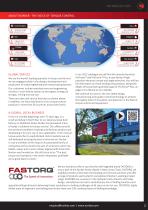
INTRODUCTION ABOUT NORBAR - THE VOICE OF TORQUE CONTROL GLOBAL SERVICE We are the world’s leading specialist in torque control and we are engaged solely in the design, development and production of torque tightening and measuring equipment. Our customers include manufacturers and engineering services in such diverse sectors as aerospace, energy, oil and gas, mining and sub-sea. There are sales and service branches as shown above. In addition, we have distributors of our torque control products in more than 60 countries around the world. In our 2022 catalogue you will find the recently launched...
Open the catalog to page 3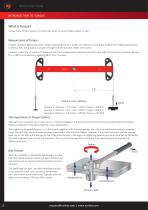
INTRODUCTION INTRODUCTION TO TORQUE What is Torque? Torque is any force or system of forces that tends to cause rotation about an axis. Measurement of Torque Imagine someone tightening a bolt using a socket attached to a meter (m) long bar. If they apply 10 kg of force (kgf) perpendicular to the bar they will produce a torque of 10 kgf·m at the axis (the centre of the bolt). However, under the S.I. system of measurement, force is expressed in Newtons (N) rather than kgf. The conversion between kgf and N is x 9.807 so the person is applying 98.07 N·m of torque. Torque = Force x Distance Example...
Open the catalog to page 4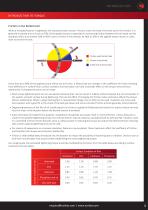
INTRODUCTION INTRODUCTION TO TORQUE Friction in the Bolted Joint When a threaded fastener is tightened, the induced tension results in friction under the head of the bolt and in the threads. It is generally accepted that as much as 50% of the applied torque is expended in overcoming friction between the bolt head and the abutting surface and another 30% to 40% is lost to friction in the threads. As little as 10% of the applied torque results in useful work to tension the bolt. Friction under the bolt head N.m Friction in the threads Useful work to tension bolt Given that up to 90% of the applied...
Open the catalog to page 5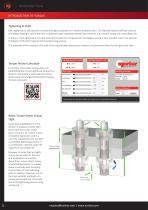
INTRODUCTION INTRODUCTION TO TORQUE Tightening to Yield Bolts tightened to yield provide consistently higher preloads from smaller diameter bolts. The reduced fastener stiffness reduces the fatigue loading to which the bolt is subjected under repeated external load reversals, e.g. cylinder heads and connecting rods. In theory, a bolt tightened to its yield point will provide the strongest and most fatigue-resistant joint possible, within the physical limitations of the bolt material and manufacturing process. The downside of this method is the cost of the sophisticated equipment necessary to...
Open the catalog to page 6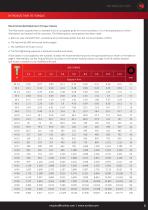
INTRODUCTION INTRODUCTION TO TORQUE Recommended Maximum Torque Values The information supplied here is intended to be an acceptable guide for normal conditions. For critical applications, further information and research will be necessary. The following basic assumptions have been made: a. Bolts are new, standard finish, uncoated and not lubricated (other than the normal protective oil film) b. The load will be 90% of the bolt yield strength c. The coefficient of friction is 0.14 d. The final tightening sequence is achieved smoothly and slowly If lubrication is to be applied to the nut/bolt,...
Open the catalog to page 7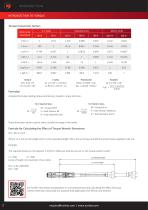
INTRODUCTION INTRODUCTION TO TORQUE Torque Conversion Factors S.I. Units Imperial Units Metric Units FLOW I/s x 2.119 = cu·ft/min cu·ft/min x 0·472 = I/s Accepted formulae relating torque and tension, based on many tests are:For Imperial Sizes M = torque lbf·ft PxD M= P = bolt tension lbf 60 D = bolt diameter (ins) For Metric Sizes M = torque N·m PxD P = bolt tension Newtons M= 5000 D = bolt diameter (mm) These formulae may be used for bolts outside the range of the tables. Formula for Calculating the Effect of Torque Wrench Extensions M1 = M2 x L1/L2 Where L1 is the normal length and L2 is the...
Open the catalog to page 8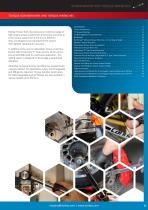
SCREWDRIVERS AND TORQUE WRENCHES TORQUE SCREWDRIVERS AND TORQUE WRENCHES Norbar Torque Tools manufacture an extensive range of high quality torque screwdrivers and torque wrenches to cover torque values from 0.3 Nm to 2,000 Nm. They are designed and manufactured to exceed international standards for accuracy. In addition to the normal ‘adjustable’ torque wrenches, Norbar offer Production ‘P’ Type versions which can be pre-set and dedicated to a particular application. This setting system is designed to discourage unauthorised alteration. All Norbar torque wrenches are offered as standard with...
Open the catalog to page 9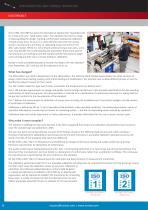
SCREWDRIVERS AND TORQUE WRENCHES ISO 6789:2017 Since 1993, ISO 6789 has been the international standard for “Assembly tools for screws and nuts – hand torque tools”. The standard now covers a range of topics guiding the design, marking, conformance testing and calibration of hand torque tools. As such, it is a key reference document for torque wrench manufacturers and those re-calibrating torque wrenches in the after sales market. While it is not primarily aimed at torque tool users, some users may benefit from understanding the parameters that torque wrench manufacturers are working to and the...
Open the catalog to page 10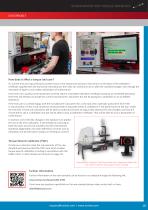
SCREWDRIVERS AND TORQUE WRENCHES ISO 6789:2017 How does it affect a torque tool user? If a current end user was previously content to buy a new torque tool and put it into service on the basis of the calibration certificate supplied with the tool by the manufacturer, then they can continue to do so after the standard changes, even though the new piece of paper is now called a declaration of conformance. If the end user’s quality control processes currently require a traceable calibration certificate issued by an accredited laboratory then they will already not accept the current manufacturer’s...
Open the catalog to page 11All Norbar Torque Tools catalogs and technical brochures
 NORTORQUE®
2 Pages
 NORBAR TORQUE TOOLS
1 Page
 T-BOX™ 2
2 Pages
 RIGHT ANGLE GEARBOX
2 Pages
 PNEUTORQUE® PTS™
2 Pages
 EVOTORQUE® BATTERY TOOL
2 Pages
 EVOTORQUE®2
2 Pages
 NORTRONIC®
2 Pages
 PROTRONIC® PLUS
2 Pages
 PROTRONIC®
2 Pages
 NorTorque model 340
2 Pages
 NorTorque model 60
2 Pages
 EvoTorque 2 ET2-72-1000-110
2 Pages
 TTs3.0
1 Page

- Torque transducer
- Electric torque wrench
- High-precision torque wrench
- Torque meter
- Adjustable torque wrench
- Digital torque wrench
- Pistol torque wrench
- Electronic torque meter
- Torque wrench for heavy-duty applications
- Cordless torque wrench
- Static torque sensor
- Analog torque sensor
- Torque multiplier
- Torque wrench for the automotive industry
- Portable torque meter
- Ratchet wrench
- Pneumatic torque wrench