

way collapsed spine EVPN/VXLAN

way collapsed spine EVPN/VXLAN
Nokia Reference Designs are design guides that showcase alternative design and product capabilities. Unlike Nokia Validated Designs, these are not extensively hardware tested but are functional designs tested as virtual fabrics using Containerlab, with deployable GitHub repositories for customization.
1. Reference Architecture
The document outlines a 4-way collapsed spine EVPN/VXLAN fabric design, enhancing scale-out capabilities with four spines. This architecture supports full-mesh connectivity for redundancy and allows direct server connections to spines or Layer 2 ToR switches, making it cost-effective for data centers with known scale limitations.
2. Design Considerations
The collapsed spine design uses spines as VXLAN tunnel endpoints (VTEPs) with Layer 2 ToR switches connected via Ethernet segments. Two underlay implementation variations are discussed: eBGP with IPv6 link-local addressing and OSPF unnumbered. The overlay employs iBGP peering for stability.
3. Feature Configuration
3.1 OSPF Unnumbered Underlay
Interfaces between spines are configured as unnumbered, using loopback addresses for OSPF. The system0 interface is used as the VTEP address, configured with a /32 address for VXLAN tunnels. Configuration examples for loopback and unnumbered interfaces are provided.
4. Feature Validation
Validation processes for both underlay and overlay configurations ensure proper MAC address and IP-MAC bindings, and route insertion into IP VRFs via EVPN Type-5 routes.
5. Packet Walks
Various packet flow scenarios are described, illustrating the design's operational dynamics.
6. Digital Twin with Containerlab
The document concludes with deploying the design using Containerlab, enabling further testing and exploration.
Overview: The document provides a detailed configuration guide for setting up a network using Nokia's EVPN/VXLAN fabric, covering eBGP and iBGP configurations, BFD, Ethernet segments, IRB interfaces, and MAC VRFs.
1. eBGP IPv6 Link-Local Underlay: This section explains the configuration of eBGP with IPv6 link-local addresses, highlighting the need for enabling IPv6 on point-to-point interfaces.
2. iBGP Overlay with eBGP Underlay: Describes a full mesh iBGP peering setup among spines using a common ASN and discusses operational challenges.
3. iBGP Overlay with OSPF Unnumbered Underlay: Outlines the configuration for an iBGP overlay with OSPF unnumbered underlay, emphasizing BFD for failure detection.
4. BFD Configuration: BFD is enabled on interfaces for rapid failure detection and recovery.
5. Ethernet Segments: Details the configuration of Ethernet segments in an all-active mode.
6. IRB Interfaces: Configured on spines to serve as Layer 3 gateways for servers.
7. MAC VRFs: Explains the setup of MAC VRF instances for Layer 2 connectivity.
IP VRFs Configuration
IP VRFs provide Layer 3 segregation within the network fabric, creating tenant-specific networks over a shared infrastructure.
Feature Validation
Underlay Validation
Underlay network can be configured using OSPF unnumbered or eBGP IPv6 link-local, with BFD enabled for rapid failure detection.
OSPF Underlay and BFD Validation
Ensures advertisement and reachability of the system0 address via equal cost paths.
eBGP Underlay Validation
Ensures reachability to peer system0 addresses.
Overlay Validation
Results in the establishment of overlay peering, ensuring seamless connectivity.
Overview: Provides a detailed technical analysis of a network configuration involving EVPN and VXLAN in a collapsed spine architecture.
1. BGP Neighbor Configuration: Outlines the BGP neighbor summary for the default network instance.
2. EVPN Route Details: Provides examples of EVPN routes, demonstrating the network's ability to learn and advertise MAC addresses and IP bindings.
3. MAC Address Learning: Confirms MAC address learning for servers connected to the network.
4. ARP Entries: Includes ARP entries for interfaces.
5. EVPN Type-5 Routes: Describes the insertion of routes into the IP VRF via EVPN Type-5 routes.
Conclusion: Provides a comprehensive view of the network's EVPN/VXLAN configuration, emphasizing route validation and MAC address learning.
Ethernet Segments
All ToR switches are connected via all-active Ethernet segments on the spine switches.
Packet Walks
Outlines various packet walk scenarios within a collapsed spine EVPN/VXLAN fabric.
Digital Twin with Containerlab
Emphasizes digital twins for validating deployments and experimenting with technologies.
Catalog excerpts
Nokia Reference Design Collapsed Spine EVPN/VXLAN Fabric Authors: Aninda Chatterjee and Vivek V © 2025 Nokia. Use subject to Terms available at: www.nokia.com/terms
Open the catalog to page 1
Collapsed Spine EVPN/VXLAN Fabric Nokia is committed to diversity and inclusion. We are continuously reviewing our customer documentation and consulting with standards bodies to ensure that terminology is inclusive and aligned with the industry. Our future customer documentation will be updated accordingly. This document includes Nokia proprietary and confidential information, which may not be distributed or disclosed to any third parties without the prior written consent of Nokia. This document is intended for use by Nokia’s customers (“You”/”Your”) in connection with a product purchased or...
Open the catalog to page 2
Collapsed Spine EVPN/VXLAN Fabric Preface for reference designs 5 4.3 MAC address and IP-MAC bindings on spines (single-homed and 5.3 Single-homed server to multihomed server (directly attached to spines) 34 6 Digital twin with Containerlab 35 Use subject to Terms available at: www.nokia.com/terms 3HE-21912-AAAA-TQZZA
Open the catalog to page 3
Collapsed Spine EVPN/VXLAN Fabric List of Figures Figure 1 Figure 2 Figure 3 Figure 4 Figure 5 © 2025 Nokia. Use subject to Terms available at: www.nokia.com/terms 3HE-21912-AAAA-TQZZA
Open the catalog to page 4
Collapsed Spine EVPN/VXLAN Fabric Preface for reference designs The main distinction between the Nokia Validated Designs (NVDs) and Nokia Reference Designs is analogous to that of a supported product versus an open-source community version of the same product. The validated designs (NVDs) are officially supported, tested on hardware, and recommended by Nokia. NVDs have a lifecycle management system, migration paths, official configuration recommendations, and support by Nokia support and services organizations. Disclaimer: Reference designs are meant to be design guides that demonstrate alternate...
Open the catalog to page 5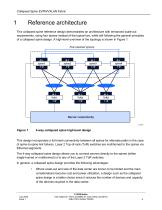
Collapsed Spine EVPN/VXLAN Fabric Reference architecture This collapsed spine reference design demonstrates an architecture with enhanced scale-out requirements, using four spines instead of the typical two, while still following the general principles of a collapsed spine design. A high-level overview of the topology is shown in Figure 1. 4-way collapsed spine high-level design This design incorporates a full-mesh connectivity between all spines for alternate paths in the case of spine-to-spine link failures. Layer 2 Top-of-rack (ToR) switches are multihomed to the spines via Ethernet segments....
Open the catalog to page 6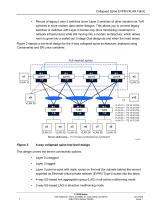
Collapsed Spine EVPN/VXLAN Fabric • Re-use of legacy Layer 2 switches (even Layer 2 switches of other vendors) as ToR switches in more modern data center designs. This allows you to connect legacy switches or switches with Layer 2 license only (thus minimizing investment in network infrastructure) while still moving into a modern architecture, which allows room to grow into a scaled-out 3-stage Clos design as and when the need arises. Figure 2 depicts a low-level design for the 4-way collapsed spine architecture, deployed using Containerlab and SR Linux container. 4-way collapsed spine low-level...
Open the catalog to page 7
Collapsed Spine EVPN/VXLAN Fabric In a collapsed spine design, the collapsed spines (spine and leaf functionality on one node) are positioned as VXLAN tunnel endpoints (VTEPs), with the Layer 2 ToR switches connecting via Ethernet segments (and link aggregation groups on the ToR side). This design provides the following two variations in how the underlay can be implemented: • External Border Gateway Protocol (eBGP) underlay using IPv6 link-local addressing and BGP dynamic neighbors • Open Shortest Path First (OSPF) unnumbered Both design variants employ full mesh Internal Border Gateway Protocol...
Open the catalog to page 8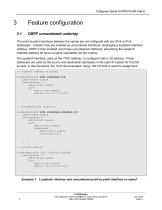
Collapsed Spine EVPN/VXLAN Fabric OSPF unnumbered underlay The point-to-point interfaces between the spines are not configured with any IPv4 or IPv6 addresses – instead, they are enabled as unnumbered interfaces, leveraging a loopback interface address. OSPF is then enabled over these unnumbered interfaces, advertising the system0 interface address for spine-to-spine reachability for the overlay. The system0 interface, used as the VTEP address, is configured with a /32 address. These addresses are used as the source and destination addresses in the outer IP header for VXLAN tunnels. In this document,...
Open the catalog to page 9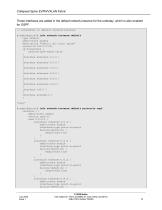
Collapsed Spine EVPN/VXLAN Fabric These interfaces are added in the default network-instance for the underlay, which is also enabled for OSPF. // interfaces in default network-instance A:admin@spine1# info network-instance default type default admin-state enable description "fabric: dc1 role: spine" router-id 192.0.2.101 ip-forwarding { receive-ipv4-check false } interface ethernet-1/1.0 { } interface ethernet-1/2.0 { } interface ethernet-1/3.0 { } interface ethernet-1/4.0 { } interface ethernet-1/5.0 { } interface ethernet-1/6.0 { } interface lo0.0 { } interface system0.0 { } *snip* A:admin@spine1#...
Open the catalog to page 10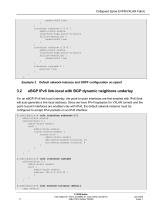
Collapsed Spine EVPN/VXLAN Fabric } interface ethernet-1/5.0 { admin-state enable interface-type point-to-point failure-detection { enable-bfd true } } interface ethernet-1/6.0 { admin-state enable interface-type point-to-point failure-detection { enable-bfd true } } interface system0.0 { passive true } enable-bfd true Default network-instance and OSPF configuration on spine1 eBGP IPv6 link-local with BGP dynamic neighbors underlay For an eBGP IPv6 link-local underlay, the point-to-point interfaces are first enabled with IPv6 (that will auto-generate a link-local address). Since we have IPv4...
Open the catalog to page 11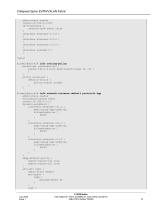
Collapsed Spine EVPN/VXLAN Fabric admin-state enable router-id 192.0.2.101 ip-forwarding { receive-ipv4-check false } interface ethernet-1/1.0 { } interface ethernet-1/2.0 { } interface ethernet-1/3.0 { } interface system0.0 { } *snip* A:admin@spine1# info routing-policy prefix-set prefixset-dc1 { prefix 192.0.2.0/24 mask-length-range 32..32 { } } policy allow-all { default-action { policy-result accept } } A:admin@spine1# info network-instance default protocols bgp admin-state enable autonomous-system 65501 router-id 192.0.2.11 dynamic-neighbors { interface ethernet-1/1.0 { peer-group bgp-underlay...
Open the catalog to page 12All Nokia catalogs and technical brochures
 Collapsed Spine EVPN VXLAN
93 Pages
 Nokia Validated Design
72 Pages