

Nokia Validated Design

Nokia Validated Design
Nokia Validated Designs (NVDs) offer validated recommendations for deploying Nokia's portfolio across various market segments. This document focuses on a 3-stage Clos EVPN VXLAN design for multi-tiered data center architecture, utilizing EVPN as the control plane and VXLAN as the data plane. The design is rigorously tested for reliability and provides a deployment template.
The architecture features a 3-stage EVPN VXLAN fabric with Nokia data center platforms at the spine and leaf layers, supporting interoperability with Broadcom platforms. It employs an IPv6-only underlay with IPv6 link-local addressing, facilitating an IPv4 overlay without the complexity of IPv4 underlay management.
The deployment includes a high-level design, platform positioning, and network architecture. It details the use of IPv6 link-local addressing for P2P interfaces, BGP for underlay and overlay routes, and various server-facing interface configurations.
This section covers configurations for underlay and overlay networks, including BGP, MTU settings, BFD, LLDP, and link aggregation groups. It also discusses VXLAN tunnels, MAC VRFs, IP VRFs, and node isolation.
The document includes a feature matrix and test results to validate the design's functionality and performance.
Details on EDA architecture, onboarding with ZTP, and Kubernetes workflows for NVD deployment are provided, including steps for node onboarding, ASN pool building, and fabric creation.
Network and EDA validation processes are outlined to ensure the design meets operational requirements.
The document discusses the use of digital twins with Containerlab for automation and orchestration of the network deployment.
The document outlines the process of converting network designs into intents by customizing Nokia's validated 3-stage EVPN VXLAN design. These intents are described using EDA K8s manifest files, REST APIs, or the UI, allowing for intent and fabric modifications without reinstalling the platform.
The network design is a 3-stage Clos fabric using BGP EVPN as the control plane and VXLAN for data encapsulation. IPv6 link-local addressing is used for point-to-point interfaces between leafs and spines.
Nokia platforms are positioned for various roles in the design, with specific models assigned as spines and leafs.
Common traffic patterns validated include Layer 2 and Layer 3 interfaces, Ethernet Segment LAGs, and server NIC-bonding.
Underlay with IPv6 Link-Local Addressing: Point-to-point interfaces use IPv6 link-local addressing.
BGP Configuration: eBGP design with dynamic discovery and MP-BGP functionality.
MTU Configuration: System-wide MTUs are set to accommodate VXLAN encapsulation.
Bidirectional Forwarding Detection (BFD): BFD is enabled for fast-failover on links between leafs and spines.
LLDP is utilized for discovering neighboring devices.
Configuration of untagged and tagged Layer 2 server-facing interfaces is discussed.
A 4-way all-active Ethernet Segment is tested, supporting multihoming within EVPN.
Single-active Ethernet Segments are tested, useful for servers requiring a single active link.
This section covers active/backup functionality using a server with two NICs configured for Linux bond mode 1.
Layer 3 interfaces are used for cloud-native environments, supporting end-to-end routing.
IRB interfaces are configured in an anycast, distributed gateway model.
VXLAN tunnels are created as tunnel interfaces, mapped to bridged (L2VNI) or routed (L3VNI) VNIs.
MAC VRFs provide Layer 2 isolation, mapped to bridged VXLAN tunnel interfaces and IRB interfaces.
IP VRFs enable Layer 3 isolation for multiple tenants/services.
Node isolation is implemented to handle VTEP uplink failures while retaining server-facing downlinks.
The document lists various features validated in SRL 24.10.2 and EDA 24.12.1.
Tests include BGP reset and active/backup configurations without LAG, measuring traffic convergence times.
Various scenarios are tested to measure traffic convergence times in a network environment.
Nokia's Event Driven Automation (EDA) platform is a cloud-native solution deployed on Kubernetes.
EDA supports Zero Touch Provisioning (ZTP) for automating the deployment of Nokia SRL nodes.
This section outlines the use of Kubernetes manifest files for deploying an EDA-orchestrated EVPN VXLAN fabric.
- Node Profile: The node profile for 'spine2' is specified with a real-srlinux-24.10.2 profile.
- ASN Pools: Two ASN pools are created: 'leaf-asn' and 'spine-asn'.
- IP Pool: An IP pool for system0 addresses is allocated.
- Interface and Link Creation: Interfaces and links are instantiated between nodes.
- Fabric Creation: The fabric is orchestrated using IPv6 link-local addressing with MP-BGP peering.
- Bridge Domain and IRB Interfaces: Bridge domains are created as MAC VRFs.
- VLAN Creation: VLANs are configured for both tagged and untagged Layer 2 interfaces.
- Utilize configlets for custom configurations.
- Ensure proper node onboarding and profile assignment.
- Various VLANs are listed with their respective VNIs, EVIs, and operational states.
- IRB interfaces are all operational with a consistent last change timestamp.
- Details for IRB interfaces include ARP timeout and bridge domain association.
- VRFs are operational with specific VNIs and EVIs.
- The edactl tool provides insights into internal transactions and workflow results.
- Digital twins using Containerlab are emphasized for validating deployments.
Catalog excerpts

Nokia Validated Design 3-stage EVPN/VXLAN Fabric 3HE-21632-AAAA-TQZZA Issue 1 March 2025 © 2025 Nokia. Use subject to terms available at: www.nokia.com/terms.
Open the catalog to page 1
Legal notice Nokia is committed to diversity and inclusion. We are continuously reviewing our customer documentation and consulting with standards bodies to ensure that terminology is inclusive and aligned with the industry. Our future customer documentation will be updated accordingly. This document includes Nokia proprietary and confidential information, which may not be distributed or disclosed to any third parties without the prior written consent of Nokia. This document is intended for use by Nokia’s customers (“You”/”Your”) in connection with a product purchased or licensed from any company...
Open the catalog to page 2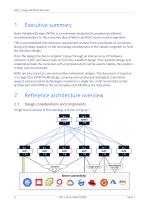
Executive summary Nokia Validated Designs (NVDs) is a workstream dedicated to producing validated recommendations to the consumer about Nokia’s portfolio across market segments. This is accomplished with extensive requirement analysis from a multitude of customers along with deep research of the technology development in the industry segment to form the solutions design. Once the design has been compiled, it goes through an intense array of hardware, software, traffic and failure tests to form the validated design. The resultant design and collateral provide the consumer with a template which...
Open the catalog to page 6
Figure 1.3-stage EVPN VXLAN NVD architecture This section describes the various components involved in this validated design and the design and technology choices that were made. • The design strategically positions multiple Nokia data center platforms at the spine and leaf layers of a 3-stage Clos fabric. The purpose of positioning multiple variants of platforms is to help the consumer make informed decisions according to their sizing, scale, and needs. • This also shows seamless interoperability with Broadcom Tomahawk platforms on the spines and Broadcom Trident platforms at the leaf layers....
Open the catalog to page 7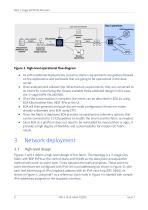
• As with traditional deployments, broad customer requirements are gathered based on the applications and workloads that are going to be operational in the data center. • Once analyzed and collated into infrastructure requirements, they are converted to an intent by customizing the closest available Nokia validated design (in this case, the 3-stage EVPN VXLAN NVD). • Once the customization is complete, the intent can be described in EDA by using EDA K8s manifest files, REST APIs or the UI. • EDA will then generate and push the per-node configuration (these are nodes already onboarded onto EDA...
Open the catalog to page 8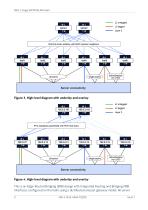
IPv6 link-local underlay with BGP dynamic neighbors Server connectivity This is an Edge-Routed Bridging (ERB) design with Integrated Routing and Bridging (IRB) interfaces configured on the leafs using a distributed anycast gateway model. All server
Open the catalog to page 9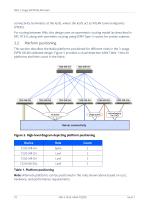
NVD 3-stage EVPN/VXLAN Fabric connectivity terminates at the leafs, where the leafs act as VXLAN tunnel endpoints (VTEPs). For routing between VNIs, this design uses an asymmetric routing model (as described in RFC 9135), along with symmetric routing using EVPN Type-5 routes for certain subnets. This section describes the Nokia platforms positioned for different roles in the 3-stage EVPN VXLAN validated design. Figure 5 provides a visual depiction while Table 1 lists all platforms and their count in the fabric. Table 1. Platform positioning Note: Alternate platforms can be positioned in the roles...
Open the catalog to page 10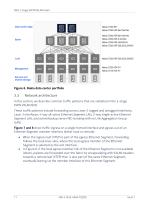
Figure 6. Nokia data center portfolio Network architecture In this section, we describe common traffic patterns that are validated in the 3-stage EVPN VXLAN NVD. These traffic patterns include forwarding across Layer 2 tagged and untagged interfaces, Layer 3 interfaces, 4-way all-active Ethernet Segment LAG, 2-way single-active Ethernet Segment LAG, and active/backup server NIC-bonding with no Link Aggregation Group (LAG). Figure 7 and 8 show traffic ingress on a single-homed interface and egress out of an Ethernet Segment member interface (either local or remote). • When the ingress leaf (VTEP)...
Open the catalog to page 11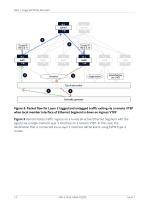
IXIA traffic generator Figure 8. Packet flow for Layer 2 tagged and untagged traffic exiting via a remote VTEP when local member interface of Ethernet Segment is down on ingress VTEP Figure 9 demonstrates traffic ingress on a 4-way all-active Ethernet Segment with the egress via a single-homed Layer 3 interface on a remote VTEP. In this case, the destination that is connected via a Layer 3 interface will be learnt using EVPN Type-5 routes.
Open the catalog to page 13
Figure 9. Packet flow for traffic ingress on a 4-way Ethernet Segment member interface directed to a destination behind a Layer 3 interface on a remote VTEP Figure 10 and Figure 11 demonstrate the traffic patterns for a destination that is behind a single-active Ethernet Segment. • Figure 10 demonstrates traffic ingress via the active VTEP of a single-active Ethernet Segment and uses local-bias forwarding rules to send out another locally attached Ethernet Segment. Figure 11 demonstrates traffic ingress on a single-homed interface. It is forwarded over the fabric by encapsulating VXLAN headers...
Open the catalog to page 14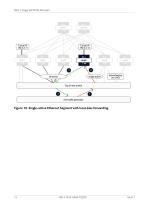
IXIA traffic generator
Open the catalog to page 15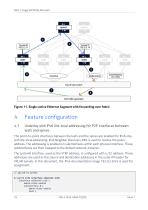
Figure 11. Single-active Ethernet Segment with forwarding over fabric Feature configuration Underlay with IPv6 link-local addressing for P2P interfaces between leafs and spines The point-to-point interfaces between the leafs and the spines are enabled for IPv6 only, with link-local addressing. IPv6 Neighbor Discovery (ND) is used to resolve the peers’ address. The addressing is enabled on subinterfaces within each physical interface. These subinterfaces are then mapped to the default network-instance. The system0 interface, used as the VTEP address, is configured with a /32 address. These addresses...
Open the catalog to page 16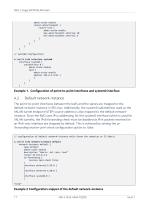
admin-state enable router-advertisement { router-role { admin-state enable max-advertisement-interval 10 min-advertisement-interval 4 } } } } } // system0 configuration A:leaf1# info interface system0 interface system0 { subinterface 0 { admin-state enable ipv4 { admin-state enable address 192.0.2.4/32 { } } } } Example 1. Configuration of point-to-point interfaces and system0 interface Default network-instance The point-to-point interfaces between the leafs and the spines are mapped to the default network-instance in SR Linux. Additionally, the system0 subinterface used as the VXLAN tunnel endpoint...
Open the catalog to page 17All Nokia catalogs and technical brochures
 way collapsed spine EVPN/VXLAN
35 Pages
 Collapsed Spine EVPN VXLAN
93 Pages