
- Catalogs
- Ningxia Maiya Sensor Technology
- MaiYa MST-4 electrochemical oxygen sensor


- Company
- Products
- Catalogs
- News & Trends
- Exhibitions
MaiYa MST-4 electrochemical oxygen sensor
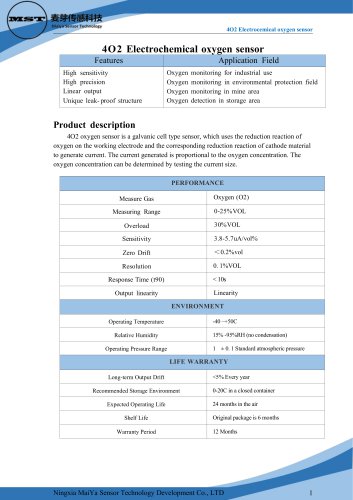
MaiYa MST-4 electrochemical oxygen sensor
The 4O2 Electrochemical Oxygen Sensor by Ningxia MaiYa Sensor Technology Development Co., LTD is designed for high sensitivity and precision in oxygen monitoring across various fields such as industrial, environmental protection, mining, and storage areas.
Product Description
This sensor operates as a galvanic cell, utilizing the reduction reaction of oxygen to generate a current proportional to the oxygen concentration. This allows for accurate determination of oxygen levels.
Performance Specifications
- Measure Gas: Oxygen (O2)
- Measuring Range: 0-25% VOL
- Overload Capacity: 30% VOL
- Sensitivity: 3.8-5.7 uA/vol%
- Zero Drift: <0.2% vol
- Resolution: 0.1% VOL
- Response Time (t90): < 10s
- Output Linearity: Linear
Environmental Conditions
- Operating Temperature: -40 to +50°C
- Relative Humidity: 15% - 95% RH (no condensation)
- Operating Pressure: 1 ± 0.1 Standard atmospheric pressure
Life and Warranty
- Long-term Output Drift: <5% per year
- Recommended Storage: 0-20°C in a closed container
- Expected Operating Life: 24 months in air
- Shelf Life: 6 months in original package
- Warranty Period: 12 months
Additional Information
The sensor exhibits long-term stability and minimal cross-sensitivity to toxic gases at allowable concentrations. However, high concentrations of oxidizing gases may interfere with oxygen diffusion.
Safety Notes
- Avoid contact with the sensor during welding.
- Ensure a power-on aging time of at least 30 minutes.
- Avoid prolonged exposure to organic solvents and high concentrations of solvent vapors.
- Store and use in environments free from acid-alkali conditions.
- Prevent excessive shock or vibration.
Contact Information
Ningxia MaiYa Sensor Technology Development Co., LTD, Tower C, Yinchuan Zhongguancun Innovation Center, Helanshan Road, Xingzhou Street, Yinchuan, Ningxia, China 750000. Email: [email protected], Phone: +86 189 9527 8133.
Catalog excerpts
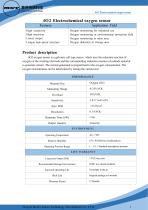
4O2 Electrocemical oxygen sensor 4O2 Electrochemical oxygen sensor Application Field High sensitivity High precision Linear output Unique leak- proof structure Oxygen Oxygen Oxygen Oxygen monitoring for industrial use monitoring in environmental protection field monitoring in mine area detection in storage area Product description 4O2 oxygen sensor is a galvanic cell type sensor, which uses the reduction reaction of oxygen on the working electrode and the corresponding reduction reaction of cathode material to generate current. The current generated is proportional to the oxygen concentration. The oxygen concentration can be determined by testing the current size. PERFORMANCE Measure Gas Measuring Range Overload Sensitivity Zero Drift Output linearity Operating Temperature Relative Humidity 1 ± 0. 1 Standard atmospheric pressure Operating Pressure Range LIFE WARRANTY Long-term Output Drift Recommended Storage Environment Expected Operating Life Shelf Life Warranty Period <5% Every year 0-20C in a closed container 24 months in the air Original package is 6 months 12 Months Ningxia MaiYa Sensor Technology Development Co., LTD
Open the catalog to page 1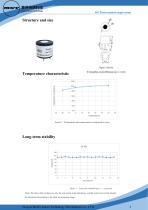
4O2 Electrocemical oxygen sensor Temperature characteristic Figure 2 : Temperature and compensation compensation curve Long-term stability Figure 3 : Long-term stabilityFigure 3 : Long-term stability Note: The above life test data are only the test results in the laboratory, and the actual service life should be determined according to the field environment usage. Ningxia MaiYa Sensor Technology Development Co., LTD
Open the catalog to page 2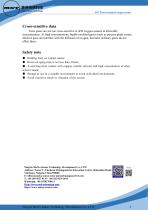
4O2 Electrocemical oxygen sensor Cross-sensitive data Toxic gases are not too cross-sensitive to 4O2 oxygen sensors at allowable concentrations. At high concentrations, highly oxidized gases (such as percent grade ozone, chlorine gas) can interfere with the diffusion of oxygen, but most ordinary gases do not affect them. Safety note ● Welding lead, no contact sensor; ● Power-on aging time is not less than 30min; ● Avoid long- term contact with organic volatile solvents and high concentration of other solvent steam; ● Storage or use in a suitable environment to avoid acid-alkali environment; ●...
Open the catalog to page 3All Ningxia Maiya Sensor Technology catalogs and technical brochures
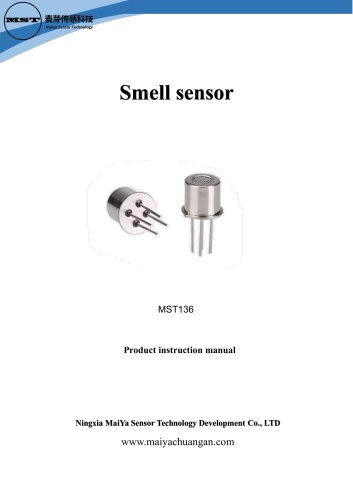 MaiYa MST-136 smell sensor
6 Pages
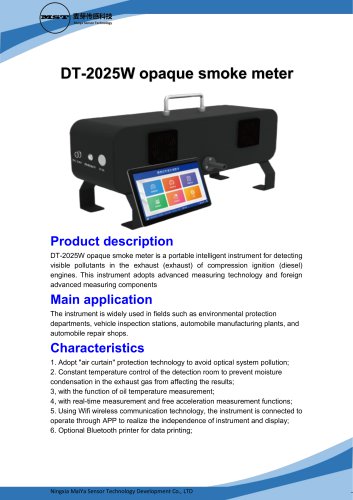 MaiYa DT-2025W gas analyzer
3 Pages
 MAIYA Gas Sensors Handbook
34 Pages
 MAIYA gas detectors handbook
34 Pages
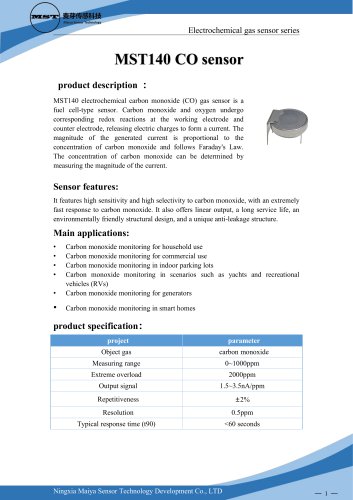 MaiYa MST140 co sensor
3 Pages
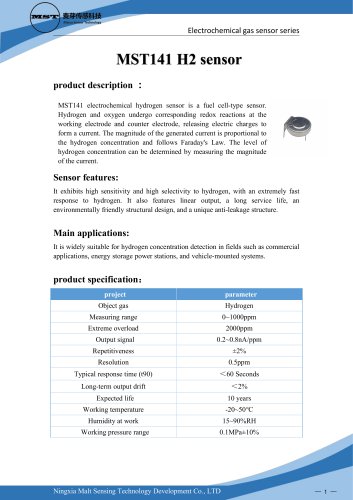 MaiYa MST141 H2 sensor
3 Pages
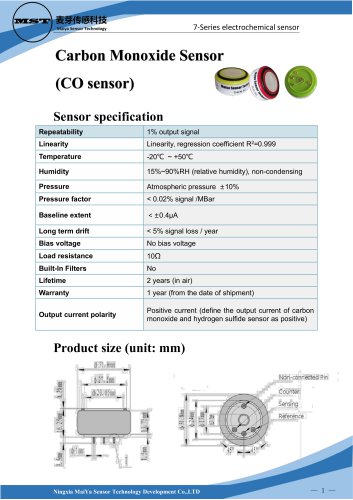 MaiYa CO sensor
3 Pages
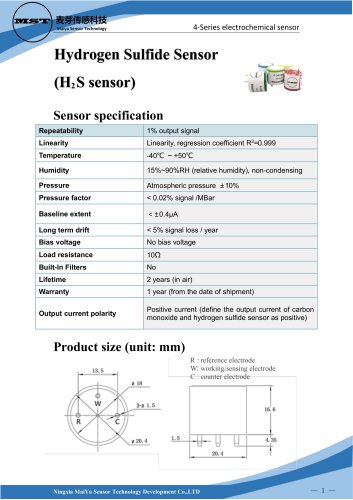 MaiYa H2S sensor
3 Pages
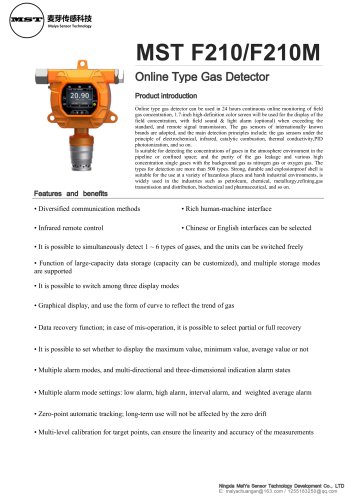 MST F210/F210M
5 Pages
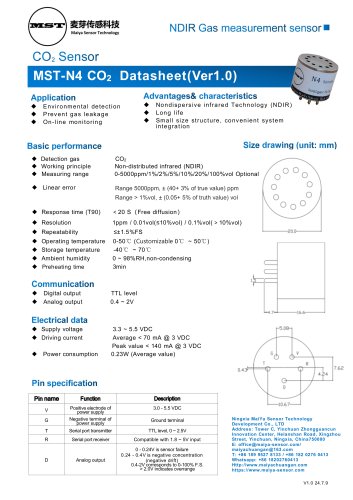 MaiYa MST-N4 NDIR CO2 sensor
1 Page
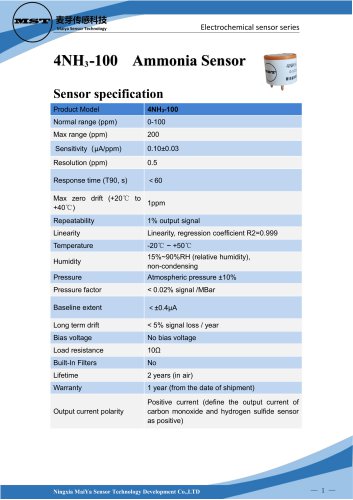 MaiYa MST-4 NH3 sensor
3 Pages
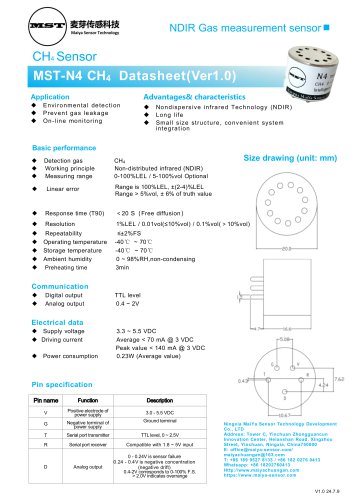 MaiYa MST-N4 NDIR CH4 sensor
1 Page
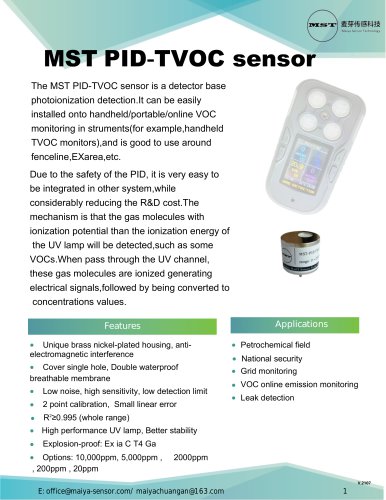 MaiYa MST-PID sensor
6 Pages

- Gas analyzer
- Concentration analyzer
- Monitoring analyzer
- Liquids analyzer
- Automatic analyser
- Benchtop analyser
- Process analyzer
- Gas detector
- Portable analyzer
- Continuous analyzer
- Real-time analyzer
- Gas sensor
- Oxygen analyzer
- Laboratory analyzer
- Digital analyzer
- Industrial detector
- Infrared analyser
- Calibration analyzer
- Monitoring detector
- Portable detector