
- Catalogs
- Ningxia Maiya Sensor Technology
- MaiYa H2S sensor


- Company
- Products
- Catalogs
- News & Trends
- Exhibitions
MaiYa H2S sensor
MaiYa H2S sensor
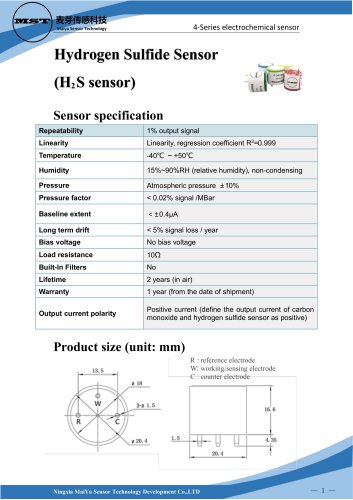
The 4-Series electrochemical sensor by Ningxia MaiYa Sensor Technology Development Co., LTD features a repeatability of 1% output signal and a linearity with a regression coefficient of R2=0.999. It operates within a temperature range of -40℃ to +50℃ and a humidity range of 15% to 90% RH, non-condensing. The sensor can withstand atmospheric pressure variations of ±10% and has a pressure factor of less than 0.02% signal per MBar. The baseline extent is less than ±0.4µA, with a long-term drift of less than 5% signal loss per year. It requires no bias voltage and has a load resistance of 10Ω. The sensor does not include built-in filters, has a lifetime of 2 years in air, and comes with a 1-year warranty from the date of shipment. The output current polarity is positive for carbon monoxide and hydrogen sulfide sensors.
The document lists various models of the 4H2S sensor, each with different normal and maximum ranges, sensitivity, resolution, response time, and maximum zero drift. For example, the 4H2S-10 model has a normal range of 0-10 ppm, a maximum range of 20 ppm, a sensitivity of 2.0±0.40 µA/ppm, a resolution of 0.005 ppm, a response time of less than 30 seconds, and a maximum zero drift of 0.1 ppm.
The sensor's cross-interference data is provided for reference only, indicating that the measurement of intersecting gases is not linear and accuracy is not guaranteed. For instance, gases like CO, H2, NH3, NO, C2H5OH, CH3OH, CH4, and C2H4 show no sensor response at specified concentrations.
The sensors are designed for gas leak monitoring and alarms, not for long-term exposure or continuous detection. Sensor pins should be connected through a PCB socket to avoid damage. Contact with organic solvents, alcohol, paint, oil, and high concentrations of gas should be avoided. Sensors with positive output current require oxygen for reactions and should be calibrated with air as the background gas. Sensors should not be removed or inserted while powered on to prevent damage.
Catalog excerpts
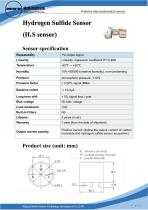
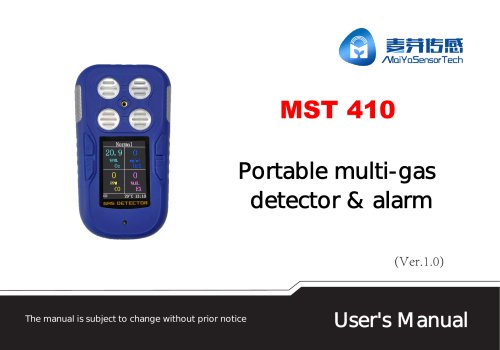
Hydrogen Sulfide Sensor(H2S sensor)Sensor specification Repeatability Ningxia MaiYa Sensor Technology Development Co.,LTD
Open the catalog to page 1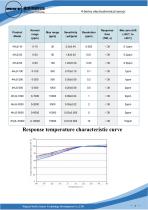
Ningxia MaiYa Sensor Technology Development Co.,LTD
Open the catalog to page 2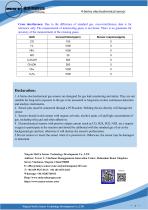
Cross interference: Due to the difference of standard gas, cross-interference data is for reference only. The measurement of intersecting gases is not linear. There is no guarantee for accuracy of the measurement of the crossing gases. Declaration: 1. 4-Series electrochemical gas sensors are designed for gas leak monitoring and alarm. They are not suitable for long-term exposure to the gas to be measured or long-term on-line continuous detection and analysis instruments. 2. Sensor pins must be connected through a PCB socket, Welding the pin directly will damage the sensor. 3. Sensors should avoid...
Open the catalog to page 3All Ningxia Maiya Sensor Technology catalogs and technical brochures
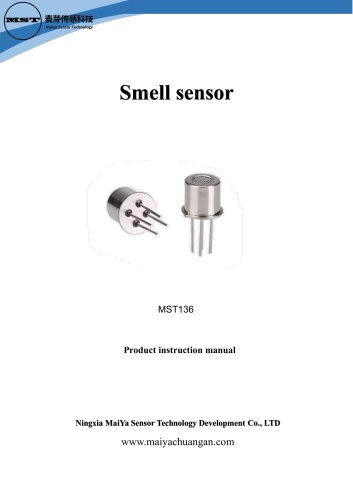 MaiYa MST-136 smell sensor
6 Pages
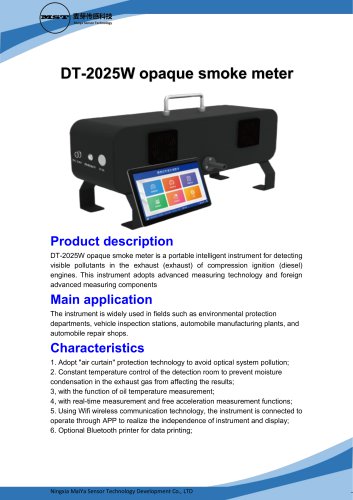 MaiYa DT-2025W gas analyzer
3 Pages
 MAIYA Gas Sensors Handbook
34 Pages
 MAIYA gas detectors handbook
34 Pages
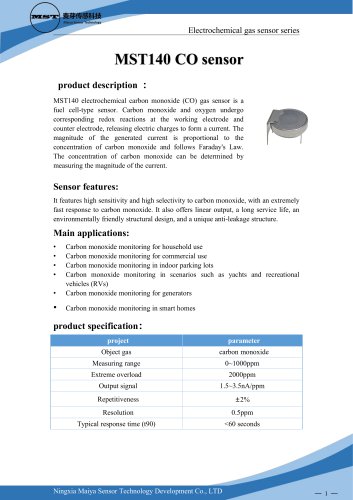 MaiYa MST140 co sensor
3 Pages
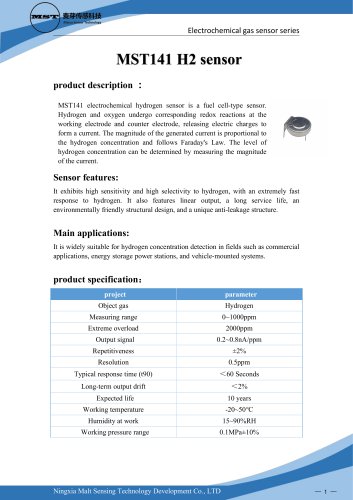 MaiYa MST141 H2 sensor
3 Pages
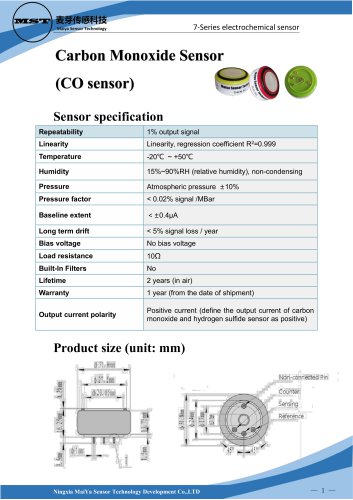 MaiYa CO sensor
3 Pages
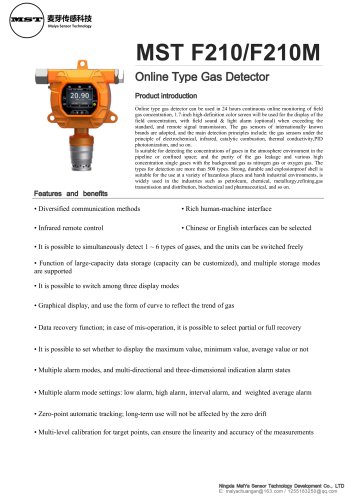 MST F210/F210M
5 Pages
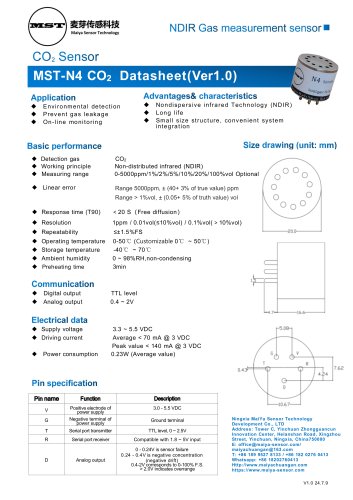 MaiYa MST-N4 NDIR CO2 sensor
1 Page
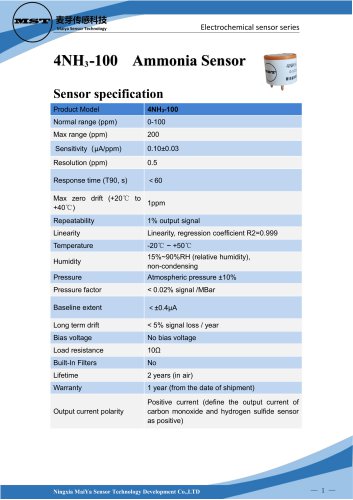 MaiYa MST-4 NH3 sensor
3 Pages
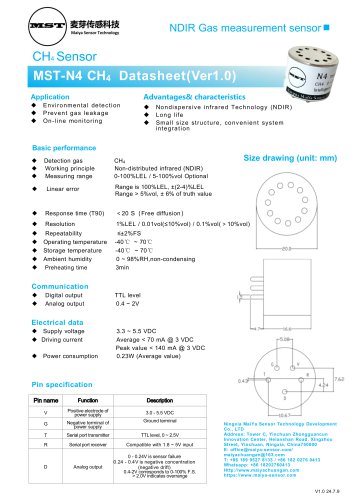 MaiYa MST-N4 NDIR CH4 sensor
1 Page
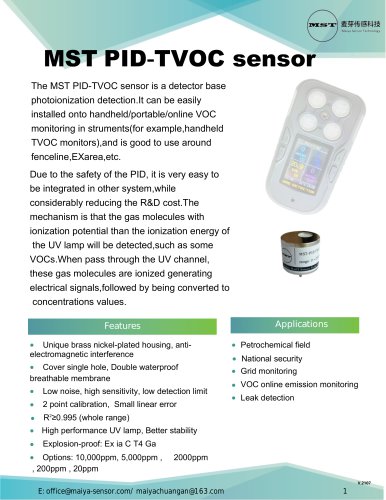 MaiYa MST-PID sensor
6 Pages

- Gas analyzer
- Concentration analyzer
- Monitoring analyzer
- Liquids analyzer
- Automatic analyser
- Benchtop analyser
- Process analyzer
- Gas detector
- Portable analyzer
- Continuous analyzer
- Real-time analyzer
- Oxygen analyzer
- Laboratory analyzer
- Digital analyzer
- Industrial detector
- Infrared analyser
- Calibration analyzer
- Monitoring detector
- Portable detector