
- Catalogs
- Nexson Group SAS
- plate heat exchanger


plate heat exchanger
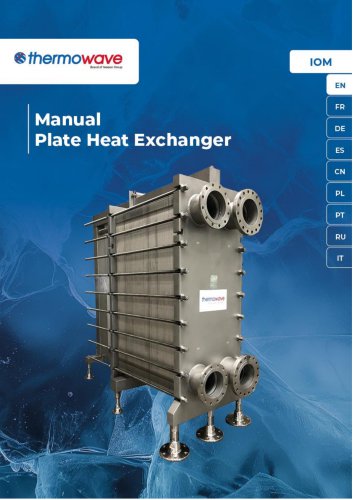
plate heat exchanger
This document provides comprehensive operating instructions for the ThermoLine plate heat exchanger by Thermowave GmbH, emphasizing the importance of understanding these instructions for smooth operation and reliability.
- Operating Instructions: Users must thoroughly read and understand the instructions.
- Limits of the Apparatus: The PHE is designed for specific mediums, pressures, and temperatures, requiring a stable installation surface.
- Technical Data: Refer to the technical data sheet for specific information.
- Environmental Conditions: Protect the PHE from moisture, dirt, and UV radiation.
- Other Limits: Proper disposal of materials is required after the life cycle ends.
- Warning Notices: Important safety information is provided to prevent misuse.
- Intended Use: The PHE should only be operated by skilled workers familiar with its hazards.
Details specific technical parameters and requirements for the PHE.
- Main Components: Describes the key parts of the PHE and their functions.
- Marking: Includes information on apparatus markings as per the Pressure Equipment Directive.
- Delivery and Transport: Guidelines for safely transporting and installing the PHE.
- Installation: Instructions for positioning and securing the PHE at the installation site.
Procedures for connecting, activating, shutting down, and reactivating the PHE.
General operational guidelines and safety measures.
- Performance Loss: Identifies potential causes and solutions for reduced performance.
- Lack of Leak-Tightness: Addresses issues related to leaks and their rectification.
- Maintenance Schedule: Regular maintenance tasks and intervals.
- Servicing Work: Instructions for replacing gaskets and repairing leaks.
- Cleaning: Methods for cleaning the PHE, including CIP and manual cleaning.
Guidelines for safely disassembling and disposing of the PHE components.
Includes parts list, technical data sheet, diagrams, and declaration of conformity.
The document outlines the connections for mediums, ventilation, and emptying facilities on the PHE, with detailed information available in order-related documents or on the nameplate.
Manufacturer's Responsibilities: Provide instructions to maintain the PHE's functional reliability.
Operator's Responsibilities: Ensure personnel are trained and unauthorized access is restricted.
Warranty claims are void if instructions are not followed or unauthorized changes are made.
Contact details for Thermowave GmbH are provided for service inquiries.
Warnings are categorized by severity, with precautionary measures highlighted.
The PHE is designed for specified operating conditions, and only trained personnel should handle it.
Technical specifications are referenced in order-related documents.
Describes the main components and structure of the PHE, including support rods and heat exchanger plates.
- Gasketed Plates: Allow for easy inspection and cleaning.
- Welded Modules: Suitable for aggressive mediums, ensuring durability.
- Delivery: Inspect for damage upon delivery.
- Transport Variants: PHEs are delivered either horizontally or vertically.
- Transport Safety: Use appropriate lifting means.
- Horizontal and Vertical Delivery: Instructions for safely erecting PHEs.
- Safety Precautions: Wear safety gear and use proper lifting equipment.
- Connection: Ensure the PHE is securely anchored.
- Activation: Follow safety protocols when operating with dangerous mediums.
- Ensure all safety devices are in place when using hazardous mediums.
- Regularly check for any damage or wear.
Warns against damaging plates and gaskets by straining the plate packet below the specified tensioning dimension.
Implement protective measures to prevent environmental damage when using harmful mediums.
Close upstream shut-off devices slowly to avoid abrupt pressure loads.
Conduct a visual inspection before re-commissioning.
Adhere to permissible pressures, temperatures, and mediums to prevent injuries.
Contact Thermowave's customer service for operational faults.
Regular maintenance is recommended to ensure secure operations.
Follow specific steps to avoid injury and damage.
Outlines the sequence for opening and closing tensioning screws in a PHE.
Instructions for the removal and installation of heat exchanger plates.
Distinguishes between CIP and mechanical cleaning methods.
Involves displacing plates for inspection and using soft brushes.
Disassembly poses injury risks, requiring the PHE to be inoperative.
Includes a parts list, technical data sheet, diagram, and declaration of conformity.
Catalog excerpts
thermowave Gesellschaft für Wärmetechnik mbH Eichenweg 4 06536 Berga
Open the catalog to page 1
Dear customer, You have decided to purchase a quality product from thermowave GmbH. Your plate heat exchanger represents an investment in a product that has been developed with respect to the latest research results. The individual components are in line with the latest status of the respective technology, and facilitate a high degree of functionality and reliability. The following pages contain operating instructions for your plate heat exchanger. These operating instructions list all the important measures that will facilitate smooth operations of your plate heat exchanger. Please ensure that...
Open the catalog to page 2
Brand of Nextort Croup
Open the catalog to page 3
Brand of Nexson Croup 9.6.1 Removal of the heat exchanger plates and the modules 9.6.3 Removal of the heat exchanger plates and the modules
Open the catalog to page 4
Brand of Nexson Croup 1.1 Following the operating instructionsNOTICE > Please read the operating instructions thoroughly and in full. > Ensure that the operating instructions are read and understood by all users who perform activities associated with the plate heat exchanger. > Always store the operating instructions in a manner that ensures that they can be accessed by all users at any time. 1.2 Limits of the apparatus The plate heat exchanger (PHE) is not a universal apparatus. It has been designed to be used in conjunction with specific mediums, pressures, temperatures and operating characteristics....
Open the catalog to page 5
Brand of Nexson Croup After the life cycle comes to an end, it is necessary to properly dispose of the materials that have been built into the PHE [► chapter 10]. The existing standards, guidelines, laws and regulations must be complied with. The connections for the mediums and potential ventilation and emptying facilities can be found on one or both plates and/or on a special intermediate frame. You can find out where the connections are located on your PHE by referring to the diagram [► chapter 11]. Information regarding the type of medium, pressure, connection design and its dimensions can...
Open the catalog to page 6
Legal information Warranty claims expire: ▪ in situations involving faults and damages that emerge as a result of the specifications contained in these operating instructions not having been complied with, in case of inappropriate usage and handling of the PHE, in case of complaints that arise because original spare parts had not been used while replacing device parts, if the PHE is subjected to changes [e.g. medium, function, stress amount (initial and final amounts), operating parameters] vis-à-vis the order-related information [► chapter 11] without obtaining prior approval from the manufacturer,...
Open the catalog to page 7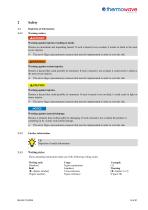
Brand of Nexson Croup Warning against injuries resulting in death. Denotes an immediate and impending hazard. If such a hazard is not avoided, it results in death or the most severe injuries. > The arrow flags a precautionary measure that must be implemented in order to avert the risk. Awarning Warning against serious injuries. Denotes a hazard that could possibly be imminent. If such a hazard is not avoided, it could result in death or the most severe injuries. > The arrow flags a precautionary measure that must be implemented in order to avert the risk. Acaution Warning against injuries. Denotes...
Open the catalog to page 8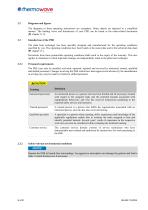
Brand of Nexson Croup The diagrams in these operating instructions are exemplary. Many details are depicted in a simplified manner. The binding views and dimensions of your PHE can be found in the order-related documents [► chapter 11.3]. The plate heat exchanger has been specially designed and manufactured for the operating conditions specified by you. The operating conditions have been listed on the name plate and in the technical data sheet [► chapter 11]. Deviations from these permissible operating conditions shall result in the expiry of the warranty. This also applies to situations in which...
Open the catalog to page 9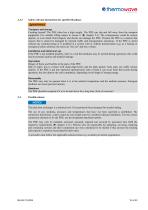
Safety-relevant instructions for specific life phases Transport and storage Crushing hazard! The PHE often has a high weight. The PHE can slip and fall away from the transport equipment. Use suitable lifting means to secure it [► chapter 5.3]. The consequences could be serious injuries, or even death. Hard impacts and shocks can damage the PHE. Position the PHE in a manner that ensures that it cannot be damaged by internal traffic and transportation operations. If the PHE is stored without any commissioning or is installed in a system with or without pressurization (e.g. as a backup or emergency/safety...
Open the catalog to page 10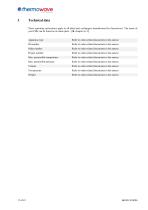
Brand of Nexson Croup These operating instructions apply to all plate heat exchangers manufactured by thermowave. The name of your PHE can be found on its name plate - [ ► chapter 4.1.2]. Apparatus type Order number Project number Test pressure Refer to order-related documents in the annexe Refer to order-related documents in the annexe Refer to order-related documents in the annexe Refer to order-related documents in the annexe Refer to order-related documents in the annexe Refer to order-related documents in the annexe Refer to order-related documents in the annexe Refer to order-related documents...
Open the catalog to page 11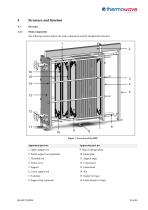
Brand of Nexson Croup 4.1 Structure4.1.1 Main components The following section depicts the main components and the fundamental structure. 9. Heat exchanger plate 16. Initial Gasket (4 rings) Apparatus part no. 1. Upper support rod 2. Profile support rod (optional) 8. Support foot (optional)
Open the catalog to page 12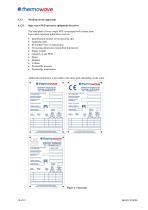
Brand of Nexson Croup 4.1.2.1 Sign as per PED (pressure equipment directive) The head plate of every single PHE is equipped with a name plate. It provides important information such as: • Identification number of the specified spot • Apparatus type • Tensioning dimension (initial/final dimension) • Empty weight • Permissible pressure • Permissible temperature
Open the catalog to page 13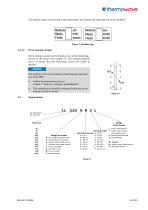
The medium signs can be found at the connections; they denote the entry and exit of the mediums. Figure 3: Medium sign Screw locking varnish Screw locking varnish can be found on two of the tensioning screws on the frame cover (Figure 4). The varnish primarily serves to ensure that the tensioning screws are sealed at delivery. The position of the screw locking varnish depends upon the size of the PHE. Follow the instructions given in chapter 5 “Delivery, transport, establishment”. The manufacturer should be informed before the screw locking varnish is broken. Design of the frames L : Carbon steel...
Open the catalog to page 14All Nexson Group SAS catalogs and technical brochures
 thermolineECO
7 Pages
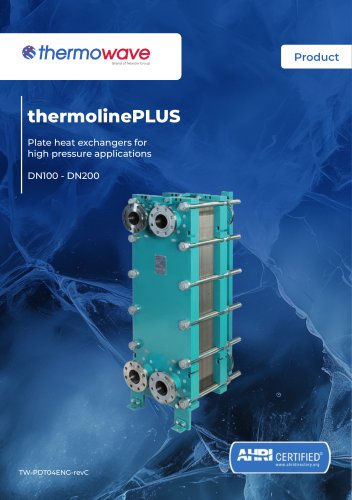 thermolinePLUS
6 Pages
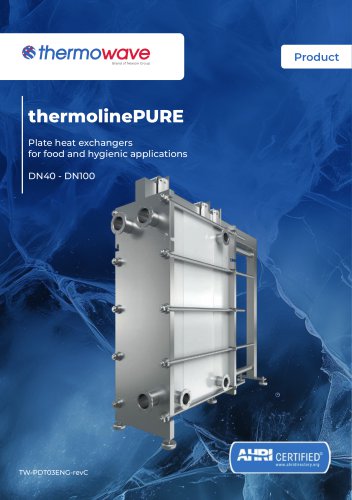 thermolinePURE
6 Pages
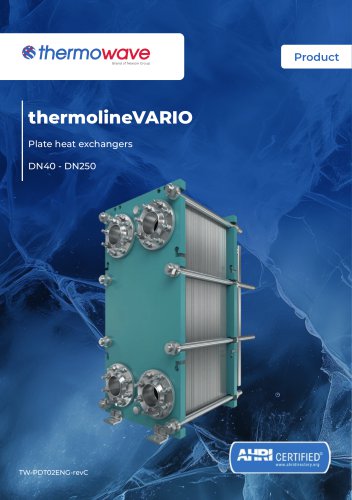 thermolineVARIO
7 Pages
 General brochure
36 Pages
- Automatic cleaning system
- Water cleaning system
- Liquid/liquid heat exchanger
- Stainless steel cleaning system
- Tubular heat exchanger
- Stainless steel heat exchanger
- Gas/liquid heat exchanger
- Compact cleaning system
- Industrial heat exchanger
- Mobile cleaning equipment
- Washing system for the food industry
- Compact heat exchanger
- Cleaning system with rinsing
- Process evaporator
- Washing system with dryer
- Gas/gas heat exchanger
- Heat exchanger for the food industry
- Technology heat exchanger