
- Catalogs
- Nexen Group, Inc.
- Air-Actuated vs. Electrically-Actuated


- Company
- Products
- Catalogs
- News & Trends
- Exhibitions
Air-Actuated vs. Electrically-Actuated

Air-Actuated vs. Electrically-Actuated
Nexen Group, Inc. conducted a comparative analysis of air-actuated versus electric clutch-brakes, highlighting seven key advantages of air-actuated systems. The tests, conducted by Huntingdon Engineering & Environmental, Inc., focused on performance and cost-saving aspects.
- Response Time: Air clutches respond 40% faster to full torque and 42% faster to zero torque compared to electric clutches.
- Torque Output: Air clutches transmit up to 145% more torque due to lower operating temperatures, whereas electric clutches transmit only 54% of their rated torque.
- Facing Life Comparison: Air clutches have a longer friction facing life, preventing metal-to-metal contact unlike electric units.
- Thermal Horsepower: Air clutches operate at lower temperatures, with a rated thermal horsepower of 0.14 compared to 0.10 for electric units.
- Repair Costs: Air clutches last more than twice as long as electric units and are cheaper to repair.
- Energy Consumption: Electric units consume 2.5 times more energy than air systems.
- Unit Cost Savings: Air clutches are up to 10% cheaper than electric counterparts.
Air-engaged clutch-brakes are more efficient due to less heat generation, leading to greater torque transmission and longer operating life. They are also more cost-effective, with simpler designs and fewer parts, resulting in significant savings.
- Response Time: Air clutches achieve full torque in 72 milliseconds and zero torque in 56 milliseconds, outperforming electric clutches.
- Clutch and Brake Overlap: Nexen's design eliminates overlap, unlike electric units which may experience simultaneous engagement.
- Torque Output and Fade: Air clutches maintain higher torque output and experience less torque fade due to lower operating temperatures.
- Facing Life: Air clutches have a longer friction facing life, with more usable material and better wear rate.
The analysis demonstrates that air-actuated clutch-brakes offer superior performance and cost-effectiveness compared to electric units, making them a better choice for industrial applications.
The document provides detailed calculations for determining the energy generated per cycle when a clutch or brake is engaged. It includes formulas for calculating usable volume, energy per capacity, and energy per cycle. The maximum number of cycles before the lining is consumed is derived by dividing the work energy capacity by the energy per cycle.
The Nexen FMCBE-625 pneumatic clutch-brake is compared to an electric clutch-brake in a conveyor system application. Key parameters include reflected inertia, speed at the clutch-brake location, energy per cycle, and maximum number of cycles. The pneumatic unit shows a higher number of cycles and longer life expectancy compared to the electric unit.
The document analyzes the electrical energy required for operating air-engaged versus electrically-engaged units. It calculates the volume of free air consumed per cycle and the horsepower required to compress this air. The pneumatic unit consumes significantly less energy than the electric unit.
The Nexen FMCBE-625 offers several advantages over electric clutch-brakes, including faster response time, higher dynamic torque, longer friction facing life, lower energy consumption, and reduced costs in unit price and repairs.
The document concludes that the Nexen Air Champ® line provides superior performance and cost efficiency compared to electric clutch-brakes. Nexen emphasizes its commitment to innovation and product improvement, supported by ISO 9001 certification.
Catalog excerpts
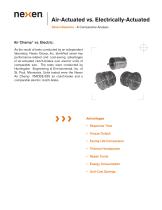
Air-Actuated vs. Electrically-Actuated Seven Reasons - A Comparative Analysis Air Champ® vs. Electric: As the result of tests conducted by an independent laboratory, Nexen Group, Inc. identified seven key performance-related and cost-saving advantages of air-actuated clutch-brakes over electric units of comparable size. The tests were conducted by Huntingdon Engineering & Environmental, Inc. of St. Paul, Minnesota. Units tested were the Nexen Air Champ FMCBE-625 air clutch-brake and a comparable electric clutch-brake. Advantages • Response Time • Torque Output • Facing Life Comparison • Thermal Horsepower • Repair Costs • Energy Consumption Unit Cost Savings
Open the catalog to page 1
Table of Contents Air Champ vs Electric: Seven Comparison Points ----------------------------------------------------------------------------------- 3 Introduction ------------------------------------------------------------------------------------------------------------------------------------------ 4 The Air Advantage --------------------------------------------------------------------------------------------------------------------------------- 5 The Tests: Nexen FMCBE-625 vs. An Electric Clutch-Brake Response Time -----------------------------------------------------------------------------------------------------------------------------...
Open the catalog to page 2
Air Champ® vs. Electric: Seven Comparison Points • Response Time: Response time is the increment of time in seconds from the time the power is turned on or off at the control valve, or power supply, to the time the clutch or brake responds with (full load) torque, or disengages and the torque begins to decay. The time to 100% clutch torque for the air clutch was 40% faster than for the electric clutch. The time to zero torque (brake on) for the air clutch was 42% faster than for the electric. • Torque Output: Tests focused on the torque output of NEMA 56 C-flanged air and electric clutch-brakes....
Open the catalog to page 3
Introduction As an international manufacturer of industrial power transmission brakes, clutches and clutch-brakes, Nexen leads the industry in innovation. Since 1951, our Engineering, Research and Development Teams have designed and tested products with one motivation in mind – to introduce quality products that help our customers reduce costs and increase productivity. Our products are continually evaluated and updated, and new products designed to meet the demands in the marketplace. With the introduction of the first air-actuated brakes on the market, Air Champ®, Nexen has set the highest...
Open the catalog to page 4
The Air Advantage Air-engaged clutch-brakes are more efficient and economical to operate than similarly sized electric clutch-brakes because of one important reason - air-engaged clutch-brakes generate less heat during operation. Less heat allows greater torque transmission and efficiency. The greater thermal capacity of air-engaged clutch-brakes gives them longer operating life. Since more work is done with an air-engaged clutch-brake, air actuation proves to be more cost effective. It also costs less to run an air compressor than to operate an electric clutch-brake. Nexen Air Champ products...
Open the catalog to page 5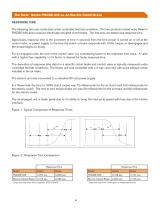
RESPONSE TIME The following test was conducted under controlled test tab conditions. The two products tested were Nexen’s FMCBE-625 and a popular electrically-actuated clutch-brake. The first area we tested was response time. Specifically, response time is the increment of time in seconds from the time power is turned on or off at the control valve, or power supply, to the time the clutch or brake responds with 100% torque, or disengages and the torque begins to decay. For air-engaged units, the size of the control valve is a contributing factor to the response time value. A valve with a higher...
Open the catalog to page 6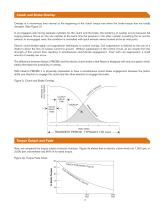
Clutch and Brake Overlap Overlap is a momentary time interval at the beginning of the clutch torque rise when the brake torque has not totally decayed. (See Figure 3.) In air-engaged units having separate cylinders for the clutch and the brake, the tendency of overlap occurs because full supply pressure forces air into one cylinder at the same time the pressure in the other cylinder is pushing the air out the exhaust. In air-engaged units, this condition is controlled with quick exhaust valves located at the air inlet ports. Electric clutch-brakes apply coil suppression techniques to control...
Open the catalog to page 7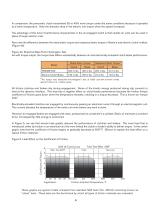
In comparison, the pneumatic clutch transmitted 35 to 40% more torque under the same conditions because it operated at a lower temperature. Note the dramatic drop in the electric unit torque when the speed increased. The advantage of this kind of performance characteristic in the air-engaged clutch is that smaller air units can be used in place of larger electric units. Also note the difference between the rated static torque and measured static torque in Nexen's and electric clutch- brakes. (Figure 4b) Figure 4b. Empirical Data From Huntingdon Test. As with torque output, the torque fade differs...
Open the catalog to page 8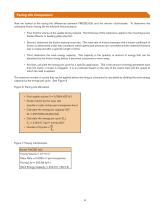
Facing Life Comparison Next we looked at the facing life differences between FMCBE-625 and the electric clutch-brake. To determine the estimated friction facing life we followed this procedure: • irst, find the volume of the usable facing material. The thickness of this material is usable to the mounting screw F heads (Nexen) or backing plate (electric). • econd, determine the friction material wear rate. (The wear rate of friction materials with a known coefficient of S friction is determined under test conditions where speed and pressure are controlled and the material thickness loss is measured...
Open the catalog to page 9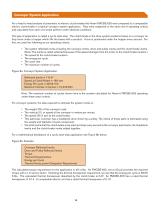
Conveyor System Application For a head to head analysis of pneumatic vs electric clutch-brakes the Nexen FMCBE-625 was compared to a comparable electric clutch-brake in a typical conveyor system application. They were subjected to the same set of operating criteria and calculated how each unit would perform under identical conditions. The type of application is called a cyclic start-stop. The clutch-brake in the drive system positions boxes on a conveyor as they move under a hopper which fills the boxes with a product. A box is positioned under the hopper every second. For this, we used the following...
Open the catalog to page 10All Nexen Group, Inc. catalogs and technical brochures
 PRECISION MOTION CONTROL
56 Pages
 LINEAR MOTION CONTROL
4 Pages
 PRINCIPALS OF OPERATION
1 Page
 Precision in motion.
2 Pages
 Compact Ring Drive
14 Pages
 Precision Ring Drive
10 Pages
 ECLIPSE PRODUCTS User Manual
14 Pages
 ECLIPSE PRODUCTS
14 Pages
 Linear Couplings
2 Pages
 Eclipse Servo Motor Brake
2 Pages
 Zero Backlash Gear Catalog
30 Pages
 Torque Limiter Catalog
16 Pages
 Servo Brake Catalog
16 Pages
 Rod Lock Catalog
12 Pages
 Rail Brake Catalog
8 Pages
 Indexer Brake Catalog
2 Pages
 Clutch & Brake Catalog
388 Pages


- Force sensor
- Coaxial gearhead
- Clamping device
- Tension/compression force transducer
- Precision gearhead
- Strain gauge force sensor
- Compact gearhead
- Solid-shaft gearhead
- Pressure separator filter
- Gearbox for industrial applications
- Friction brake
- Signal amplifying integrated circuit
- Clamp gearbox
- Basket filter
- Spring brake
- Disc brake
- Friction brake caliper
- High load capacity gear reducer
- Electromagnetic brake
- Friction clutch