
- Catalogs
- NETZSCH Grinding & Dispersing
- Fine-Grinding and Fine-Classifying


Fine-Grinding and Fine-Classifying

Fine-Grinding and Fine-Classifying
- Fine Impact Mill CONDUX® 60: Suitable for fine grinding applications.
- Steam Jet Mill S-JET® 25: Utilizes steam for fine grinding.
- Fluidized Bed Jet Mill CGS 10: Offers efficient fine classification.
- Classifier Mill CSM: Combines grinding and classifying in one step.
- High-Efficiency Fine Classifier CFS/HD-S: Provides precise classification.
Catalog excerpts

Proven Excellence. Fine-Grinding and Fine-Classifying for Processing Dry Products - NETZSCH Trockenmahltechnik GmbH Business Unit GRINDING & DISPERSING
Open the catalog to page 1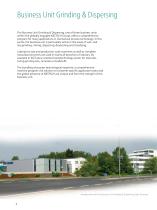
Business Unit Grinding & Dispersing The Business Unit Grinding & Dispersing, one of three business units within the globally engaged NETZSCH-Group, offers a comprehensive program for many applications in mechanical process technology. In this sector, the business unit is particularly active in the areas of wet- and dry-grinding, mixing, dispersing, deaerating and classifying. Laboratory-size and production-scale machines as well as complete manufacturing lines are used in nearly all branches of industry, for example in the future-oriented nanotechnology sector for manufacturing printing inks,...
Open the catalog to page 2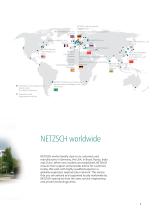
NETZSCH Vakumix GmbH Weyhe-Dreye NETZSCH Mastermix Ltd. Lichfield NETZSCH Trockenmahltechnik GmbH Hanau AO NETZSCH Tula Tula NETZSCH FRÈRES S.A.R.L. Arpajon NETZSCH Premier Technologies, LLC. Exton NETZSCH Espana S.A.U. Terrassa Tramega Terrassa ECUTEC Barcelona S.L. Barcelona Companies which belong to the Business Unit Grinding & Dispersing NETZSCH Korea Co., Ltd. Goyang NETZSCH Makine Sanayi ve Ticaret Ltd. Sti. NETZSCH (Shanghai) Machinery and Instruments Co., Ltd. Shanghai NETZSCH-Feinmahltechnik GmbH Selb NETZSCH Lohnmahltechnik GmbH Bobingen NETZSCH Technologies India Private Ltd. Chennai...
Open the catalog to page 3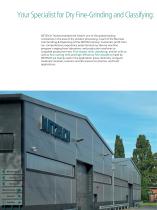
NETZSCH Trockenmahltechnik GmbH, one of the global leading companies in the area of dry product processing, is part of the Business Unit Grinding & Dispersing of the NETZSCH Group. Customers profit from our comprehensive experience potential and our diverse machine program, ranging from laboratory- and production machines to complete production lines. Fine impact mills, classifying- and jet mills as well as fine-cutting mills and high-efficiency fine classifiers made by NETZSCH are mainly used in the application areas chemistry, inorganic materials/minerals, ceramics and life science for pharma-...
Open the catalog to page 4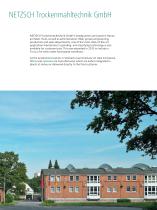
NETZSCH Trockenmahltechnik GmbH NETZSCH Trockenmahltechnik GmbH’s headquarters are based in Hanau am Main. Here, as well as administration, R&D, process engineering, production and sales departments, one of the most state-of-the-art application laboratories in grinding- and classifying technology is also available for customer tests. This was extended in 2015 to include a FOODLAB for tests under food-grade conditions. At the production location in Stockach near Konstanz on Lake Constance, filters and cyclones are manufactured, which are either integrated in plants at Hanau or delivered directly...
Open the catalog to page 5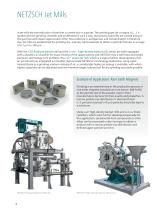
NETZSCH Jet Mills In jet mills the size-reduction of particles is carried out in a gas jet. The grinding gas (air or argon, N2, ...) is guided into the grinding chamber and accelerated in such a way, that product particles are carried along in the gas flow and impact against each other. Size-reduction is autogenous and contamination is therefore low. Jet mills are predestined for grinding dry- and very hard materials to obtain a particle fineness in a range of 0.1 µm to 100 µm. With the CGS fluidized bed jet mill and the CONJET® high-density bed jet mill, which are both equipped with a dynamic air...
Open the catalog to page 6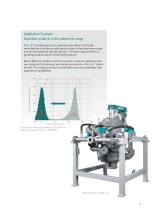
Application Example: Superfine products in the submicron range The S-JET® grinding process is opening new doors for the dry manufacture of products with particle sizes in the submicron range and an exact particle size distribution. The basic requirement is a grinding product which is thermally resistant. Many different products, such as minerals, ceramics, pigments and raw materials for batteries are already processed on the S-JET® steam jet mill. This unique process has provided access to completely new application possibilities. x (diameter) / µm Particles size measuring method CILAS 1064 wet...
Open the catalog to page 7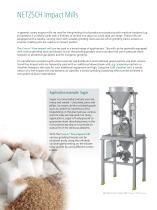
NETZSCH Impact Mills In general, rotary impact mills are used for the grinding of soft products to products with medium-hardness (up to hardness 3 on Mohs scale) with a fineness of several mm down to a one-digit µm-range. These mills are equipped with a rapidly-running rotor with suitable grinding tools around which grinding tracks, screens or counter-rotating pins are used as an impact partner. The CONDUX® fine-impact mill can be used in a broad range of applications. This mill can be optimally equipped with various grinding tools and stators to suit the grinding product and it can also find use...
Open the catalog to page 8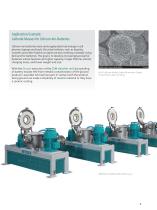
Application Example: Cathode Masses for Lithium-Ion-Batteries Lithium ion batteries store and supply electrical energy in cell phones, laptops and tools. Electrical vehicles, such as bicycles, scooters and other hybrid concepts are also creating a steadily rising demand for batteries. The goal is to develop increasingly powerful batteries whose features are higher capacity, longer lifetime, shorter charging times, and lower weight and size. With the CERAMIC-execution of the CSM classifier mill, dry-grinding of battery masses free from metallic contamination of the ground product is possible! All...
Open the catalog to page 9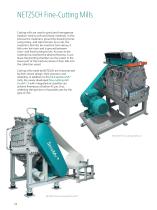
NETZSCH Fine-Cutting Mills Cutting mills are used to grind and homogenize medium-hard to soft and elastic materials. In this process the material is ground by shearing forces using rotary- and stator knives. As a rule, the material is fed into the machine from above, it falls onto the rotor and is ground between rotor- and fixed cutting knives. As soon as the material has reached the desired fineness, it can leave the grinding chamber via the screen in the lower part of the machine where it then falls into the collection vessel. Cutting mills made by NETZSCH are characterized by their robust design,...
Open the catalog to page 10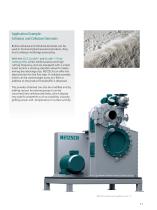
Application Example: Cellulose and Cellulose Derivates Before cellulose and cellulose derivates can be used in food and pharmaceutical products, they must undergo multistage processing. With the CS-Z, SECOMY® and SECOMY® S finecutting mills, which exhibit precise and high cutting frequency and are equipped with a screen insert and/or a rotating classifier wheel for determining the discharge size, NETZSCH can offer the ideal solution for the first step. A cellulose powder, which can be used straight away as a filler or additive to the product (foodstuffs) is obtained. The powder obtained can also...
Open the catalog to page 11All NETZSCH Grinding & Dispersing catalogs and technical brochures
 NETZSCH MiniVac
2 Pages
 NETZSCH ConduxVita
4 Pages
 NETZSCH Pre-Grinding Mill ProPhi
12 Pages
 NETZSCH Zumba
4 Pages
 Salsa® System
12 Pages
 NETZSCH MasterCream
8 Pages
 Laboratory Mill MiniZeta
2 Pages
 NETZSCH Image G&D
28 Pages
 NETZSCH Connect
4 Pages
 NETZSCH Fine Classifier CFS
8 Pages
 Pamir
Pamir4 Pages
 NETZSCH-Beads®
20 Pages
 NETZSCH Steam Jet Mill s-Jet®
20 Pages
 NETZSCH Classifier Mills CSM
12 Pages
 Milling of Spices
4 Pages
 NETZSCH Fine Impact Mill CONDUX®
12 Pages
 NETZSCH SPHERHO®
4 Pages
 EpsilonVita Inline Disperser
2 Pages
 Vacuum De-Aerator DA/DA-VS
8 Pages
 Inline Disperser MaxShear
4 Pages
 PMD-VC Intensive Mixers
8 Pages
 MasterMix® Dissolver
8 Pages
 Ψ-Mix® Inline-Disperser
12 Pages
 NETZSCH Mill Control Systems
12 Pages
 Atlas Vertical Roller Mill
4 Pages
 URAL | Air classifier mill
4 Pages
 Bora Air Classifier
4 Pages
 ALPHA®LAB
2 Pages
 Agitator Bead Mill Alpha®
24 Pages
 Discus Grinding System
12 Pages
 MONSOON | Whizzer Classifier
4 Pages
 Nanomill Zeta RS
20 Pages
 Zeta® Grinding System
8 Pages
 Epsilon Inline Disperser
8 Pages
 AfterSales Support
16 Pages
 NETZSCH CaseStudy Tango
8 Pages
 Discus Intensive Rotor
12 Pages
 Grinding System Neos®
12 Pages
 Netzsch filter and cyclones
12 Pages
 NETZSCH SmartRemoval
4 Pages
 Laboratory Plants
20 Pages
 NETZSCH Toll Grinding
8 Pages
 NETZSCH_DeltaVitaMini
4 Pages
 Agitator Bead Mill DeltaVita®
12 Pages
 Fine Cutting Mill SecoMy
8 Pages
 NETZSCH Case Study Sakata
8 Pages
 NETZSCH Case Study S&S
8 Pages


- Vessel
- Dynamic agitator
- Batch agitator
- Filter with cartridge
- Solids separator
- Metal tank
- Liquid homogenizer
- Industrial use filter
- Pressure separator filter
- NETZSCH centrifugal separator
- Homogenizer for the chemical industry
- Vertical tank
- Dust collector
- NETZSCH horizontal mill
- NETZSCH vertical mill
- Dust separator filter
- NETZSCH food mill
- Cascade separator
- Blender for the pharmaceutical industry