
- Catalogs
- NETZSCH Analyzing & Testing
- Thermal Insulation Materials


- Company
- Products
- Catalogs
- News & Trends
- Exhibitions
Thermal Insulation Materials

Thermal Insulation Materials
Thermal insulation materials are designed to minimize heat transfer through conduction, convection, and radiation. They are essential for energy conservation, temperature control, vapor flow facilitation, system efficiency enhancement, and compliance with industry standards.
Types of Insulation Materials
- Fibrous Insulations: Made from small diameter fibers such as silica, glass, rock wool, and alumina silica, with glass fiber and mineral wool being common types.
- Cellular Insulations: Composed of small cells, often made from glass or foamed plastics like polystyrene and polyurethane.
- Granular Insulations: Contain voids or hollows, examples include calcium silicate and expanded vermiculite.
Main Modes of Heat Transfer
- Convection: Predominant in liquids and gases, involving conduction and fluid flow.
- Radiation: Occurs without a medium, based on electromagnetic radiation.
- Conduction: Significant in solids, involving energy transfer through atomic interactions.
Testing and Standards
Performance of thermal insulation materials is tested using methods like heat flow meters and guarded hot plates, adhering to ASTM and ISO standards for thermal conductivity measurement.
Instruments for Thermal Conductivity Measurement
- NETZSCH GHP 456 Titan®: Uses the guarded hot plate technique, suitable for a wide temperature range without calibration standards.
- NETZSCH Thermal Conductivity Tester 426: Operates on the hot wire technique, suitable for various thermal conductivities.
- Heat Flow Meters HFM 436 Lambda Series: Accurate and fast, ideal for low-conductivity materials, with features like automatic thickness determination.
Unique Features of Instruments
Instruments like the GHP 456 Titan® feature motorized hoists, high-resolution temperature measurement, and computerized control systems for enhanced test speed and accuracy.
Technical Specifications of GHP 456 Titan®
The GHP 456 Titan® supports symmetrical test configurations with two samples, operating from -160°C to 250°C, measuring thermal conductivity from 0 to 2 W/(m·K). It accommodates various atmospheres and sample thicknesses up to 100 mm, with standard plate dimensions of 300 x 300 mm, and is vacuum-tight to 10-4 mbar. Cooling options include forced air, refrigerated bath circulator, and liquid nitrogen systems, with optimized temperature measurement using 29 calibrated Pt-100 sensors.
Principle of Operation
The system uses a hot plate and guard ring between two samples, with cold plates establishing a temperature difference. Power input is measured at thermal equilibrium to calculate thermal conductivity using the steady-state heat transfer equation.
Thermal Analysis Techniques
Techniques like Differential Scanning Calorimetry (DSC) and Simultaneous Thermal Analysis (STA) are crucial for understanding thermal properties such as specific heat, enthalpies, and mass changes. DSC analyzes energetic effects in solids or liquids, while STA combines Thermogravimetry (TG) and DSC for comprehensive analysis.
Applications in Insulation Materials
Discusses materials like expanded polystyrene (EPS), extruded polystyrene (XPS), polyurethane (PUR), and polyisocyanurate (PIR). EPS is noted for thermal and acoustical insulation, XPS for reliability and environmental resistance, and PUR for low thermal conductivity and high mechanical stability.
Dilatometry and Dielectric Analysis
Dilatometry measures dimensional changes in materials, applicable to metallic alloys, ceramics, and plastics. Dielectric Analysis investigates resin curing behavior, providing insights into ion mobility and dipole alignment.
Aerogels and Fiber Insulations
Aerogels are excellent insulators due to low pore sizes, reducing gas conduction, produced through supercritical drying. Fiber insulations like rock mineral wool and glass fiber offer thermal, acoustic, and fire insulation properties, used in building and horticulture.
Conclusion
The document provides a comprehensive overview of thermal analysis techniques and their applications in insulation materials, emphasizing the importance of understanding thermal properties for developing and optimizing insulation solutions.
Overview of Thermal Analysis and Glass Wool Properties
Glass wool is highlighted for its fire-resistant properties and use as a thermal insulation and acoustic absorbent material. Melting occurs between 1050°C and 1250°C with an enthalpy of 549 J/g, with slight mass changes above 700°C due to oxidation and evaporation of impurities.
NETZSCH Services and Expertise
NETZSCH offers comprehensive support and reliable service worldwide, including installation, commissioning, preventive maintenance, calibration, and on-site repairs, along with training programs to maximize instrument potential.
Applications Laboratories
NETZSCH's Thermal Analysis applications laboratories provide extensive support for thermal analysis issues, from sample preparation to result interpretation, offering high-precision measurement results and valuable interpretations.
Company Profile
NETZSCH is a mid-sized, family-owned German company with a global presence in machinery and instrumentation manufacturing, operating through three business units: Analyzing & Testing, Grinding & Dispersing, and Pumps & Systems, employing over 3,000 people in 28 countries.
Catalog excerpts
Analyzing & Testing Thermal Insulation Materials Material Characterization, Phase Changes, Thermal Conductivity Leading Thermal Analysis
Open the catalog to page 1
Thermal insulation materials are specifically designed to reduce the heat flow by limiting heat conduction, convection, radiation or all three while performing one or more of the following functions: ■ Conserving energy by reducing heat loss or gain ■ Controlling surface temperatures for personnel protection and comfort ■ Facilitating vapor flow and water condensation of a process ■ Increasing operating efficiency of heating/ventilating/cooling, plumbing, steam, process and power systems found in commercial and industrial installations ■ Assisting mechanical systems in meeting standard criteria...
Open the catalog to page 2
Main Modes of Heat Transfer Heat transfer is the transition of thermal energy, or simply heat, from a hotter object to a cooler object. There are three main modes of heat transfer: Convection is usually the dominant form of heat transfer in liquids and gases. Convection comprises the combined effects of conduction and fluid flow. In convection, enthalpy transfer occurs by the movement of hot or cold portions of the fluid/gas together with heat transfer by conduction. Radiation is the only form of heat transfer that can occur in the absence of any form of medium (i.e., in a vacuum). Thermal radiation...
Open the catalog to page 3
Testing Insulation Materials ide Carb e pper , Sili con Diam ond Fibe r Bo Build ards, Fib er In ing B sula oard tion s, O s, ils Woo d, Po lyme rs, C oal Wat er Con crete , Gla ss, F ire C Poro lay us C eram ics, R efra ctor ies Alum ono silic Silico n Ni ates tride Air, Micr opo Poly styre rous Ins ul ne, P U Fo ations ams system to achieve the required efficiency, and what are the best materials to use? How do I design a heat exchanger from an electronic component? How can I improve the heat transfer How does this change with the What is the heating ooling load of /c For highly conductive...
Open the catalog to page 4
The guarded hot plate and heat flow meter methods are standardized test techniques. The "insulation materials" application has many standards associated with it. The NETZSCH GHP 456 and HFM 436 series instruments are confirmed for compliance with all of these. Examples for hot wire standards are listed as well. international Standards
Open the catalog to page 5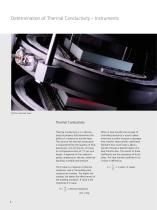
Determination of Thermal Conductivity – Instruments Thermal Conductivity Thermal Conductivity λ is a thermophysical property that determines the ability of a material to transfer heat. The value of the thermal conductivity is characterized by the quantity of heat passing per unit of time per unit area at a temperature drop of 1°C per unit length. It depends on the medium‘s phase, temperature, density, molecular bonding, humidity and pressure. The R value is a measure of thermal resistance used in the building and construction industry. The higher the number, the better the effectiveness of the...
Open the catalog to page 6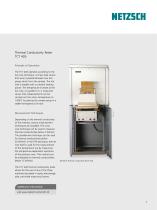
Thermal Conductivity Tester TCT 426 Principle of Operation The TCT 426 operates according to the hot wire technique. A linear heat source (hot wire) is placed between two test pieces which form the sample. The hot wire is loaded with a constant heating power. The temperature increase at the hot wire, or parallel to it, is measured versus time. Measurements can be carried out from room temperature to 1450°C by placing the sample setup in a stable homogenous furnace. Measurement Techniques Depending on the thermal conductivity of the material, various measurement techniques are available. The crosswire...
Open the catalog to page 7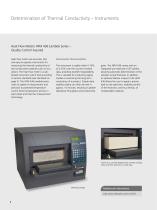
Determination of Thermal Conductivity – Instruments Heat Flow Meters HFM 436 Lambda Series – Quality Control Assured Heat flow meters are accurate, fast and easy-to-operate instruments for measuring the thermal conductivity of low-conductivity materials such as insulations. The heat flow meter is a calibrated instrument which tests according to various standards (see standards on page 5). The HFM 436 Lambda series owes its speed of measurement and precision to patented temperature control (three temperature sensors in each plate) and heat flux measurement technology. Instruments Characteristics...
Open the catalog to page 8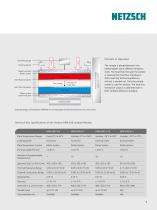
Hoisting device Thickness gauge Electronics and data acquisition system Upper heat sink Peltier system Hot plate Heat flux transducer Test sample Direction of heat flow Heat flux transducer Cold plate Peltier system Lower heat sink The sample is placed between two heated plates set at different temperatures. The heat flow through the sample is measured by heat flux transducers. After reaching thermal equilibrium, the test is carried out. Only the sample center is used for analysis. The heat flux transducer output is calibrated with a NIST certified reference standard. Cooling system Schematic...
Open the catalog to page 9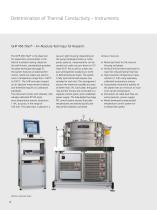
The GHP 456 Titan® is the ideal tool for researchers and scientists in the field of insulation testing. Based on the well-known, standardized guarded hot plate technique (see page 5), the system features unrivaled performance. Aluminum plates are used to cover a temperature range from -160°C to 250°C. The GHP principle is based on an absolute measurement method and therefore requires no calibration standards. The instrument works with sheeted, individually calibrated PT100 resistance temperature sensors (resolution 1 mK, accuracy in the range of 100 mK). The plate stack is placed in a vacuum-tight...
Open the catalog to page 10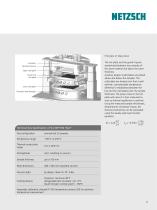
NETZ5CH Principle of Operation The hot plate and the guard ring are sandwiched between two samples of the same material and about the same thickness. Auxiliary heaters (cold plates) are placed above and below the samples. The cold plates are heated such that a well-defined, user-selectable temperature difference is established between the hot and the cold plates (over the sample thickness). The power input in the hot plate with area A is then measured as soon as thermal equilibrium is reached. Using the measured sample thicknesses, temperatures and power inputs, the thermal conductivity can be...
Open the catalog to page 11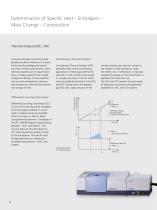
Determination of Specific Heat – Enthalpies – Mass Change – Composition To environmentally and economically develop insulation materials, it is essential to have knowledge and control over their thermal conductivities. Other thermal properties are of equal importance, including specific heat, length change and density. These properties can vary with temperature, pressure, and composition, affecting the transfer and storage of heat. Simultaneous Thermal Analysis Simultaneous Thermal Analysis (STA) generally refers to the simultaneous application of Thermogravimetry (TG) and DSC to one and the...
Open the catalog to page 12All NETZSCH Analyzing & Testing catalogs and technical brochures
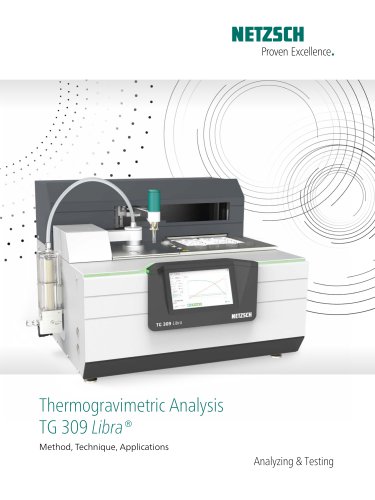 TG 309 Libra Series
24 Pages
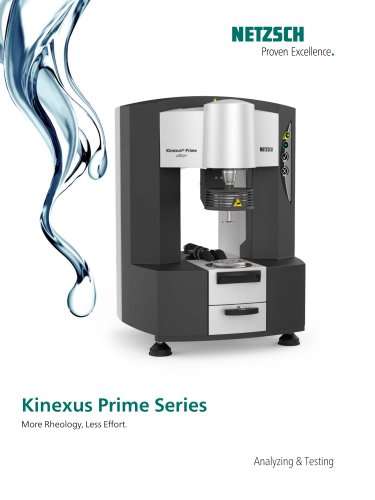 Kinexus Prime Series
20 Pages
 NTA Fire Testing Systems
20 Pages
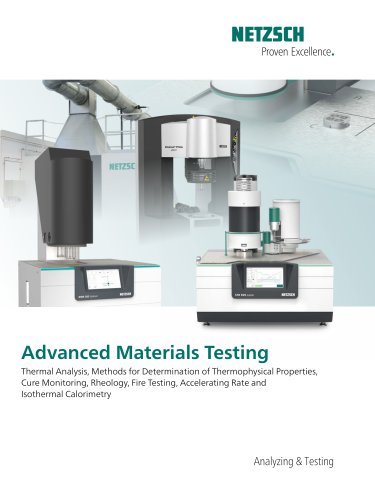 Advanced Materials Testing
32 Pages
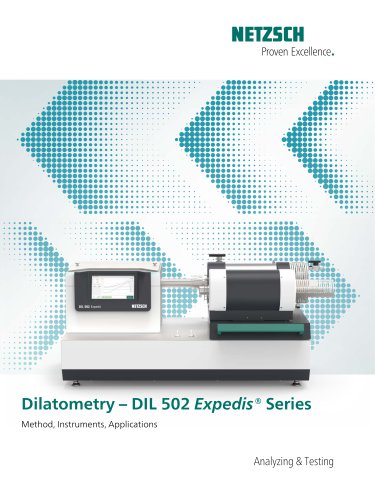 DIL 502 Expedis Series
28 Pages
 NETZSCH Energy Solutions
40 Pages
 Product Overview
12 Pages
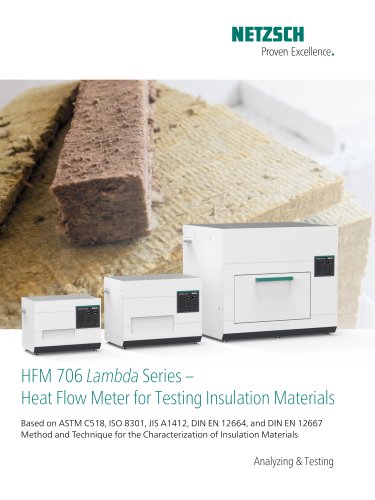 HFM 706 Lambda Series
16 Pages
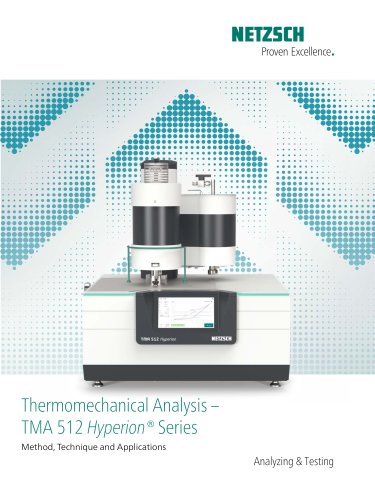 TMA 512 Hyperion® Series
24 Pages
 LFA 427 - product brochure
24 Pages
 Kinexus Prime DSR Series
20 Pages
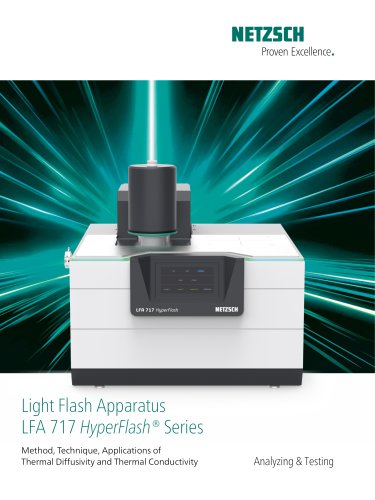 LFA 717 HyperFlash® Series
28 Pages
 DMA 303 Eplexor
24 Pages
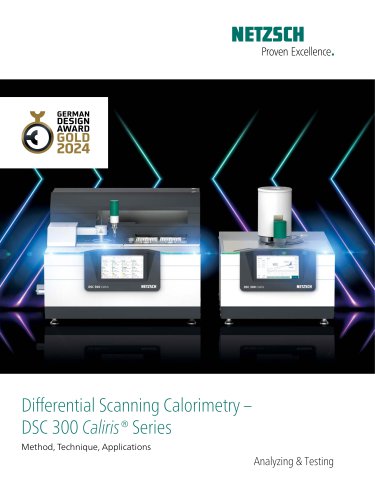 DSC 300 Caliris Series
28 Pages
 STA 509 Jupiter Series
28 Pages
 DEA 288 Ionic
20 Pages
 STA 2500 Regulus
12 Pages
 NTA Guarded Hot Plate Series
16 Pages
 Rosand Series
20 Pages
 Accelerating Rate Calorimetry
20 Pages
 NTA HotBoxes
16 Pages
 DIL 402 Expedis Classic
16 Pages
 Kinetics NEO
20 Pages
 TG-FTIR - product brochure
24 Pages
 TA-QMS Coupling
28 Pages
 HMOR 422
1 Page
 RUL/CIC 421
1 Page
 Cone Calorimeter TCC 918
12 Pages
 SBA 458 Nemesis®
24 Pages
 NETZSCH NEVIO Instrument Series
24 Pages
 DMA GABO EPLEXOR up to 1500°C
12 Pages
 GABOMETER®
8 Pages





- Test machine
- NETZSCH measuring instrument
- NETZSCH gas analyzer
- NETZSCH test chamber
- Concentration analyzer
- Monitoring analyzer
- Analysis software solution
- Liquids analyzer
- Test stand
- NETZSCH automatic analyzer
- Temperature test chamber
- Windows software
- Automated testing machine
- Material test machine
- Climatic test cabinet
- NETZSCH benchtop analyzer
- NETZSCH solids analyzer
- Spectrometer
- Quality control test cell
- Computer-controlled test machine