
- Catalogs
- NETZSCH Analyzing & Testing
- Thermal Characterization of Polymers


- Company
- Products
- Catalogs
- News & Trends
- Exhibitions
Thermal Characterization of Polymers
Thermal Characterization of Polymers
Polymer materials are essential in modern life due to their versatility and cost-efficiency. The industry is moving towards sustainability, focusing on recycling, bio-based alternatives, and accurate material characterization. This transformation requires reliable testing and quality assurance.
Thermal analysis and rheology are key for understanding polymer behavior during processing and use. Thermal analysis identifies phase transitions and thermal stability, while rheology assesses material deformation and flow. These analyses predict processability and performance.
Fire testing evaluates flammability, smoke generation, and heat release, ensuring safety and compliance with regulations. These tests are crucial for understanding structural changes in polymers under temperature and time.
Techniques like Differential Scanning Calorimetry (DSC), Thermogravimetric Analysis (TGA), and Simultaneous Thermal Analysis (STA) provide insights into thermal, mechanical, and fire-related properties, supporting quality control and research.
DSC analyzes energetic effects in polymers, providing data on melting/crystallization temperatures and oxidative stability, aiding in product identification and process optimization.
TGA measures mass changes with temperature or time, offering insights into thermal stability and composition, useful in quality control and failure analysis.
STA combines TGA and DSC, providing comprehensive data on mass changes and compositional analysis under identical conditions.
TMA and DIL measure dimensional changes under temperature and load, essential for characterizing polymers and composites.
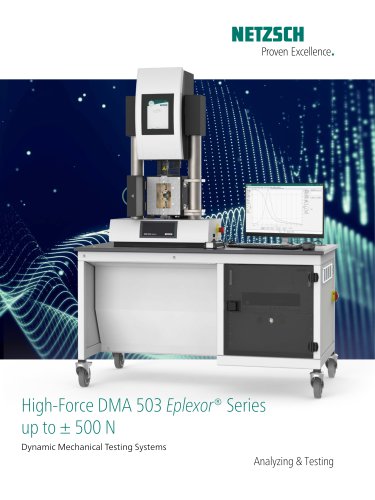
DMA determines mechanical properties under oscillating force, providing data on stiffness, damping, and glass transitions, supporting product development and quality control.
NETZSCH Analyzing & Testing offers a comprehensive portfolio of instruments and expertise for polymer characterization, supporting innovation and quality assurance.
The document discusses the curing behavior of thermosetting resin systems, highlighting Dielectric Analysis (DEA) as a method for investigating curing behavior and optimizing production processes.
DEA measures changes in dielectric properties during curing, applicable in both laboratory settings and in-situ monitoring for process control.
Capillary rheometry measures shear and extensional flow properties of polymer melts, aiding in material development and process troubleshooting.
Rotational rheometry characterizes the flow and deformation behavior of polymers, supporting a wide range of tests and equipped with a UV-curing system for photo-reactive polymers.
The Laser Flash Technique (LFA) and Heat Flow Meters (HFM) measure thermal conductivity and diffusivity, essential for predicting heat transfer and processing behavior.
Fire testing methods like UL 94 and LOI assess flammability, with the Cone Calorimeter providing comprehensive data on fire growth and regulatory approval.
Kinetics Neo software analyzes the kinetics of temperature-dependent chemical processes, offering insights into reaction steps and kinetic parameters.
Materials analyzed include PA6, PA66, PMMA, and rubber compounds, focusing on parameters like glass transition temperature, melting temperature, and thermal conductivity.
DSC and DMA analyses determine thermal transitions and mechanical properties, conducted at various heating rates and frequencies.
Findings include glass transition temperatures, melting points, and the influence of moisture on material properties.
Consider the effects of moisture and additives on thermal and mechanical properties when selecting materials, and use DSC for quality control.
DSC curves and DMA graphs highlight transitions and variations in material properties.
Data on thermal diffusivity, specific heat capacity, and thermal conductivity are provided, showing changes with temperature.
Fillers like glass fiber and Al2O3 enhance mechanical properties and affect thermophysical properties.
LFA measures thermophysical properties, with special sample holders for laminate testing.
Thermal conductivity tests on EPS samples show consistent results, meeting standards.
DSC tests reveal glass transition temperatures and specific heat changes, while thermal analysis of rubber compounds shows mass loss.
Sections include thermal analysis, dynamic mechanical analysis, differential scanning calorimetry, thermogravimetric analysis, evolved gas analysis, dielectric analysis, and material properties.
NETZSCH offers an Unlimited Warranty for their instruments, emphasizing comprehensive coverage and expert service.
Catalog excerpts
Proven Excellence. Thermal and Rheological Characterization of Polymers Thermoplastics, Thermosets, Elastomers Analyzing & Testing
Open the catalog to page 1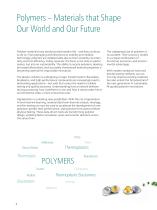
Polymers – Materials that Shape Our World and Our Future Polymer materials have revolutionized modern life – and they continue to do so. From packaging and electronics to mobility and medical technology, polymers are indispensable due to their versatility, functionality, and cost-efficiency. Today, however, the focus is not only on performance, but also on sustainability. The ability to recycle polymers, develop bio-based alternatives, and accurately characterize material properties is becoming essential for responsible innovation. The plastics industry is undergoing a major transformation. Recyclates,...
Open the catalog to page 2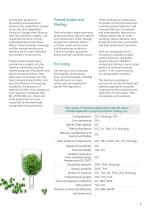
During their production, processing, and application, polymers are subjected to temperature- and time-dependent structural changes that influence their flow behavior, stability, and overall performance. To fully understand and control these effects, thermal analysis, rheology, and fire testing have become essential tools in both industrial and research environments. These analytical techniques provide deep insights into the thermal, mechanical, and fire-related properties of polymers and polymer-based products. They allow users to evaluate not only basic material characteristics, but also the...
Open the catalog to page 3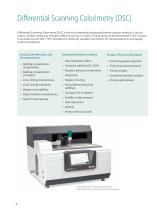
Differential Scanning Calorimetry (DSC) is the most frequently employed thermal analysis method. It can be used to analyze nearly any energetic effect occurring in a solid or liquid during thermal treatment. DSC analysis in accordance with ISO 1 1357 provides the following valuable information for the development and quality control of polymers: Product Identification and Characterization ■ Glass transition temperatures ■ Specific heat capacity Advanced Materials Analysis ■ Reaction behavior and kinetics ■ Purity determination for additives ■ Stability under pressure Product/Process Information...
Open the catalog to page 4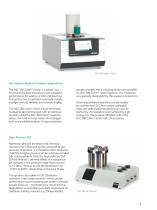
DSC Systems Made for Polymer Applications The DSC 300 Caliris® Classic is a robust, economical entry-level instrument with excellent performance for quality control and teaching. This system has an optional automatic sample changer with 20 samples and a touch display. The DSC 300 Caliris® Select allows the sensor module to be interchanged with an identical module, while the DSC 300 Caliris® Supreme allows the module to be freely interchanged with any available module. A large automatic sample changer and a coupling option are available for DSC 300 Caliris® Select/Supreme. The P-Module was specially...
Open the catalog to page 5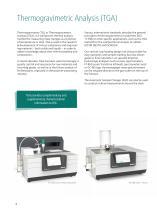
Thermogravimetric Analysis (TGA) Thermogravimetry (TG), or Thermogravimetric Analysis (TGA), is a well proven thermal analysis method for measuring mass changes as a function of temperature or time. TGA is used in the research & development of various substances and engineering materials – both solids and liquids – in order to obtain knowledge about their thermal stability and composition. In recent decades, TGA has been used increasingly in quality control and assurance for raw materials and incoming goods, as well as in the failure analysis of finished parts, especially in the polymer-processing...
Open the catalog to page 6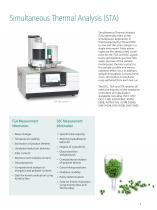
Simultaneous Thermal Analysis (STA) generally refers to the simultaneous application of thermogravimetry (TG) and DSC to one and the same sample in a single instrument. Main advantages are the identical test conditions for the TGA and DSC signals (same atmosphere, gas flow rate, vapor pressure of the sample, heating rate, thermal contact to the sample crucible and sensor, radiation effect, etc.). In addition, sample throughput is improved as more information is simultaneously gathered from each test run. The DSC, TGA and STA systems all meet the majority of the respective instrument and application...
Open the catalog to page 7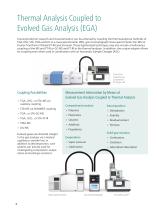
Top-level polymer research and characterization can be achieved by coupling the thermoanalytical methods of TGA, DSC, STA, TMA and DIL to a mass spectrometer (MS), gas chromatograph/mass spectrometer (GC-MS) or Fourier Transform Infrared (FT-IR) spectrometer. These hyphenated techniques may also include simultaneous coupling of the MS and FT-IR or GC-MS and FT-IR to the thermal analyzer. In addition, the unique adapter allows for coupling even when used in combination with an Automatic Sample Changer (ASC). Coupling Possibilities ■ "GA-, DSC-, or STA-MS via capillary coupling ■ STA-MS via SKIMMER...
Open the catalog to page 8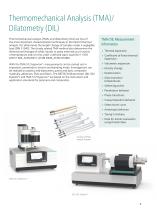
Thermomechanical Analysis (TMA)/ Dilatometry (DIL) Thermomechanical analysis (TMA) and dilatometry (DIL) are two of the most important characterization techniques in the field of thermal analysis. DIL determines the length change of samples under a negligible load (DIN 51045). The closely related TMA method also determines the dimensional changes of solids, liquids or pasty materials as a function of temperature and/or time under a defined static load (ISO 11359, DIN 51 005, ASTM E831, ASTM D696, ASTM D3386). TMA/DIL Measurement Information With the TMA 512 Hyperion®, measurements can be carried...
Open the catalog to page 9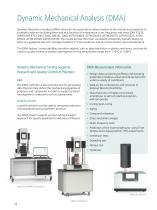
Dynamic Mechanical Analysis (DMA) Dynamic Mechanical Analysis (DMA) allows for the quantitative determination of the mechanical properties of a sample under an oscillating force and as a function of temperature, time, frequency and strain (DIN 53513, DIN EN ISO 6721, DIN 53440, DIN-IEC 1006, ASTM D4065, ASTM D4092, ASTM D4473, ASTM D5023, ASTM D5024, ASTM D5026, ASTM D5418). The results portray the linear viscoelastic properties, typically depicting them as a graphical plot of E’ (storage modulus), E” (loss modulus), and tan δ (loss factor) versus temperature. The DMA Eplexor® series identifies...
Open the catalog to page 10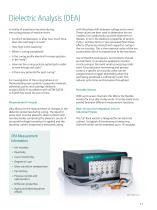
A variety of questions may arise during the curing process of reactive resins. ■ At which temperature, or after how much time, does the resin begin to cure? ■ When is curing completed? ■ s the curing profile identical for every position in the mold? ■ How can the curing cycle be optimized in order to save energy and costs? ■ s there any potential for post-curing? For investigation of the curing behavior of thermosetting resin systems, composite materials, adhesives, paints and coatings, dielectric analysis (DEA) in accordance with ASTM E2038 or E2039 has stood the test of time. Measurement Principle...
Open the catalog to page 11All NETZSCH Analyzing & Testing catalogs and technical brochures
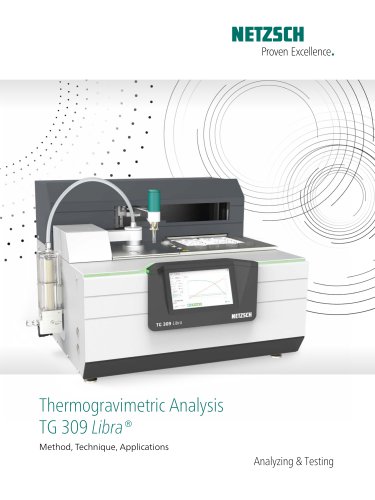 TG 309 Libra Series
24 Pages
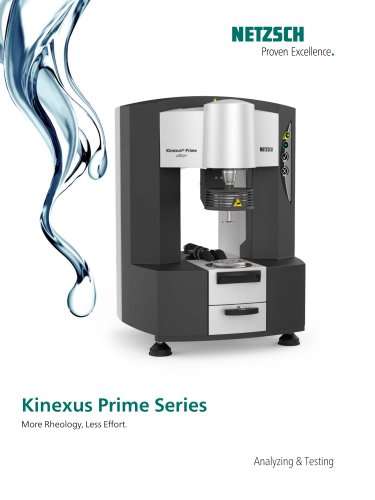 Kinexus Prime Series
20 Pages
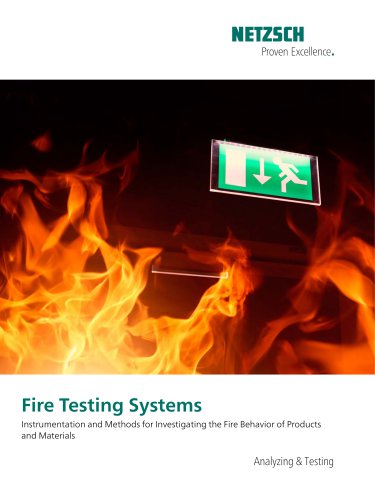 NTA Fire Testing Systems
20 Pages
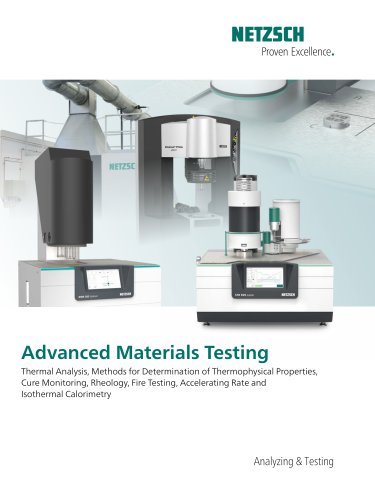 Advanced Materials Testing
32 Pages
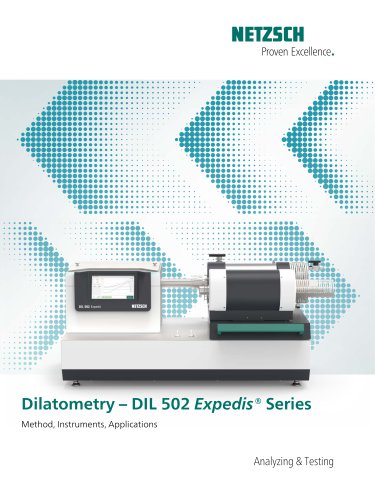 DIL 502 Expedis Series
28 Pages
 NETZSCH Energy Solutions
40 Pages
 Product Overview
12 Pages
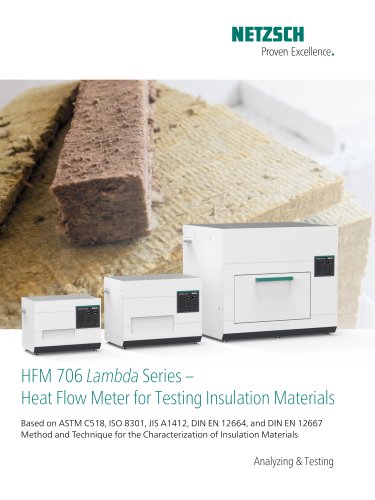 HFM 706 Lambda Series
16 Pages
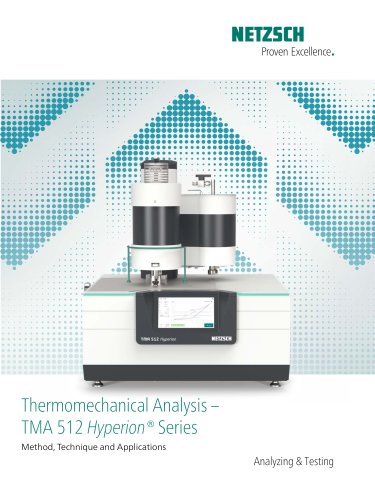 TMA 512 Hyperion® Series
24 Pages
 LFA 427 - product brochure
24 Pages
 Kinexus Prime DSR Series
20 Pages
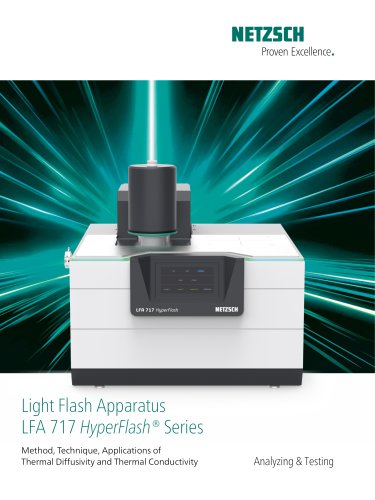 LFA 717 HyperFlash® Series
28 Pages
 DMA 303 Eplexor
24 Pages
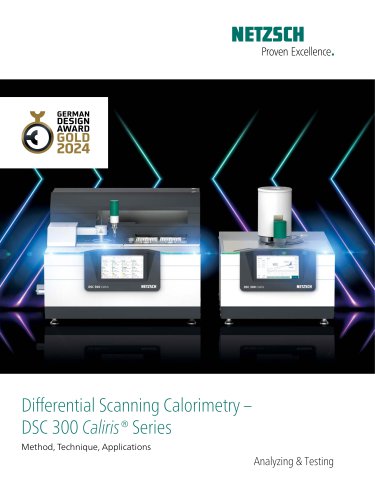 DSC 300 Caliris Series
28 Pages
 STA 509 Jupiter Series
28 Pages
 DEA 288 Ionic
20 Pages
 STA 2500 Regulus
12 Pages
 NTA Guarded Hot Plate Series
16 Pages
 Rosand Series
20 Pages
 Accelerating Rate Calorimetry
20 Pages
 NTA HotBoxes
16 Pages
 DIL 402 Expedis Classic
16 Pages
 Kinetics NEO
20 Pages
 TG-FTIR - product brochure
24 Pages
 TA-QMS Coupling
28 Pages
 HMOR 422
1 Page
 RUL/CIC 421
1 Page
 Cone Calorimeter TCC 918
12 Pages
 SBA 458 Nemesis®
24 Pages
 NETZSCH NEVIO Instrument Series
24 Pages
 Thermal Insulation Materials
24 Pages
 DMA GABO EPLEXOR up to 1500°C
12 Pages
 GABOMETER®
8 Pages





- Test machine
- NETZSCH measuring instrument
- NETZSCH gas analyzer
- NETZSCH test chamber
- Concentration analyzer
- Monitoring analyzer
- Analysis software solution
- Liquids analyzer
- Test stand
- NETZSCH automatic analyzer
- Windows software
- Automated testing machine
- Material test machine
- Temperature test chamber
- NETZSCH benchtop analyzer
- NETZSCH solids analyzer
- Climatic test cabinet
- Quality control test cell
- Computer-controlled test machine