
- Catalogs
- NETZSCH Analyzing & Testing
- Thermal Analysis and Rheology of Batteries


- Company
- Products
- Catalogs
- News & Trends
- Exhibitions
Thermal Analysis and Rheology of Batteries

Thermal Analysis and Rheology of Batteries
Designing lithium-ion batteries requires effective thermal management to enhance performance, extend battery life, and prevent thermal runaway. This involves characterizing battery components and understanding the influence of design parameters, manufacturing processes, and operating conditions on battery temperature.
Ensuring quality throughout the manufacturing process is crucial. Monitoring critical parameters from raw materials to cell assembly helps maintain battery performance by preventing defects and contaminants.
There is a growing demand for batteries with increased capacity, longer life, shorter charging times, and reduced weight and size. NETZSCH supports this demand with advanced thermal analysis techniques and products to improve process efficiency and quality control.
Various techniques are used to assess battery materials, including:
- Cathode precursor and electrode materials: Crystal phase analysis using STA and QMS.
- Battery slurry: Viscosity and stability analysis using Rheometry.
- Electrode and electrode coating: Thermal management analysis using Laser/Light Flash Analysis and DSC.
- Electrolyte: Thermal stability analysis using STA and DSC.
- Binder and additives: Thermal behavior analysis using STA and Rheometry.
- Separator: Heat capacity analysis using DSC and TMA.
- Battery cell: Thermal stability analysis using Isothermal Calorimetry and EGA.
Thermoanalytical methods help design cells resilient to hot spot growth. Kinetics of chemistries can be modeled using data from DSC, LFA, DIL, and HFM.
Li-ion cells are prone to thermal runaway due to high energy density. Causes include environmental conditions, excessive heat, and mechanical damage.
Proper thermal management ensures longer battery lifespan by maintaining optimal temperatures. NETZSCH offers systems for investigating thermophysical properties.
Temperature changes affect material properties, causing dimensional changes. TMA and Dilatometry measure these changes to predict deformation in battery components.
Temperature increases can lead to separator melting or breaking, causing short circuits. Rapid temperature rise results in material shrinkage and elongation.
DSC and LFA are used to determine specific heat capacity and investigate thermal characteristics of battery components.
Electrolytes must balance conductivity and stability. Nickel content in cathodes increases capacity but reduces stability, requiring careful design.
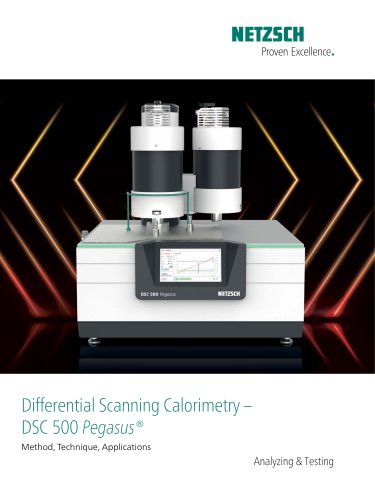
DSC instruments operate within a wide temperature range and feature automatic sample changers and gas-tight systems.
Reactions start at around 60°C, releasing significant energy. Different formulations affect reaction enthalpy.
STA systems offer fast atmosphere adjustment and high sensitivity for precise thermo-analytical measurements.
Battery slurries are processed by coating methods affecting leveling behavior. Rheology helps optimize flow properties.
High viscosity can complicate coating processes. Oscillatory shear experiments assess slurry stability.
Understanding heat generation during cycles is crucial for efficiency. The MMC 274 Nexus® measures heat signatures.
ARC measures self-heating and thermal runaway, aiding in understanding material stability.
- Calorimetry and Thermal Analysis: Highlights the importance of high tracking rate capability in calorimeters for accurate data collection.
- Service Offerings: NETZSCH provides services including relocation, maintenance, calibration, and customer training.
- Material Characterization Instruments: Lists instruments for material characterization, including DSC, STA, and TMA.
- Rheology and Testing Equipment: Offers equipment for analyzing and testing, including solutions for dry and wet processing.
- Company Background: NETZSCH is a globally recognized technology company with a focus on engineering and customer-focused services.
Catalog excerpts

Thermal Analysis and Rheology of Batteries Analyzing & Testing
Open the catalog to page 1
THERMAL ANALYSIS AND RHEOLOGY OF BATTERIES Engineers often face challenges when designing lithium ion batteries. A thorough thermal management strategy is required to enhance performance, improve battery life, and to keep batteries from going into thermal runaway. Thermal management starts with careful characterizations of battery components for the development of inherently safer batteries. Design parameters, for intended use, manufacturing processes and operating conditions all have an effect upon battery temperature during use. Manufacturers of battery components must consistently deliver...
Open the catalog to page 2
Cathode precursor & electrode materials Battery slurry Electrode and electrode coating Binder, additives Battery cell Material testing CriticalParameters Crystal phase ■ Viscosity ■ Thermal management (thermal diffusivity/ conductivity) ■ Specific heat capacity ■ Reactivity Performance changes ■ Thermal stability■ Degradation with air/moisture■ Performance changes ■ Thermal behavior ■ Specific heat capacity Dimensional change ■ Internal short tests Enthalpies Thermal conductivity ■ Gas production (quantitative and qualitative) ■ Kinetic model development ■ sotropic & parasitic reactions Compatibility...
Open the catalog to page 3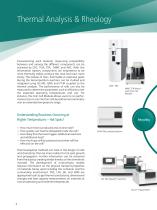
Thermal Analysis & Rheology Characterizing each material, measuring compatibility between and among the different components can be achieved by DSC, TGA, STA, MMC and ARC. With this information battery components are engineered to be more thermally stable, produce less heat and react more slowly. The release of toxic, flammable or explosive gases during the decomposition reactions can be studied and mitigated using GC-MS, QMS and FT-IR coupled to the thermal analyzer. The performance of cells can also be measured to determine parameters such as efficiency over the expected operating temperatures...
Open the catalog to page 4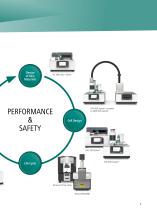
PERFORMANCE & SAFETY STA 509 Jupiter® coupled to QMS 505 Aëolos Cell Design Life Cycle Kinexus Prime ultra+
Open the catalog to page 5
Thermal Runaway Li-ion cells are relatively lightweight and have a high energy density. These performance benefits have made them invaluable to the portable energy market. These two benefits also makes them more likely to be involved in thermal runaway. Thermal runaway occurs when the self-heating of cell is greater than the amount of heat that can be removed from the cell. This stored heat in the cell causes the temperature to rise which results in even higher self-heating. Left unchecked, a thermal runaway can cause the cell temperatures to rise rapidly leading to the production of toxic gases,...
Open the catalog to page 6
Where it may be possible to design battery management and safety systems to reduce the frequency and consequence from external sources, this is a bit harder to do when the source is an internal defect. The age, health and charge of a cell all play a role in how and when this self-heating can occur. Characterizing the pathways of thermal runaway can be done using dedicated testing equipment and methodologies. Integrating safety, compatibility and other advanced testing methods early in the development process can have enormous payback in reducing time-to-market and in the creation of inherently...
Open the catalog to page 7
Like the human body, the operating temperature of a battery should always be monitored, protected and kept at an optimal level. If the ambient temperature is too low, it will not deliver its full power and reduce the lifetime of the cell. If the ambient temperature rises too high promote the increase of parasitic reactions, reducing efficiency and lifetime. The battery can even swell, catch fire, explode and release toxic gases. Proper battery thermal management ensures longer lifespan by keeping the cells within a limited temperature range during storage, operation and charging. The State-of-Charge(SOC)-State...
Open the catalog to page 8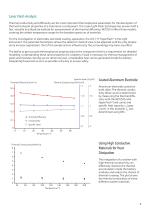
Laser Flash Analysis Thermal conductivity and diffusivity are the most important thermophysical parameters for the description of the heat transport properties of a material or a component. The Laser/Light Flash technique has proven itself a fast, versatile and absolute method for measurement of the thermal diffusivity. NETZSCH offers three models, covering the widest temperature range for the broadest spectrum of materials. For the investigation of electrodes, electrode coating, separators, the LFA 717 HyperFlash® is the right instrument. The patented ZoomOptics allows the detector’s field of...
Open the catalog to page 9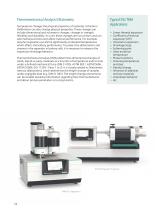
Temperature changes the physical properties of materials. Lithiation/ Delithiation can also change physical properties. These changes can include dimensional and volumetric changes, changes in strength, flexibility and durability. In a cell, these changes are not uniform and can add mechanical stress and affect material performance. For example, polymer separators can shrink significantly at elevated temperatures which affects the battery performance. To predict the deformation and stresses in the separator in battery cells, it is necessary to measure the expansion/shrinkage behavior. Thermomechanical...
Open the catalog to page 10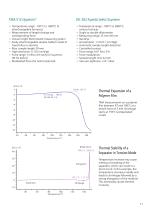
Temperature range: -150°C to 1600°C (5 interchangeable furnaces) Measurement of length change and corresponding force Vacuum-tight thermostatic measuring system Easily interchangeable sample holders made of fused silica or alumina Max. sample length 30 mm High resolution: 0.125 nm/digit Force range: 1mN to 4 N (only for Supreme, 3N for Select) Modulated force (for Select optional) Temperature range: -180°C to 2800°C, various furnaces Single or double dilatometer Measuring range: 25 mm/50 mm NanoEye Δl resolution: 1 nm/0.1 nm/digit Automatic sample length detection Controlled contact Force range:...
Open the catalog to page 11
THERMAL STABILITY Designing Inherently Safer Batteries Which Meet Application Challenges Electrolytes are characterized by high conductivity, good electrochemical stability and the ability to perform at low temperatures. However, the thermal stability of many electrolyte solutions is restricted even at moderate temperatures where side reactions can begin to limit the lifetime and performance of cells. Thermal stability is one of several important criteria in battery design. The trick is to find the right design that meets the application criteria. For example, there is a positive correlation...
Open the catalog to page 12All NETZSCH Analyzing & Testing catalogs and technical brochures
 TG 309 Libra Series
24 Pages
 Kinexus Prime Series
20 Pages
 NTA Fire Testing Systems
20 Pages
 Advanced Materials Testing
32 Pages
 DIL 502 Expedis Series
28 Pages
 NETZSCH Energy Solutions
40 Pages
 Product Overview
12 Pages
 HFM 706 Lambda Series
16 Pages
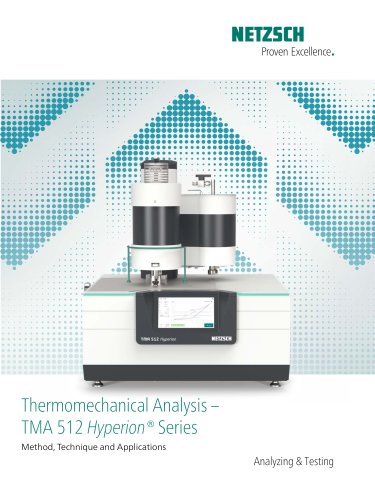 TMA 512 Hyperion® Series
24 Pages
 LFA 427 - product brochure
24 Pages
 Kinexus Prime DSR Series
20 Pages
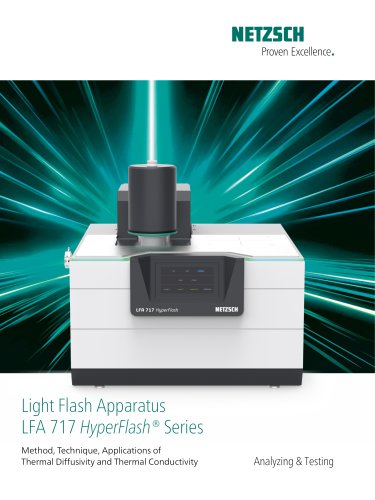 LFA 717 HyperFlash® Series
28 Pages
 DMA 303 Eplexor
24 Pages
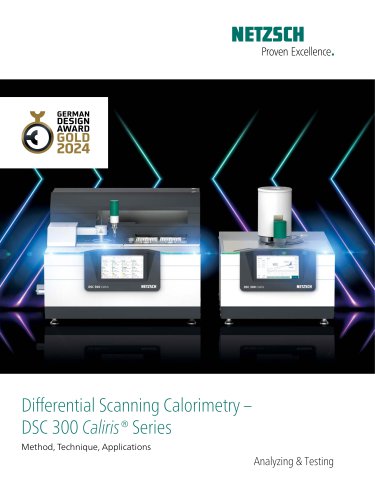 DSC 300 Caliris Series
28 Pages
 STA 509 Jupiter Series
28 Pages
 DEA 288 Ionic
20 Pages
 STA 2500 Regulus
12 Pages
 NTA Guarded Hot Plate Series
16 Pages
 Rosand Series
20 Pages
 Accelerating Rate Calorimetry
20 Pages
 NTA HotBoxes
16 Pages
 DIL 402 Expedis Classic
16 Pages
 Kinetics NEO
20 Pages
 TG-FTIR - product brochure
24 Pages
 TA-QMS Coupling
28 Pages
 HMOR 422
1 Page
 RUL/CIC 421
1 Page
 Cone Calorimeter TCC 918
12 Pages
 SBA 458 Nemesis®
24 Pages
 NETZSCH NEVIO Instrument Series
24 Pages
 Thermal Insulation Materials
24 Pages
 DMA GABO EPLEXOR up to 1500°C
12 Pages
 GABOMETER®
8 Pages





- Test machine
- NETZSCH measuring instrument
- NETZSCH gas analyzer
- NETZSCH test chamber
- Concentration analyzer
- Monitoring analyzer
- Analysis software solution
- Liquids analyzer
- Test stand
- NETZSCH automatic analyzer
- Windows software
- Automated testing machine
- Material test machine
- Temperature test chamber
- NETZSCH benchtop analyzer
- NETZSCH solids analyzer
- Spectrometer
- Climatic test cabinet
- Quality control test cell
- Computer-controlled test machine