
- Catalogs
- NETZSCH Analyzing & Testing
- TG-FTIR - product brochure


- Company
- Products
- Catalogs
- News & Trends
- Exhibitions
TG-FTIR - product brochure

TG-FTIR - product brochure
Fourier Transform Infrared (FT-IR) Spectrometers, when combined with Thermal Analysis, offer a robust method for analyzing both organic and inorganic materials. This integration allows for the detection of thermodynamic transitions, thermal stability, decomposition, and chemical reactions across a broad temperature range. The synergy between thermal analysis and infrared spectroscopy provides a detailed chemical fingerprint by identifying evolved gases, enhancing the understanding of material behavior.
The document describes various configurations for coupling FT-IR with thermal analysis instruments like TGA, DSC, STA, DIL, and TMA. These configurations include both external and internal gas cells, optimized for high resolution and sensitivity, and are designed to be vacuum-capable to reduce oxygen interference and improve measurement accuracy.
FT-IR spectroscopy operates on the interaction of infrared radiation with molecular dipole moments, producing a unique spectrum for each substance. The spectrometer uses a beam splitter to create two beams that interfere to form an interferogram, which is then converted into a spectrum via Fourier Transformation.
The gas cells are designed for high sensitivity, featuring long path lengths and low volumes to maximize interaction with the IR beam. The absence of internal mirrors prevents condensation, maintaining detection sensitivity. The cells are equipped with KBr windows for easy cleaning and maintenance.
Several coupling methods are detailed, including the use of transfer lines and direct coupling via the PERSEUS® system. These methods ensure a defined gas atmosphere, crucial for accurate FT-IR measurements, by minimizing water and carbon dioxide interference.
Advanced features include the use of DLaTGS detectors, which do not require cooling, and the option for MCT detectors for higher signal-to-noise ratios. The systems are flexible, allowing for additional accessories like ATR units or microscopes.
The combination of thermal analysis and FT-IR spectroscopy provides detailed insights into material properties, including phase transitions and decomposition processes. The PERSEUS® system offers a compact, efficient solution with a short gas path for rapid response times, suitable for high-throughput testing and complex analyses.
The document outlines specifications for using TGA/DSC/STA-FT-IR instruments, emphasizing the importance of repeatable and temperature-independent calibration pulses for accurate quantification.
The integration of NETZSCH Proteus® and OPUS FT-IR software allows for seamless data exchange and control of measurements, ensuring synchronized data collection and evaluation.
Applications include decomposition, dehydration, pyrolysis, combustion, oxidation, and more, highlighting the technique's suitability for detecting inorganic gases and organic molecules.
Case studies include the analysis of Ethylene Vinyl Acetate (EVA), Aspirin®, Biodiesel and Diesel Fuel, Urea, Clay Firing, and Silicone Manufacturing, each demonstrating the utility of TGA-FT-IR coupling in material characterization.
The document provides technical specifications for various coupling systems and instruments, detailing temperature ranges and requirements for different detectors and furnaces.
The document concludes by emphasizing the utility of TGA-FT-IR coupling in material characterization and process optimization, offering insights into decomposition processes and aiding in the detection of manufacturing issues.
The document provides technical specifications and operational details for various NETZSCH FT-IR coupling systems and their compatibility with existing thermal analysis devices.
Temperature ranges for different devices are listed: STA (up to 1100°C), TGA (up to 1550°C), TMA (up to 2000°C), and DIL (up to 700°C). It also specifies compatible Bruker FT-IR spectrometers like INVENIO and ALPHA.
The FT-IR systems can be coupled with existing NETZSCH devices like TGA, DSC, STA, DIL, and TMA. Detailed compatibility information is available through NETZSCH sales representatives.
Additional analytical instruments like MS or GC-MS can be used. Details on Tmax transfer line temperatures and gas cell configurations are provided.
NETZSCH-Gerätebau GmbH is an international technology company based in Germany, specializing in thermal analysis, calorimetry, and other testing solutions, emphasizing high performance and customer service.
Catalog excerpts

Fourier Transform Infrared (FT-IR) Spectrometers Coupled to Thermal Analysis Concepts, Instruments and Applications from -150°C to 2000°C Analyzing & Testing
Open the catalog to page 1
Thermal Analysis Plus FT-IR More Than Just the Sum of Its Parts Perfect Combination Bridges the Analytical Gap and Facilitates Fingerprint Analysis Thermal Analysis provides ideal tools for the characterization of all kinds of organic and inorganic solids and liquids. Thermodynamic transitions, thermal stability, decomposition and chemical reactions can be detected and quantified with high accuracy over a broad temperature range. In some cases, however, information about the type of gases evolved is needed in order to gain a detailed understanding of the chemistry behind the processes. The combination...
Open the catalog to page 2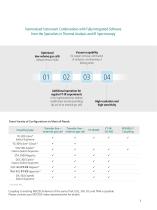
Harmonized Instrument Combinations with Fully Integrated Software from the Specialists in Thermal Analysis and IR Spectroscopy Vacuum capability for oxygen removal, elimination of carryover, and lowering of boiling points Optimized low-volume gas cells without mirrors inside Additional operation for regular FT-IR experiments or for hyphenated tests without modification and disassembling (by use of an external gas cell) High resolution and high sensitivity Great Variety of Configurations to Meet all Needs Coupling type Transfer line – external gas cell Transfer line – internal gas cell PERSEUS®...
Open the catalog to page 3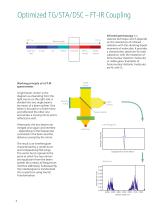
Optimized TG/STA/DSC – FT-IR Coupling Gamma rays Wave length Afterwards, the two beams are merged once again and interfere – depending on the frequencies contained in the beam and the distance covered by the mirror. The result is an interferogram characterized by a center burst and comparatively flat wings. The center burst represents the point at which the two mirrors are equidistant from the beam splitter (this means all frequencies interfere additively). Subsequently, the interferogram is transformed into a spectrum using Fourier Transformation. Radio waves Moving mirror Q Light source Beam...
Open the catalog to page 4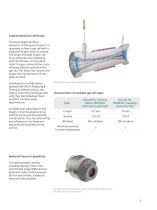
Sophisticated Gas Cell Design To ensure highly sensitive detection of the gases evolved, it is necessary to have a gas cell with a long path length and low volume. The longer the path length, the more molecules are interacting with the IR beam. On the other hand, the gas concentration is also influenced by the volume of the gas cell. The lower the volume, the higher the concentration of the gases evolved. Developed in a collaboration between NETZSCH Analyzing & Testing and Bruker Optics, the beam-conforming metal gas cells with their optimized gas flows perfectly combine these requirements. An...
Open the catalog to page 5
TGA/STA-FT-IR Coupling for Maximum Flexibility Bruker INVENIO with external gas cell coupled to the NETZSCH TG 309 Libra® with ASC and QMS 505 Aëolos All NETZSCH thermobalances and simultaneous thermal analyzers (STAs) are characterized by their vertical, top-loading design. This not only guarantees easy operation and sample loading, but is also in accordance with the natural gas flow path inside the furnace (warm gases have the tendency to rise) and protects the balance underneath in an optimal way. Because of this natural gas flow path, top-loading thermobalances are ideally suited for coupling...
Open the catalog to page 6
Schematic of the TGA-FT-IR coupling using an external gas cell, adapter and heated transfer line TG cell Prerequisite for Effective Coupling An adapter together with a short transfer line should connect the gas outlet of the TGA, DSC or STA furnace to the gas cell of the FT-IR spectrometer. The evolved gases are transferred using a carrier gas (usually nitrogen). To prevent cold spots and thus condensation of the gases evolved, the entire gas path should be heated. The temperatures are up to 400°C for the adapter and max. 400°C for transfer line. The Right Detector for Any Application Built-in...
Open the catalog to page 7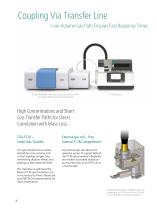
Coupling Via Transfer Line Low-Volume Gas Path Ensures Fast Response Times Bruker INVENIO with external gas cell and an ATR unit in the FT-IR sample compartment High Concentrations and Short Gas Transfer Paths for Direct Correlation with Mass Loss TGA-FT-IR – Smart Gas Transfer External gas cell – Free Internal FT-IR Compartment The gas transfer line is characterized by a low volume and a short capillary length, thus minimizing dilution effects and leading to fast response times. An external gas cell allows the operator access to a great deal of the FT-IR spectrometer’s flexibility and makes...
Open the catalog to page 8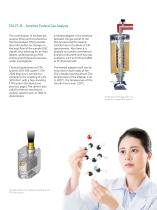
STA-FT-IR – Sensitive Evolved Gas Analysis The combination of evolved gas analysis (EGA) and simultaneous thermal analysis (STA) provides also information on changes in the heat flow of the sample (DSC signal), thus allowing for an even deeper understanding of the chemical and physical processes under investigation. A heated adapter is the interface between the gas outlet of the STA furnace and the heated transfer line to the Bruker FT-IR spectrometer. Also here, it is possible to connect one thermal analysis instrument with two gas analyzers, such as FT-IR and QMS or FT-IR and GC-MS. Classical...
Open the catalog to page 9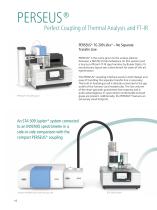
Perfect Coupling of Thermal Analysis and FT-IR PERSEUS® TG 209 Libra® – No Separate Transfer Line PERSEUS® is the name given to the unique alliance between a NETZSCH thermobalance (or STA system) and a tiny but efficient FT-IR spectrometer by Bruker Optics. Its revolutionary layout sets a benchmark for state-of-the-art hyphenation. The PERSEUS® coupling interface excels in both design and ease of handling. No separate transfer line is necessary. The built-in heated gas cell is directly connected to the gas outlet of the furnace via a heated tube. The low volume of the short gas path guarantees...
Open the catalog to page 10
Space-Saving PERSEUS® STA 509 Jupiter® The powerful and cost-effective PERSEUS® STA 509 features a compact 2-in-1 design which saves over 50% of the bench top space required for a capillary-coupled system. The short gas path with low volume provides an excellent correlation between mass losses and the gases detected. In order to minimize the risk of condensation, the PERSEUS® coupling interface is heated using a constant voltage. Optionally, a temperature control system is available (recommended for condensable gases). The maximum temperature of the entire gas path is set to 200°C. Any existing...
Open the catalog to page 11All NETZSCH Analyzing & Testing catalogs and technical brochures
 TG 309 Libra Series
24 Pages
 Kinexus Prime Series
20 Pages
 NTA Fire Testing Systems
20 Pages
 Advanced Materials Testing
32 Pages
 DIL 502 Expedis Series
28 Pages
 NETZSCH Energy Solutions
40 Pages
 Product Overview
12 Pages
 HFM 706 Lambda Series
16 Pages
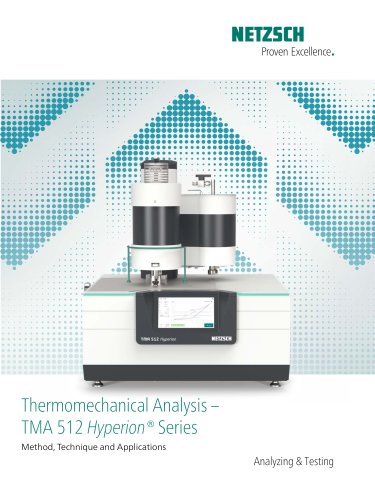 TMA 512 Hyperion® Series
24 Pages
 LFA 427 - product brochure
24 Pages
 Kinexus Prime DSR Series
20 Pages
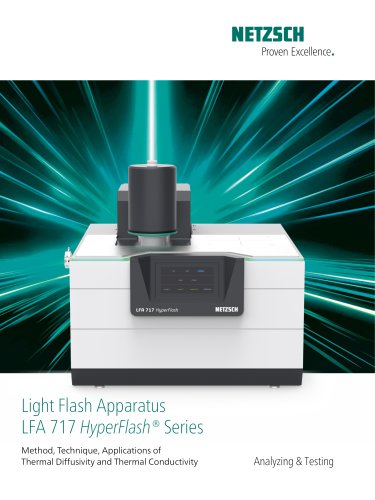 LFA 717 HyperFlash® Series
28 Pages
 DMA 303 Eplexor
24 Pages
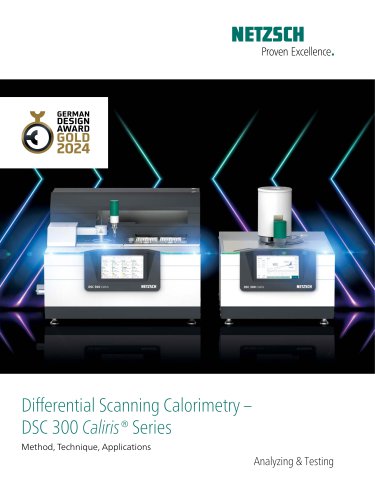 DSC 300 Caliris Series
28 Pages
 STA 509 Jupiter Series
28 Pages
 DEA 288 Ionic
20 Pages
 STA 2500 Regulus
12 Pages
 NTA Guarded Hot Plate Series
16 Pages
 Rosand Series
20 Pages
 Accelerating Rate Calorimetry
20 Pages
 NTA HotBoxes
16 Pages
 DIL 402 Expedis Classic
16 Pages
 Kinetics NEO
20 Pages
 TA-QMS Coupling
28 Pages
 HMOR 422
1 Page
 RUL/CIC 421
1 Page
 Cone Calorimeter TCC 918
12 Pages
 SBA 458 Nemesis®
24 Pages
 NETZSCH NEVIO Instrument Series
24 Pages
 Thermal Insulation Materials
24 Pages
 DMA GABO EPLEXOR up to 1500°C
12 Pages
 GABOMETER®
8 Pages





- Test machine
- NETZSCH measuring instrument
- NETZSCH test chamber
- Concentration analyzer
- Monitoring analyzer
- Analysis software solution
- Liquids analyzer
- Test stand
- NETZSCH automatic analyzer
- Windows software
- Automated testing machine
- Material test machine
- Temperature test chamber
- NETZSCH benchtop analyzer
- NETZSCH solids analyzer
- Climatic test cabinet
- Quality control test cell
- Computer-controlled test machine