
- Catalogs
- NETZSCH Analyzing & Testing
- TG 309 Libra Series


- Company
- Products
- Catalogs
- News & Trends
- Exhibitions
TG 309 Libra Series
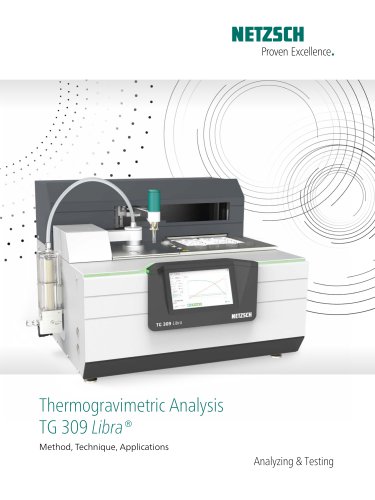
TG 309 Libra Series
Thermogravimetric Analysis (TGA) is a precise analytical technique used to measure changes in the mass of a sample over time or temperature under controlled conditions. It is highly sensitive, capable of detecting weight changes down to fractions of a microgram, making it invaluable for determining physical and chemical properties of materials.
TGA is crucial in various industries such as pharmaceuticals, chemicals, and food for ensuring product quality and safety. It evaluates thermal stability, shelf-life, and degradation pathways, which are essential for quality control and regulatory compliance. TGA is also versatile, applicable in polymer industry, materials engineering, pharmaceutical research, and environmental science.
The TG 309 Libra® series includes three models: Classic, Select, and Supreme, each tailored for different needs from quality control to advanced research. The design features a vertical top-loading system with a vacuum-tight chamber, ensuring easy and safe sample handling. The system includes a micro-furnace for efficient heating and cooling, and magnetic levitation to minimize external interference.
The TG 309 Libra® offers features like precise sample temperature detection with c-DTA® for accurate temperature calibration, and four mass flow controllers for easy gas switching and mixing. The AutoVac feature allows for automatic evacuation and gas filling, enhancing measurement conditions.
The TG 309 Libra® Select and Supreme models include an Automatic Sample Changer (ASC) for handling up to 204 samples, improving efficiency and flexibility. The ASC is equipped with a tray cover to protect samples from environmental influences and features like 'RemoveCap' for volatile samples.
The PROTEUS® software offers SmartMode for routine tasks and ExpertMode for advanced settings, providing a user-friendly interface for measurement setup and execution. The BeFlat® feature simplifies baseline correction, enhancing routine test work efficiency.
- SmartMode and ExpertMode: SmartMode allows users to start measurements without being experts in TGA, while ExpertMode provides access to advanced features and settings.
- AutoCalibration: This feature automates the generation of calibration curves, considering current temperature calibrations and monitoring their validity.
- AutoEvaluation: Automatically evaluates significant mass changes in TGA measurements, generating derivative curves and evaluating peak temperatures. It provides objective results independent of user input.
- Identify Software: A tool for material identification and classification, allowing comparisons with database measurements or literature data. It supports multiple signal types and can incorporate user data.
- c-DTA®: Calculates DTA-like curves by comparing measured sample temperatures with preset programs, revealing caloric effects and aiding in material characterization.
- Eco Mode: An energy-saving feature that reduces power consumption by switching the instrument to idle or eco mode when not in use, significantly lowering electricity usage and carbon footprint.
- The document includes various graphs and tables illustrating temperature changes, mass loss, and other parameters during TGA measurements. Key data points include peak temperatures and residual mass percentages.
- Examples of TGA measurements on different materials, such as kaolinite and thermoplastic elastomers, are provided to demonstrate the software's capabilities.
- LED Status Bar: Provides visual status updates of the instrument, indicating readiness, measurement progress, and any issues.
- User Interface: The integrated color display allows for easy monitoring and control of measurements, including starting measurements, checking progress, and adjusting settings directly on the instrument.
- LabV® Integration: Compatible with the LabV® data management platform, which automates data collection and analysis, offering a centralized view for organizing and exploring data.
- Bicycle Tire Casing: TGA analysis identifies plasticizer content and separates rubber component degradation steps. It also detects inorganic fillers like chalk.
- Plaster with Fire Protection: TGA-MS analysis identifies decomposition steps and evolved gases, including water, organic compounds, CO2, and SO2.
- Naproxen Sodium: TGA-MS analysis reveals different hydrate forms and decomposition steps, identifying water, CO2, and hydrocarbon fragments.
- Walnut Shell: Proximate analysis shows humidity release, pyrolysis steps, and carbon content combustion, determining ash content.
Catalog excerpts
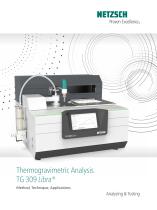
Thermogravimetric Analysis TG 309 Libra® Method, Technique, Applications Analyzing & Testing
Open the catalog to page 1
TG 309 Libra® UNLOCKING THE POWER OF THERMOGRAVIMETRY Thermogravimetry has the ability for differentiation between individual components based on their distinct thermal behavior. By analyzing weight-loss profiles, users can deduce the composition of complex samples, enabling deeper understanding of their structure and properties. Revealing the Mysteries of Complex Mixtures and Material Transformations Thermogravimetry (TG) is renowned for its precision and sensitivity. By subjecting a sample to controlled temperature increments while continuously measuring its weight change, TGA can detect even...
Open the catalog to page 2
■ Compositional analysis Identification ■ Reduction behavior Corrosion studies ■ added carbon black ■ Influence of aging Curie temperatures Reaction kinetics State of hydration Residual solvents Various international standards describe the general principles of thermogravimetry for polymers (ISO 1 1358) or other specific applications, such as compositional analysis for rubber (ASTM D6370) and evaporation loss in lubricating oils (ASTM D6375). Measuring Principle Thermogravimetric analysis (TGA) is a precise analytical technique used to track changes in the mass of a sample over time and/or temperature...
Open the catalog to page 3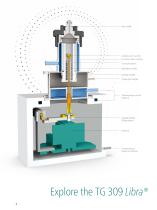
Sample and crucible Furnace water cooling Furnace heater Radiation shield Sample holder Purge gas sample Thermostatic control balance Sample holder lifting device Protective gas balance chamber
Open the catalog to page 4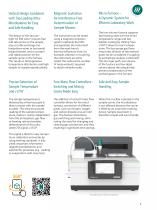
Vertical Design Combined with Top-Loading UltraMicrobalance for Easy and Safe Handling The design of the vacuum-tight TG 309 Libra® ensures free and safe access to the sample, easy crucible exchange (no hang-down wires or horizontal balance beam), and a constant and stable position for the sample carrier in the furnace. This results in homogeneous temperature distribution and high sample-to-sample reproducibility. Magnetic Levitation for Interference-Free Determination of Sample Masses The instrument can be raised using a magnetic levitation system (optional) that lifts and separates the instrument...
Open the catalog to page 5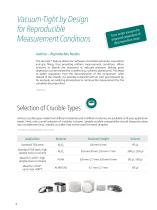
Vacuum-Tight by Design for Reproducible Measurement Conditions or cuum f a v r e d f n Tests u separation o d e improv osition steps p decom AutoVac – Reproducible Results The AutoVac* feature allows for software-controlled automatic evacuation and gas filling, thus providing uniform measurement conditions. When mixtures or blends are measured at reduced pressure, boiling point depression can be realized for volatiles (e.g., solvents, plasticizers). This leads to better separation from the decomposition of the component. After release of the volatile, it is possible to backfill with an inert...
Open the catalog to page 6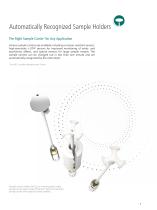
Automatically Recognized Sample Holders The Right Sample Carrier1 for Any Application Various sample carriers are available including corrosion-resistant sensors, high-sensitivity c-DTA® sensors for improved monitoring of endo- and exothermic effects, and special sensors for large sample masses. The sample carriers can be changed out in less than one minute and are automatically recognized by the instrument. 1 Sample carriers made of Al2O3 for corrosive gases (right), sample carrier type P made of Platinel® (left) and standard sample carrier with radiation shield (middle).
Open the catalog to page 7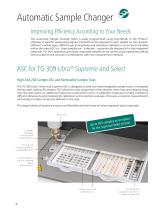
Automatic Sample Changer Improving Efficiency According to Your Needs The Automatic Sample Changer (ASC) is easily programmed using SmartMode of the Proteus® software. A specific measuring program (method) can be assigned to each sample on the carousel. Different crucible types, different gas atmospheres and individual calibration curves can be handled within the same ASC run. Used samples are – if desired – automatically disposed of in the integrated waste bin. For 24/7 operation, previously measured samples can be continuously replaced by adding new crucibles to the carousel in combination...
Open the catalog to page 8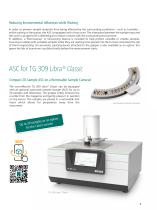
Reducing Environmental Influences while Waiting In order to prevent sample materials from being affected by the surrounding conditions – such as humidity – whilst waiting in the queue, the ASC is equipped with a tray cover. The interspace between the sample trays and the cover is purged with a defined gas to reduce contact with the surrounding environment. In addition, a “RemoveCap“ or lid-piercing feature is included to help protect unstable or volatile samples. Covering crucibles with unstable samples while they are waiting to be placed into the furnace minimizes the risk of them evaporating....
Open the catalog to page 9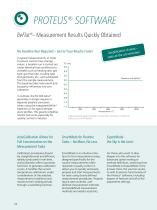
BeFlat®– Measurement Results Quickly Obtained 40 No Baseline Run Required – Get to Your Results Faster In typical measurements, in order to ensure correct mass change values, a baseline run is carried out under identical test conditions for variables such as heating rate, gas type, gas flow rate, crucible type and geometry, etc., and subtracted from the sample measurement. The baseline takes instrument and buoyancy influences into consideration. 0.6 0.4 0.2 Baseline with BeFlat® Stable baseline (green) thanks to automatic correction of external influences via TGA-BeFlat® 100 SmartMode TG curve...
Open the catalog to page 10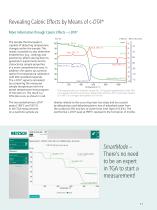
Revealing Caloric Effects by Means of c-DTA® 100 More Information through Caloric Effects – c-DTA® c-DTA /K DTG /(%/min) The sample thermocouple is capable of detecting temperature changes within the sample. This makes it possible to also determine endothermic (e.g., melting) and exothermic effects during thermogravimetric experiments and to characterize sample properties in a more comprehensive way. In addition, this opens up a precise option for temperature calibration with DSC standard materials. The c-DTA® signal is calculated by comparing the measured sample temperature with the preset temperature-time...
Open the catalog to page 11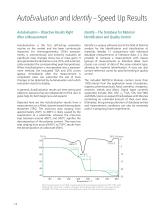
AutoEvaluation and Identify – Speed Up Results AutoEvaluation – Objective Results Right After a Measurement Identify – The Database for Material Identification and Quality Control AutoEvaluation is the first self-acting evaluation routine on the market and has been continuously improved. For thermogravimetry (TGA) measurements, it autonomously and instantly evaluates all significant mass changes (mass loss or mass gain). It also generates the derivative curve, DTG, and automatically evaluates the corresponding peak temperatures. When AutoEvaluation is incorporated into a measurement method, the...
Open the catalog to page 12All NETZSCH Analyzing & Testing catalogs and technical brochures
 Kinexus Prime Series
20 Pages
 NTA Fire Testing Systems
20 Pages
 Advanced Materials Testing
32 Pages
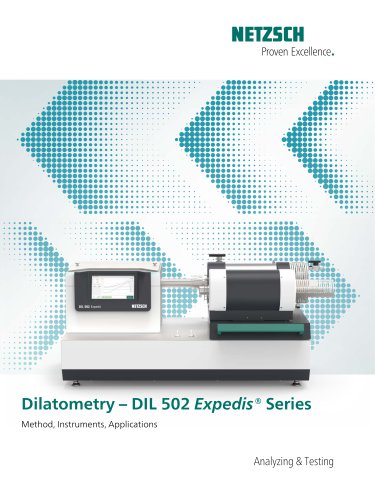 DIL 502 Expedis Series
28 Pages
 NETZSCH Energy Solutions
40 Pages
 Product Overview
12 Pages
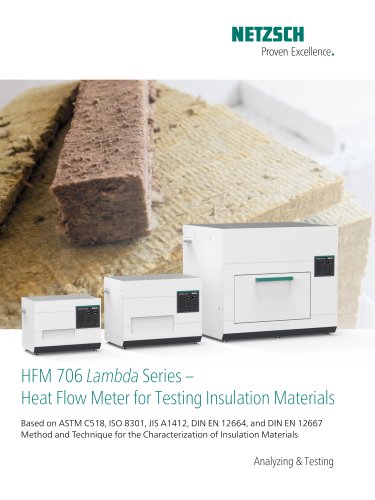 HFM 706 Lambda Series
16 Pages
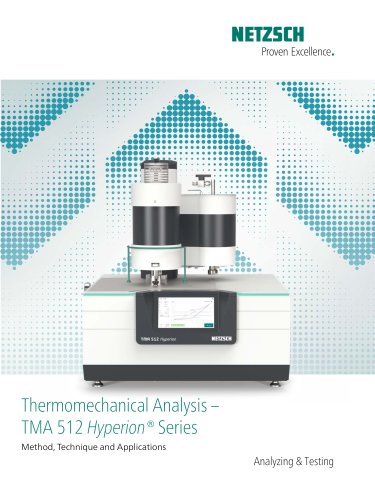 TMA 512 Hyperion® Series
24 Pages
 LFA 427 - product brochure
24 Pages
 Kinexus Prime DSR Series
20 Pages
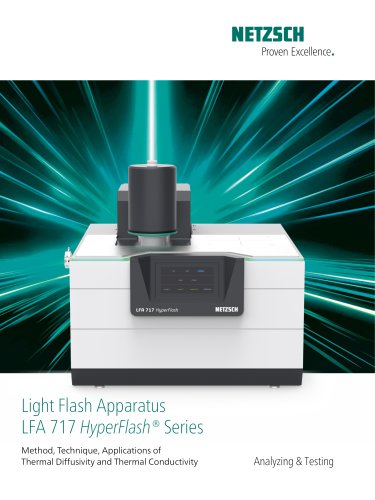 LFA 717 HyperFlash® Series
28 Pages
 DMA 303 Eplexor
24 Pages
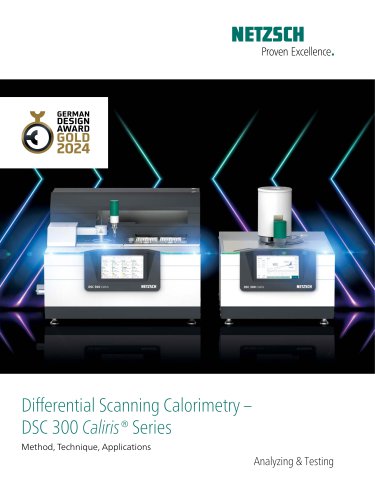 DSC 300 Caliris Series
28 Pages
 STA 509 Jupiter Series
28 Pages
 DEA 288 Ionic
20 Pages
 STA 2500 Regulus
12 Pages
 NTA Guarded Hot Plate Series
16 Pages
 Rosand Series
20 Pages
 Accelerating Rate Calorimetry
20 Pages
 NTA HotBoxes
16 Pages
 DIL 402 Expedis Classic
16 Pages
 Kinetics NEO
20 Pages
 TG-FTIR - product brochure
24 Pages
 TA-QMS Coupling
28 Pages
 HMOR 422
1 Page
 RUL/CIC 421
1 Page
 Cone Calorimeter TCC 918
12 Pages
 SBA 458 Nemesis®
24 Pages
 NETZSCH NEVIO Instrument Series
24 Pages
 Thermal Insulation Materials
24 Pages
 DMA GABO EPLEXOR up to 1500°C
12 Pages
 GABOMETER®
8 Pages






- Test machine
- NETZSCH measuring instrument
- NETZSCH gas analyzer
- NETZSCH test chamber
- Concentration analyzer
- Monitoring analyzer
- Analysis software solution
- Liquids analyzer
- Test stand
- NETZSCH automatic analyzer
- Windows software
- Automated testing machine
- Material test machine
- Temperature test chamber
- NETZSCH benchtop analyzer
- NETZSCH solids analyzer
- Spectrometer
- Climatic test cabinet
- Quality control test cell
- Computer-controlled test machine