
- Catalogs
- NETZSCH Analyzing & Testing
- TA-QMS Coupling


- Company
- Products
- Catalogs
- News & Trends
- Exhibitions
TA-QMS Coupling

TA-QMS Coupling
Thermal analysis techniques like Thermogravimetry (TGA) and Simultaneous Thermal Analysis (STA) are crucial for understanding the thermal behavior of materials. They provide insights into properties, composition, and stability by observing weight changes during heating. However, they lack chemical information, which can be supplemented by Evolved Gas Analysis (EGA) using quadrupole mass spectrometry for detailed chemical analysis.
Applications
The coupling of thermal analysis with mass spectrometry is beneficial in fields such as decomposition, stability analysis, pyrolysis, combustion, and catalysis. It allows precise analysis of gas composition and solid-gas interactions.
Quadrupole Mass Spectrometry (QMS)
QMS is sensitive and selective, ideal for EGA when combined with thermal analyzers. It efficiently ionizes gases for high sensitivity detection.
Coupling Techniques and Equipment
NETZSCH provides solutions for coupling thermal analyzers with mass spectrometers. Examples include the STA 509 Jupiter® and TG 309 Libra® coupled with the QMS 505 Aëolos. The SKIMMER furnace supports high-temperature gas transfer.
Pressure Adjustment Interfaces
Mass spectrometers require high vacuum conditions, necessitating pressure reduction interfaces. The QMS 505 Aëolos uses a single-step reduction, while the STA 449 F3 Jupiter® with SKIMMER furnace uses a double-step reduction.
Optimized Gas Flow Conditions
Ideal gas flow conditions are crucial for transporting gases to the mass spectrometer's ion source, ensuring precise analysis. A bypass allows for simultaneous analysis with other gas analyzers.
State-of-the-Art Capillary Coupling
The QMS 505 Aëolos features robust capillary coupling, minimizing cold spots and condensation risks, supporting TGA-MS measurements under humid conditions.
Technical Specifications
The QMS 505 Aëolos offers a mass range of 1 u to 300 u, with a detection limit of less than 100 ppb, featuring a quadrupole mass filter and a dynamic range of 9 decades.
Applications and Case Studies
Examples include analysis of unknown polymers and high boiling organics, demonstrating the system's sensitivity and capability to handle larger molecules.
This document analyzes thermal analysis techniques and their applications, focusing on TGA and MS in studying material decomposition and gas evolution, with case studies and technical specifications.
1. TGA-MS Measurement on Blue Vitriol
The study of blue vitriol shows stepwise release of crystalline water below 400°C and decomposition to copper-(I)-oxide at higher temperatures.
2. Water-Vapor Furnace
NETZSCH offers a water-vapor furnace for hydrous atmospheres up to 1250°C, used to study carbon gasification processes.
3. Sorbent Activity of Limestone
TGA assesses the cycle stability of TES systems, with MS monitoring CO2 consumption and release during carbonation-calcination cycles.
4. SKIMMER Coupling
The SKIMMER system enhances detection sensitivity and supports high temperatures, reducing condensation risks.
5. Decomposition Products of Carbon Pitch
During thermal treatment, aromatic compounds are released, detected using MID curves.
6. Thermal Stability of Thermoelectric Material PbTe
PbTe's thermal stability is analyzed, showing decomposition starting at 600°C.
7. Proteus® Software
Proteus® software integrates thermal analysis and QMS for simultaneous control and data acquisition.
8. PulseTA® for Calibration
PulseTA® allows for quantitative gas detection and simplifies adsorption/desorption experiments.
Conclusion
The document highlights advanced thermal analysis techniques and equipment, emphasizing TGA and MS integration for comprehensive analysis.
This document provides a technical overview of the isothermal treatment of calcium oxide (CaO) using the NETZSCH PulseTA® 300 system, focusing on the reaction with CO2.
Experimental Setup
The experiment involved treating CaO in a dry argon atmosphere with CO2 injections, monitored through mass changes and MS signals.
Results and Observations
CO2 injections resulted in stepwise mass increases, indicating reaction with CaO. The reaction showed decreasing reactivity as saturation was approached.
Conclusion
The experiment demonstrates the solid-gas reaction dynamics of CaO with CO2, providing insights into its behavior under controlled conditions.
Company Information
NETZSCH-Gerätebau GmbH is a German technology company specializing in thermal analysis and testing solutions, with over 60 years of experience.
Catalog excerpts

Thermal Analysis – Mass Spectrometer Coupling Evolved Gas Analysis Method, Techniques and Applications Analyzing & Testing
Open the catalog to page 1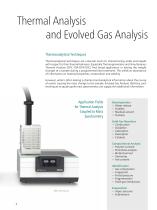
Thermal Analysis and Evolved Gas Analysis Thermoanalytical Techniques Thermoanalytical techniques are universal tools for characterizing solids and liquids with respect to their thermal behavior. Especially Thermogravimetry and Simultaneous Thermal Analysis (STA, TGA-DTA/DSC) find broad application in testing the weight changes of a sample during a programmed heat treatment. This yields an abundance of information on material properties, composition and stability. However, what is often lacking is chemical and analytical information about the course of events causing the mass change to the sample....
Open the catalog to page 2
Reasons to Couple a Mass Spectrometer to a Thermal Analyzer Complementary Information Gas analysis allows for an explanation of the effects recorded by means of thermal analysis. The gases evolved can be detected down to the ppb range, which exceeds the typical sensitivity of thermoanalytical methods. The combination of the two methods therefore forms the ideal basis for top-notch material characterization. Quadrupole Mass Spectrometry (QMS) A quadrupole mass spectrometer’s sensitivity, selectivity, speed and capacity for continuous operation make the system ideally suited for evolved gas analysis...
Open the catalog to page 3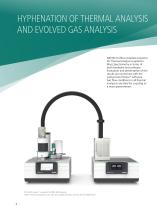
HYPHENATION OF THERMAL ANALYSIS AND EVOLVED GAS ANALYSIS NETZSCH offers complete solutions for Thermal Analysis coupled to Mass Spectrometry in terms of both hardware and software. Evaluation and presentation of the results are carried out with the well-proven Proteus® software. Gas flow conditions in all thermal analyzers are ideal for coupling to a mass spectrometer. STA 509 Jupiter® coupled to QMS 505 Aëolos; other thermal analyzers can also be coupled to MS, such as the TG 309 Libra®
Open the catalog to page 4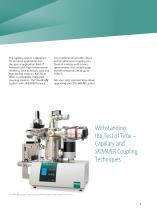
The capillary system is designed for universal application. For the special application field of materials with high condensation tendency, such as metals, salts and high-boiling organics, NETZSCH offers a completely integrated coupling solution: The STA 449 F3 Jupiter® with SKIMMER furnace. This combination provides direct and simultaneous coupling of a thermal analyzer with a mass spectrometer, thus enabling gas transfer temperatures of up to 1950°C. Ask your sales representative about upgrading your STA 449 F3 Jupiter®. Withstanding the Test of Time – Capillary and SKIMMER Coupling Techniques...
Open the catalog to page 5
TA-QMS Coupling Techniques Interface for Pressure Adjustment Mass spectrometers, composed of a mass filter, an electron impact ion source and an ion detector, work only in high vacuum. Therefore, an interface is required for the coupling of a thermobalance – which works with a purge gas flow at atmospheric pressure – to the mass spectrometer. Different versions of pressure reduction interfaces are realized depending on instrumentation and applications. STA 449 F3 Jupiter® with SKIMMER furnace Single-Step Pressure Reduction Double-Step Pressure Reduction A capillary of small internal diameter...
Open the catalog to page 6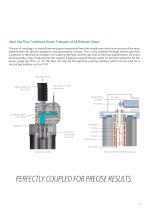
Ideal Gas Flow Conditions Ensure Transport of All Relevant Gases The aim of coupling is to have all relevant gases transported from the sample area into the ion source of the mass spectrometer for precise qualitative and quantitative analysis. This is only achieved through perfect gas flow conditions in the thermal analyzer, the coupling interface and the gas inlet of the mass spectrometer. As only a small quantity of gas is required for the analysis, a bypass is used at the gas outlet on the thermobalance for the excess purge gas flow; i.e., for the flow not passing through the coupling interface,...
Open the catalog to page 7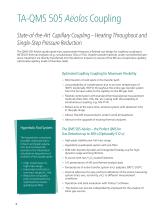
TA-QMS 505 Aëolos Coupling State-of-the-Art Capillary Coupling – Heating Throughout and Single-Step Pressure Reduction The QMS 505 Aëolos quadrupole mass spectrometer features a fleshed-out design for capillary coupling to NETZSCH thermal analyzers (e.g., simultaneous TGA or STA). Volatile sample materials under controlled temperature treatment are directly transferred into the electron impact ion source of the MS via a fused silica capillary (optionally capillary made of stainless steel). Optimized Capillary Coupling for Maximum Flexibility ∙ ∙ ∙ ∙ ∙ ∙ Hyperbolic Rod System The hyperbolic rod...
Open the catalog to page 8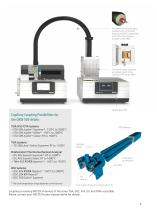
Insulated inert quartz glass capillary with controlled heating to 300°C (optionally 350°C) for loss-free gas transfer to the QMS Furnace for easy assembly and adjustment of the capillary inlet at the QMS Capillary Coupling Possibilities for the QMS 505 Aëolos TGA-DSC/DTA Systems STA 509 Jupiter® Supreme*: -150°C to 2000°C STA 509 Jupiter® Select*: -150°C to 2000°C STA 509 Jupiter® Classic: RT to 1600°C TGA Systems TG 309 Libra® Select/Supreme: RT to 1100°C Capillary guide Dilatometer/Thermomechanical Analyzer DIL 402 Expedis Supreme*: RT to 1600°C DIL 402 Expedis Select: RT to 1600°C TMA 402...
Open the catalog to page 9
Sensitive and Linear Detector System Detection Sensitivity for Hydrogen For demonstration of the detection sensitivity in the low mass range, argon purge gas was treated with pulses of hydrogen by using the NETZSCH PulseTA®. The volume of the pulses was equivalent to 1 μg, 5 μg and 10 μg hydrogen. For m/z 2, an integration time of 1 s was used. Due to high performance of the MS, low hydrogen quantities can be detected with high precision. STA-MS measurement of hydrogen pulses at constant temperature Since the pulse area increases linearly with the pulse volume, quantification over a high concentration...
Open the catalog to page 10
QMS 505 Aëolos Coupling QMS Specifications Mass range* 1 u to 300 u (optionally to 512 u); including auto-tuning using PFTBA to calibrate the mass scale axis Mass filter Quadrupole with hyperbolic rods and pre-filter (patented) Two iridium cathodes with Y2O3 coating Electron energy Emission current Detector Dynamic range (electronic) Detection limit Resolution Vacuum system RF generator Measuring modes Scan rate (electronic) Power Power consumption SEM with discrete dynodes and integrated Faraday cup 9 decades < 100 ppb (gas-dependent) 0.5 u to 1.5 u Turbo molecular pump with 4-stage diaphragm...
Open the catalog to page 11All NETZSCH Analyzing & Testing catalogs and technical brochures
 TG 309 Libra Series
24 Pages
 Kinexus Prime Series
20 Pages
 NTA Fire Testing Systems
20 Pages
 Advanced Materials Testing
32 Pages
 DIL 502 Expedis Series
28 Pages
 NETZSCH Energy Solutions
40 Pages
 Product Overview
12 Pages
 HFM 706 Lambda Series
16 Pages
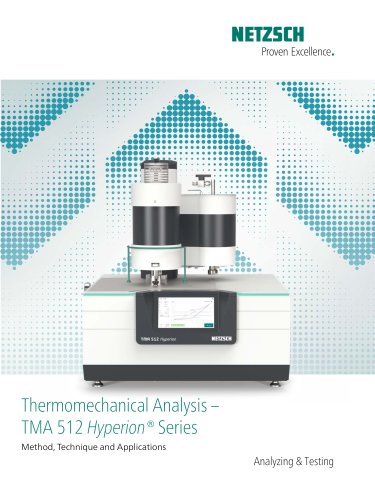 TMA 512 Hyperion® Series
24 Pages
 LFA 427 - product brochure
24 Pages
 Kinexus Prime DSR Series
20 Pages
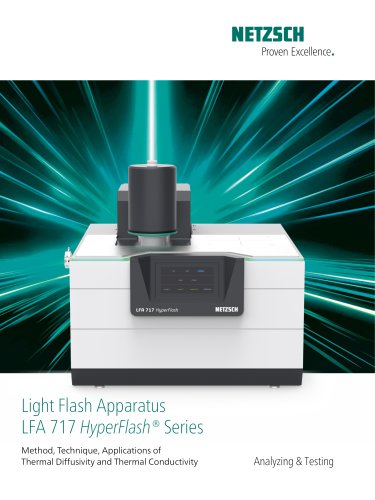 LFA 717 HyperFlash® Series
28 Pages
 DMA 303 Eplexor
24 Pages
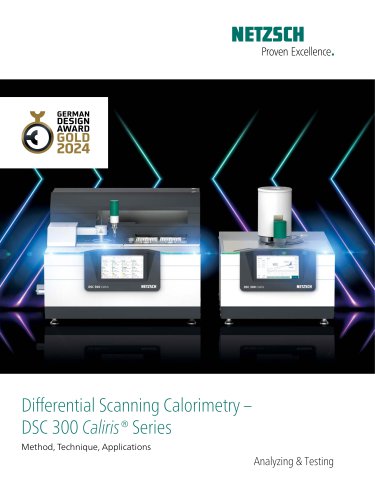 DSC 300 Caliris Series
28 Pages
 STA 509 Jupiter Series
28 Pages
 DEA 288 Ionic
20 Pages
 STA 2500 Regulus
12 Pages
 NTA Guarded Hot Plate Series
16 Pages
 Rosand Series
20 Pages
 Accelerating Rate Calorimetry
20 Pages
 NTA HotBoxes
16 Pages
 DIL 402 Expedis Classic
16 Pages
 Kinetics NEO
20 Pages
 TG-FTIR - product brochure
24 Pages
 HMOR 422
1 Page
 RUL/CIC 421
1 Page
 Cone Calorimeter TCC 918
12 Pages
 SBA 458 Nemesis®
24 Pages
 NETZSCH NEVIO Instrument Series
24 Pages
 Thermal Insulation Materials
24 Pages
 DMA GABO EPLEXOR up to 1500°C
12 Pages
 GABOMETER®
8 Pages






- Test machine
- NETZSCH measuring instrument
- NETZSCH test chamber
- Concentration analyzer
- Monitoring analyzer
- Analysis software solution
- Liquids analyzer
- Test stand
- NETZSCH automatic analyzer
- Temperature test chamber
- Windows software
- Automated testing machine
- Material test machine
- Climatic test cabinet
- NETZSCH benchtop analyzer
- NETZSCH solids analyzer
- Quality control test cell
- Computer-controlled test machine