
- Catalogs
- NETZSCH Analyzing & Testing
- NETZSCH NEVIO Instrument Series


- Company
- Products
- Catalogs
- News & Trends
- Exhibitions
NETZSCH NEVIO Instrument Series

NETZSCH NEVIO Instrument Series
The document provides an overview of the NETZSCH Nevio Instrument Series, which includes advanced equipment for Differential Scanning Calorimetry (DSC), Thermogravimetric Analysis (TGA), and Simultaneous Thermal Analysis (STA). These instruments are vital for laboratories in industries such as chemical, pharmaceutical, cosmetics, and food for substance analysis and characterization.
Thermal analysis is essential for evaluating material property changes during heating or cooling. The main techniques include:
- DSC (Differential Scanning Calorimetry): Detects phase transitions, melting temperatures, and crystallization by measuring heat-flow differences.
- TGA (Thermogravimetric Analysis): Assesses thermal stability, decomposition, and compositional analysis by measuring mass changes.
- STA (Simultaneous Thermal Analysis): Offers comprehensive analysis by combining DSC and TGA.
The NETZSCH Nevio line is designed for research, development, quality control, and contract testing. The instruments are user-friendly, precise, and reliable, with automation solutions to streamline laboratory work.
DSC and TGA are complementary methods that help distinguish structural changes from mass changes. Coupling thermal analyzers with evolved gas analyzers like FT-IR, MS, or GC-MS enhances understanding of decomposition processes.
- Polymorphism of Paracetamol: Demonstrates phase transitions and crystallization behavior using DSC.
- Denaturation of DNA: Shows the transition of DNA from helical to single strands, observed as an endothermal effect in DSC.
Thermal analysis using the NETZSCH Nevio series provides critical insights into material properties, aiding in the development and quality assurance of products in various industries.
The document outlines the specifications of various NETZSCH instruments, including the TG 209 F3 Nevio and DSC 214 Nevio. Key parameters such as temperature range, heating/cooling rates, and gas atmospheres are detailed.
It describes the procedures for conducting thermal analysis using these instruments, including the use of Proteus® software for data evaluation and the coupling of gas analyzing systems for evolved gas analysis.
Recommendations for using the instruments in specific applications are provided, emphasizing the importance of maintaining a pure inert gas atmosphere for accurate evolved gas analysis.
The Proteus® software is highlighted for its efficiency in handling and evaluating test runs, with features like AutoEvaluation and Identify for curve recognition and database comparison.
- Instrument Capabilities: The instruments handle a wide range of temperatures and are equipped with features like automatic sample changers and gas-tight designs for enhanced performance.
- Software Integration: Proteus® software offers advanced functionalities for data integrity and user management, meeting regulatory requirements such as 21 CFR Part 11.
- Application Areas: Suitable for quality assurance and process optimization in pharmaceuticals and foodstuffs.
The document discusses the AutoEvaluation feature, allowing users to customize value displays. The SuperPosition of Curves tool simulates how curves composed of multiple components might appear, useful in quality control and defor-mulation studies.
Describes two methods for curve averaging: one based on absolute values, considering sample masses, and another based on relative values, using the number of measurements as the denominator.
NETZSCH provides comprehensive installation and commissioning services, including configuration, parameterization, and basic operator instruction. They offer installation qualification (IQ) and operational qualification (OQ) in line with USP <1085> or GAMP 5, and assist with performance qualification (PQ) if needed.
NETZSCH offers on-site calibration services and regular recalibrations. Their service includes maintenance, repair, software updates, and spare part assistance to ensure the longevity of the instruments.
The NETZSCH Thermal Analysis applications laboratories provide solutions for thermal analysis and thermophysical property measurement. They offer comprehensive instrument and method training, application service, and contract testing.
NETZSCH is a German family-owned company specializing in machinery and instrumentation. With over 3,500 employees in 35 countries, they provide tailored solutions in Analyzing & Testing, Grinding & Dispersing, and Pumps & Systems. Their extensive experience and product line ensure they meet and exceed customer expectations in thermal analysis and calorimetry.
Catalog excerpts

Investigation of Pharmaceuticals, Foods and Cosmetics with the NETZSCH Nevio Instrument Series Analyzing & Testing
Open the catalog to page 1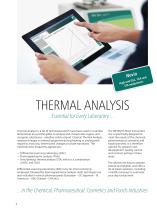
and , TGA d DSC ents en High- equipm STA THERMAL ANALYSIS Essential for Every Laboratory ... Thermal Analysis is a set of techniques which have been used in countless laboratories around the globe to analyze and characterize organic and inorganic substances − whether solid or liquid. Classical Thermal Analysis assesses changes in material properties during heating or cooling with regard to mass loss, dimensional changes or phase transitions. The methods most frequently applied are: Differential scanning calorimetry (DSC) Thermogravimetric analysis (TGA) Simultaneous thermal analysis (STA, which...
Open the catalog to page 2
DSC measures the change in heat-flow difference into a sample and a reference material while they are subjected to a controlled temperature program. In a heat-flux DSC, the difference in heat flow between sample and reference is derived from the temperature difference between sample and furnace and reference and furnace or between sample and reference. Melting temperatures and enthalpies (enthalpies of fusion) Polymorphism Crystallization temperatures and enthalpies Glass transitions (e.g., amorphous content) Solid-solid interactions Compatibility Phase diagrams Eutectic purity Solid-fat content...
Open the catalog to page 3
Improving Interpretation by Coupling Evolved Gas Analyzers to Thermal Analyzers The strength of DSC lies in its capability of detecting and monitoring a material’s phase transitions. However, the reason for a DSC effect is not always obvious; it might be: In order to gain a deeper understanding of what happens during evaporation and decomposition processes, it is possible to couple an evolved gas analyzer (e.g., an FT-infrared spectrometer (FT-IR), mass spectrometer (MS), or gas chromatographmass spectrometer (GC-MS)) to the thermal analyzer. a polymorphic transition, a melting effect, or an...
Open the catalog to page 4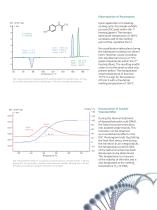
Substance: Mol mass: Purity: Impurities: Area: 158.7 J/g T melting: Peak*: 159.6°C T meting pure: Onset: 156.7°C Correction for linearization: Baseline: Area: 166.1 J/g Peak*: 171.6°C [1.2] Onset: 169.0°C Van‘t Hoff Lin. Van‘t Hoff 160 180 DSC measurement on paracetamol (4-acetaminophenol); sample mass: 2.6 mg, Al crucibles with pierced lid, heating rate: 10 K/min, nitrogen atmosphere Upon application of a heatingcooling cycle, this sample exhibits just one DSC peak within the 1st heating (green). The extrapolated onset temperature at 169°C correlates well to the melting point of the crystalline...
Open the catalog to page 5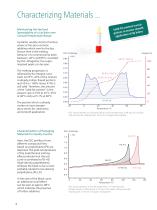
Maintaining the Feel and Spreadability of a Lip Balm over a Broad Temperature Range Lip balms usually consist of various waxes or fats plus cosmetic additives which care for the lips. Shown here is the melting behavior of a commercial lip balm between -20°C and 85°C, recorded by DSC. Altogether, five superimposed peaks can be seen. The melting progression is reflected by the integral curve (red). At 25°C, 47% of the mixture is already molten (liquid portion) and 53% (= 100% minus 47%) is still solid. Therefore, the amount of the “solid-fat content” in the present case is 53% at 25°C, 45% at 40°C...
Open the catalog to page 6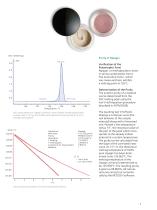
Verification of the Polymorphic Form Nipagin, or methylparaben, exists in various polymorphic forms. The monoclinic form I, which was measured here, exhibits a melting point at 126°C. Determination of the Purity The eutectic purity of a material can be determined from the DSC melting peak using the Van’t Hoff equation (procedure described in ASTM E928). DSC measurement on nipagin (chemical name: methyl 4-hydroxybenzoate); sample mass: 2.12 mg, Al crucibles with pierced lid, heating rate: 0.7 K/min, nitrogen atmosphere Substance: Mol mass: Purity: Mid: 85.0°C Impurities: Delta Cp*: 0.152 J/(g*K)...
Open the catalog to page 7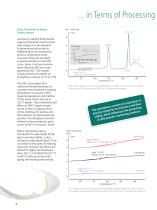
Glass Transition of SprayDried Lactose Lactose (crystalline disaccharide sugar) is frequently used in food technology or as an excipient in pharmaceutical products. Depending on the production process, amorphous areas may exist. They are recorded as glass transitions in the DSC curve. Here, α-lactose monohydrate (FlowLac 90) was investigated by DSC. The sample is spray-dried and exhibits an amorphous content of 10 to 15%. The DSC curve above illustrates the thermal behavior of α-lactose monohydrate including dehydration at around 149°C (peak temperature) and melting of the water-free α-lactose...
Open the catalog to page 8
-2 DSC measurement on potassium clavulanate; sample mass: 2.3 mg, Al crucibles 200.2°C -3 Hygroscopicity: A Challenge for Shelf Life Potassium clavulanate is classified as hygroscopic. Therefore, the condition of the supplied material is crucial to its shelf life. Here, DSC and TGA-FT-IR measurements were carried out to elucidate the condition of this chemical. DSC Measurement During heating in nitrogen atmosphere, the DSC curve (upper plot) shows two effects: a stretched endothermal one with a peak temperature at 77°C and a double exothermal peak starting at 187°C (extrapolated onset). Thermal...
Open the catalog to page 9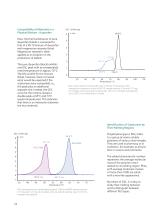
Area: 166.1 J/g Peak*: 171.6°C Onset: 169.0°C Compatibility of Materials in a Physical Mixture – Ibuprofen 100 Here, the thermal behaviorTemperature /°C of pure The pure ibuprofen (black) exhibits one DSC peak77.3°C an extrapolated with onset temperature of approx. 76°C. The DSC profile for the mixture (blue), however, does not reveal what would be expected if the substances were compatible; i.e., -1.87 % this peak plus an additional separate one. Instead, the DSC curve for the mixture reveals a double peak at 65°C and 73°C (peak temperatures). This indicates that there is an interaction between...
Open the catalog to page 10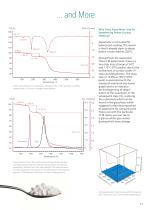
TGA measurement on aspartame; sample mass: 7.46 mg, Al2O3 crucible, heating rate: 10 K/min, nitrogen atmosphere Presentation of the TGA (red) curve of aspartame and the corresponding traces of methanol and carbon dioxide (as examples), derived from the associated FT-IR measurement. TG /% A trace represents the course of the absorption intensity of a specific FT-IR band as a function of time or temperature. Derived from the associated TGA-FT-IR experiment, there is a two-step mass change at 54°C and 115°C (DTG peaks), due to the evolvement of surface water (1st step) and dehydration. The mass...
Open the catalog to page 11All NETZSCH Analyzing & Testing catalogs and technical brochures
 TG 309 Libra Series
24 Pages
 Kinexus Prime Series
20 Pages
 NTA Fire Testing Systems
20 Pages
 Advanced Materials Testing
32 Pages
 DIL 502 Expedis Series
28 Pages
 NETZSCH Energy Solutions
40 Pages
 Product Overview
12 Pages
 HFM 706 Lambda Series
16 Pages
 TMA 512 Hyperion® Series
24 Pages
 LFA 427 - product brochure
24 Pages
 Kinexus Prime DSR Series
20 Pages
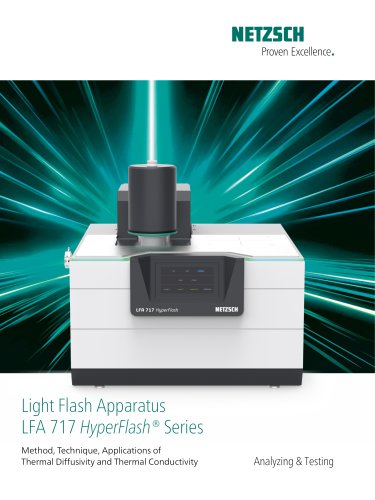 LFA 717 HyperFlash® Series
28 Pages
 DMA 303 Eplexor
24 Pages
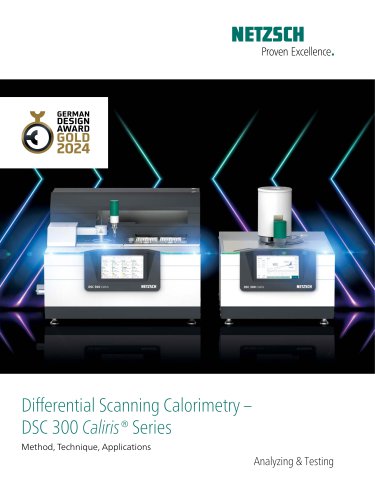 DSC 300 Caliris Series
28 Pages
 STA 509 Jupiter Series
28 Pages
 DEA 288 Ionic
20 Pages
 STA 2500 Regulus
12 Pages
 NTA Guarded Hot Plate Series
16 Pages
 Rosand Series
20 Pages
 Accelerating Rate Calorimetry
20 Pages
 NTA HotBoxes
16 Pages
 DIL 402 Expedis Classic
16 Pages
 Kinetics NEO
20 Pages
 TG-FTIR - product brochure
24 Pages
 TA-QMS Coupling
28 Pages
 HMOR 422
1 Page
 RUL/CIC 421
1 Page
 Cone Calorimeter TCC 918
12 Pages
 SBA 458 Nemesis®
24 Pages
 Thermal Insulation Materials
24 Pages
 DMA GABO EPLEXOR up to 1500°C
12 Pages
 GABOMETER®
8 Pages






- Test machine
- NETZSCH measuring instrument
- NETZSCH test chamber
- Concentration analyzer
- Monitoring analyzer
- Analysis software solution
- Liquids analyzer
- Test stand
- NETZSCH automatic analyzer
- Windows software
- Automated testing machine
- Material test machine
- Temperature test chamber
- NETZSCH benchtop analyzer
- NETZSCH solids analyzer
- Climatic test cabinet
- Quality control test cell
- Computer-controlled test machine