
- Catalogs
- NETZSCH Analyzing & Testing
- MMC 315 Nexus® - product brochure


- Company
- Products
- Catalogs
- News & Trends
- Exhibitions
MMC 315 Nexus® - product brochure
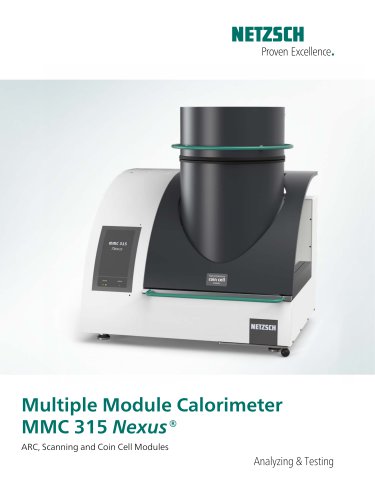
MMC 315 Nexus® - product brochure
The NETZSCH Multiple Module Calorimeter MMC 315 Nexus® is a versatile instrument for analyzing energetic materials and batteries, suitable for R&D, universities, research centers, and quality control across various industries. It supports multiple analytical methods to enhance product and process understanding.
The MMC 315 Nexus® offers scanning, isothermal, and adiabatic testing modes with a wide temperature and pressure range. It includes Proteus® software for comprehensive data evaluation.
- ARC Module: Simulates worst-case scenarios under adiabatic conditions for process safety, thermal runaway, and storage studies.
- Scanning Module: Analyzes high-energy exo- and endothermal reactions in solids and liquids.
- Coin Cell Modules: Characterizes coin cells for battery studies and can be used for pharmaceuticals and polymers.
Designed to minimize heat loss and maintain adiabatic conditions, it supports temperatures from room temperature to 500°C and pressures up to 150 bar.
Enhances the ARC module by compensating for heat loss, allowing accurate determination of reaction enthalpies in scanning and isothermal modes.
Used for chemical reaction measurements, phase change analysis, process safety analysis, and coin cell characterization, particularly useful for understanding thermal behavior, hazard potential, and kinetic parameters.
The document analyzes thermal behavior and decomposition characteristics of chemical compounds using Differential Scanning Calorimetry (DSC) and other techniques, including studies on DTBP, NH4NO3, and KNO3, and insights into battery development.
Investigates DTBP self-decomposition at 110°C, with an adiabatic temperature rise of 133.7 K and decomposition pressure of 42.7 bar, using a first-order decomposition mechanism.
Reveals three endothermal solid-solid phase transitions and melting at 169°C, followed by thermal decomposition, highlighting the importance of understanding exothermic reactions for safety.
Analyzed using the Scanning module, showing endothermal effects at 129°C and 334°C related to phase transitions, emphasizing explosive potential of rapid redox reactions.
ANC, a mixture of NH4NO3 and fuel oil, shows three endothermal phase transitions before a large exothermal decomposition at approximately 235°C, releasing 705 J/g.
Highlights the importance of understanding heat generation during battery cycles to improve efficiency, performance, and lifespan, emphasizing calorimetric analysis in development.
Provides insights into thermal behavior of chemical compounds, emphasizing calorimetric techniques for safety and efficiency in chemical processing and product development.
Discusses the use of coin cells in battery testing, highlighting their role in understanding processes during cycling and providing quantitative comparisons beyond current and voltage measurements.
Designed for caloric measurements, allowing charge/discharge tests to improve battery performance and condition evaluation, acting as a high-volume DSC for detecting subtle thermal transitions.
- No special sample preparation required.
- Analysis of complete coin cells instead of individual components.
- Merging of heat generation data with battery data.
- Simple interface to a cycler device.
Available in High-Temperature (HT) and High-Sensitivity (HS) variations, with temperature ranges of RT to 300°C (HT) and RT to 200°C (HS), and detection limits of 0.1 mW (HT) and 0.05 mW (HS).
Details calibration methods using traditional melting standards and TrueJoule calibration for isothermal experiments, ensuring high accuracy in thermal analysis.
The Coin Cell Module offers comprehensive characterization of coin cells, replicating real-world performance with improved stability and sensitivity, simplifying connection to external battery testing systems.
Discusses advanced calibration and measurement techniques for battery research and quality control, focusing on the TrueJoule calibration system and High-Sensitivity Coin Cell module.
The TrueJoule system delivers precise power pulses into calibration cells, ensuring high measurement reliability, crucial for battery R&D.
Details the formation of the Solid Electrolyte Interphase (SEI) in lithium-ion batteries and long-term cycling tests to reveal thermal and electrical characteristics.
Emphasizes precise thermal measurements for quality control and advanced polymer development, comparing DSC with MMC results.
Recommends using larger samples for improved reliability and suggests integrating the module with preferred potentiostats for flexibility.
Includes graphs and data tables illustrating calibration methods and temperature scans, revealing differences that smaller sample analyses might miss.
NETZSCH-Gerätebau GmbH is a leading global technology company specializing in mechanical, plant, and instrument engineering, offering solutions in thermal analysis, calorimetry, rheology, and fire testing.
Catalog excerpts
Proven Excellence. Multiple Module Calorimeter MMC 315 Nexus® ARC, Scanning and Coin Cell Modules Analyzing & Testing
Open the catalog to page 1
Multiple Module Calorimeter Synergy of Proven Methods Scientists and engineers generally recognize that more product and process information can be obtained by multiple analytical methods rather than using a single technique. Different signals can be recorded, and superimposed sample effects can often be much better explained. The technique has to be reliable, fast and easy to use in everyday operations. The NETZSCH Multiple Module Calorimeter MMC 315 Nexus® is an instrument which can be operated with different modules for the investigation of energetic materials and batteries (coin cells). It...
Open the catalog to page 2
Advantages and Key Features of the MMC 315 Nexus® ARC Module -Process Safety Knowing the amount of energy released by a given chemical reaction is essential for ensuring safe and reliable processes. The ARC (Accelerating Rate Calorimetry) module allows you to study the worst-case scenarios at elevated temperatures without losing heat to the environment. ARC systems in accordance with ASTM E1981 have been widely used for decades to simulate the behavior of actual large-scale reactors. However, these instruments have a large footprint. In contrast, the MMC 315 Nexus® with ARC module has a space-saving...
Open the catalog to page 3
Thermal runaway scenarios can be understood by investigating the runaway reaction. Questions arise which can be answered by means of measurements under adiabatic conditions. For this purpose, the NETZSCH MMC 315 Nexus® can be configured with the ARC module, which can also be equipped with VariPhi®. The ARC Module Process Safety What is the thermal behavior of the material? n is l reactio en its a ic m e A ch y' wh 'runawa n rate is e b o t said uctio at prod t losses. own he han hea higher t What is the thermal hazard potential of the material? At what temperature does the reaction occur (onset)?...
Open the catalog to page 4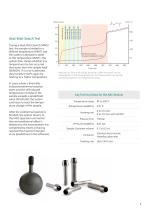
Initial heating Heat-Wait-Search Test During a Heat-Wait-Search (HWS) test, the sample is heated to a defined temperature (HEAT) and the system is allowed to settle at this temperature (WAIT). The system then checks whether any temperature rise has occurred that stems from the sample itself (SEARCH). If no rise is detected, the procedure starts again by heating to a higher temperature. In cases where a thermally induced exothermal reaction starts and the self-induced temperature increase of the sample exceeds a predefined value (threshold), the system continues to track the temperature change...
Open the catalog to page 5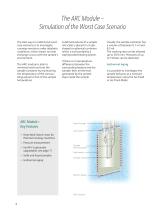
The best way to understand worst case scenarios is to investigate runaway reactions under adiabatic conditions, which means no heat exchange occurs with the sample's environment. The ARC module is able to minimize heat loss from the sample container by maintaining the temperature of the surroundings equal to that of the sample temperature. A defined volume of a sample (ml scale) is placed in a tubeshaped or spherical container which is surrounded by a sophisticated heating system. If there is no temperature difference between the surrounding heaters and the sample, then all the heat generated...
Open the catalog to page 6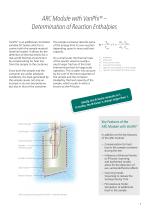
VariPhi® is an additional controlled variable DC heater which is in contact with the sample material (internal heater). It allows for the definition of thermal inertia for a real-world thermal environment by compensating for heat loss from the sample to the container. Since both the sample and the container are under adiabatic conditions, the heat generated by the sample causes not only an increase in its own temperature but also in that of the container. The sample container absorbs some of the energy from its own reaction depending upon its mass and heat capacity. On a small scale, the thermal...
Open the catalog to page 7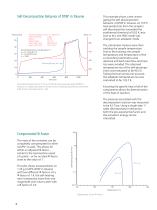
Heat flow /(mW/mg) Self-Decomposition Behavior of DTBP in0.10 Toluene Horizontal Step (110.21 °C - 200.51°C): Thermal Inertia: 1.480 delta T: 90.3 K delta T ideal: 133.7 K react. spec. heat: 280.675 J/g react. total. heat: 1611.075 J Kinetic Parameters, zero baseline, F1 A = 15.152 log (1/s) E = 151.039 kJ/mol n = 1.000 This example shows a test investigating the self-decomposition Area: 29.31 J/g behavior of DTBP in toluene. At 110°C, heat production from the sample's self-decomposition exceeded the exothermal threshold of 0.02 K/min. 156.7°C DueOnset: to this, the HWS mode was changed to an...
Open the catalog to page 8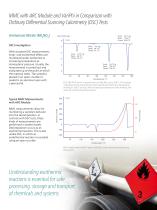
MMC with ARC Module and VariPhi in Comparison with Ordinary Differential Scanning Calorimetry (DSC) Tests Area: -76.7 J/g Peak: 172.3°C Onset: 169.0°C ↑ exo Area: -2.4 J/g Peak: 94.3°C Onset: 91.1°C -1 Heat flow /(mW/mg) With standard DSC measurements, endo- and exothermal effects are monitored under isothermal or increasing temperature at atmospheric pressure. Usually, the measurement is carried out and evaluated up to the point at which the material melts. The sample is placed in an open crucible or sealed in an aluminum pan with a pierced lid. Area: -23.3 J/g Peak: 65.3°C Onset: 53.2°C Area:...
Open the catalog to page 9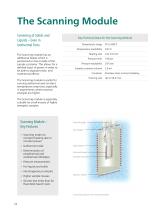
Key Technical Data for the Scanning Module The Scanning module has an additional heater which is positioned on the outside of the sample container. This allows for a defined input of power in order to be able to separate endo- and exothermal effects. The Scanning module is useful for running isothermal and constant temperature ramp tests, especially in experiments where reaction energies are higher. The Scanning module is especially suitable for small masses of highly energetic samples. Temperature range Temperature readability Heating rate Pressure limit Pressure readability Sample container...
Open the catalog to page 10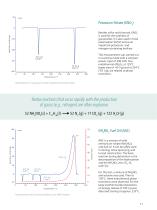
Heat flow Voltage Current Heat flow /(mW/mg) Besides sulfur and charcoal, KNO3 is used for the synthesis of gunpowder. It is also used in food preservation (E252) and as an important potassium- and nitrogen-containing fertilizer. This measurement was carried out in scanning mode with a constant power input of 200 mW. Two endothermal effects, at 129°C (peak area of -45 J/g) and at 334°C (-87 J/g), are related to phase transitions. Measurement on potassium nitrate using the Scanning module ↑ exo Heat flow /(mW/mg) Heat flow /(mW) Redox reactions that occur rapidly with the production of gases (e.g.,...
Open the catalog to page 11All NETZSCH Analyzing & Testing catalogs and technical brochures
 TG 309 Libra Series
24 Pages
 Kinexus Prime Series
20 Pages
 NTA Fire Testing Systems
20 Pages
 Advanced Materials Testing
32 Pages
 DIL 502 Expedis Series
28 Pages
 NETZSCH Energy Solutions
40 Pages
 Product Overview
12 Pages
 HFM 706 Lambda Series
16 Pages
 TMA 512 Hyperion® Series
24 Pages
 LFA 427 - product brochure
24 Pages
 Kinexus Prime DSR Series
20 Pages
 LFA 717 HyperFlash® Series
28 Pages
 DMA 303 Eplexor
24 Pages
 DSC 300 Caliris Series
28 Pages
 STA 509 Jupiter Series
28 Pages
 DEA 288 Ionic
20 Pages
 STA 2500 Regulus
12 Pages
 NTA Guarded Hot Plate Series
16 Pages
 Rosand Series
20 Pages
 Accelerating Rate Calorimetry
20 Pages
 NTA HotBoxes
16 Pages
 DIL 402 Expedis Classic
16 Pages
 Kinetics NEO
20 Pages
 TG-FTIR - product brochure
24 Pages
 TA-QMS Coupling
28 Pages
 HMOR 422
1 Page
 RUL/CIC 421
1 Page
 Cone Calorimeter TCC 918
12 Pages
 SBA 458 Nemesis®
24 Pages
 NETZSCH NEVIO Instrument Series
24 Pages
 Thermal Insulation Materials
24 Pages
 DMA GABO EPLEXOR up to 1500°C
12 Pages
 GABOMETER®
8 Pages





- Test machine
- NETZSCH measuring instrument
- NETZSCH gas analyzer
- NETZSCH test chamber
- Concentration analyzer
- Monitoring analyzer
- Analysis software solution
- Liquids analyzer
- Test stand
- NETZSCH automatic analyzer
- Temperature test chamber
- Windows software
- Automated testing machine
- Material test machine
- Climatic test cabinet
- NETZSCH benchtop analyzer
- NETZSCH solids analyzer
- Spectrometer
- Quality control test cell
- Computer-controlled test machine