
- Catalogs
- NETZSCH Analyzing & Testing
- LFA 717 HyperFlash® Series


- Company
- Products
- Catalogs
- News & Trends
- Exhibitions
LFA 717 HyperFlash® Series
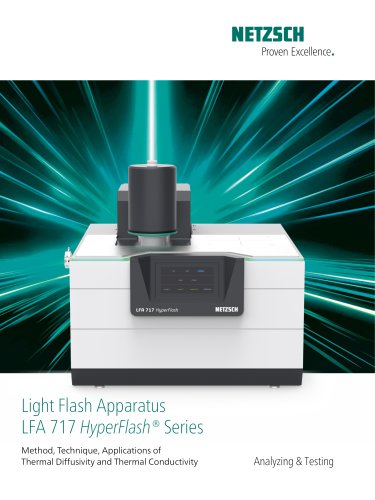
LFA 717 HyperFlash® Series
The document provides an in-depth analysis of the LFA 717 HyperFlash® series, focusing on thermal diffusivity and conductivity measurements using the Light Flash Apparatus (LFA) method. This method is essential for understanding heat transfer in applications like insulation and heat sinks.
Thermal conductivity is crucial for selecting materials in applications requiring efficient heat transfer. The Flash Method offers a reliable solution for measuring these properties, aiding in thermal management and material design for extreme temperatures.
The Light Flash technique is a non-destructive method for determining thermal diffusivity and specific heat capacity. It involves heating a sample with a light pulse and measuring the temperature change to calculate thermal properties.
The LFA 717 HyperFlash® allows simultaneous measurement of up to 16 samples, offers cooling options, and includes advanced calculation models. It supports a wide range of sample holders and materials, enhancing its application scope.
This version extends the temperature range up to 1250°C, featuring a vacuum-tight furnace and efficient sample throughput. It uses a xenon flash lamp for cost-effective measurements without consumables.
The series includes various sample holders for different applications, such as liquids, pastes, and anisotropic materials. Special holders ensure continuous contact and minimize heat transfer through container walls.
Special handling is required for toxic or sensitive materials. The LFA units can be adapted for use in glove boxes or hot cells to ensure safety and prevent environmental exposure.
The LFA 717 HyperFlash® offers cooling options using liquid nitrogen and compressed air. Energy-efficient chillers reduce consumption by up to 50%, enhancing sustainability.
The Proteus® software provides intelligent operation, supporting multiple instruments and offering advanced data analysis capabilities. It includes features for specific heat capacity determination, contact resistance analysis, and thermal diffusivity graphs.
The software is divided into measurement and analysis components, allowing for flexible data processing. It supports simultaneous measurement and evaluation, with options for data export and graphical analysis.
The LFA 717 HyperFlash® series, with its advanced features and software, sets a high standard in thermal analysis, offering precise and efficient measurement solutions for a wide range of applications.
The document discusses various correction techniques for thermal diffusivity measurements, including Equivalent Square, Gravity Center, and Double Exponential Pulse Correction. These corrections significantly impact the model function's appearance and the 'Goodness of fit'.
A simulation of a high-diffusivity material shows the importance of pulse correction. Without correction, calculated thermal diffusivity decreases with increasing pulse length, whereas with exponential pulse correction, diffusivity remains constant.
The document describes the Standard Model for opaque, homogeneous, and isotropic samples, suitable for about 90% of LFA applications. Special models, including 2- and 3-Layer Models and In-Plane Heat Flow Models, are available for specific applications.
The Penetration Model is used for porous materials where energy absorption extends into the specimen thickness. The Transparent Model accounts for radiative heat transfer in transparent materials, affecting the thermal curve.
The LFA 717 HyperFlash® is designed for robustness and precision, with features like easy access to components and user-friendly operation. Safety features include protective enclosures and non-contact sample handling tools.
The document highlights the thermal conductivity of silver alloys, noting a decrease in thermal diffusivity and conductivity with temperature increase. Measurements are possible in both solid and liquid states using a sapphire sample holder.
Anisotropic ceramics are engineered for specific thermal conductivity directions, useful in electronic devices and high-temperature applications. The document describes measuring thermal diffusivity in different directions using an SiC laminate sample holder.
This section discusses the thermal diffusivity of a ceramic with embedded fibers, measured between room temperature and 800°C. The specimen preparation involves using a laminate sample holder made of SiC, suitable for high temperatures up to 1250°C.
This section covers the thermal diffusivity of polylactic acid (PLA), a common 3D printing polymer. The study examines PLA printed in three orientations, noting a step at around 60°C indicating the glass transition of PLA.
Alumina (Al2O3) is analyzed for its thermal diffusivity from room temperature to 1250°C. The Transparent Model is necessary for accurate results at higher temperatures due to radiative heat transfer.
This section examines lactose monohydrate, used in pharmaceuticals, for its thermal diffusivity. The fresh powder shows up to 16% lower thermal diffusivity than the expired powder, likely due to a higher proportion of amorphous material.
The document provides a comprehensive analysis of thermal diffusivity and conductivity measurements using the LFA 717 HyperFlash® and related equipment. It covers various materials and discusses the methodologies and standards applied in these measurements.
The LFA 717 HyperFlash® measures thermal diffusivity from 0.01 mm²/s to 2000 mm²/s and thermal conductivity from 0.1 W/(m·K) to 3000 W/(m·K). It operates within a temperature range of -100°C to 1250°C, with a maximum heating rate of 50 K/min.
The document details the use of the Penetration Model for evaluating the thermophysical properties of autoclaved aerated concrete (AAC) and the Standard Model for salts like NaNO³ and NaNO².
The document references several standards, including ASTM E1461, ISO 22007-4, and JIS R 1611, guiding the measurement of thermal diffusivity and conductivity using the laser flash method.
For accurate measurements, the document suggests using the Penetration Model for porous materials and ensuring material compatibility for ionic compounds at high temperatures.
The document includes graphs showing the thermal diffusivity of various materials as a function of temperature, highlighting phase changes and radiative heat transfer effects.
NETZSCH offers a range of services, including maintenance, calibration, and training, to support the use of their thermal analysis instruments.
Catalog excerpts
Proven Excellence. Light Flash Apparatus LFA 717 HyperFlash® Series Analyzing & Testing Method, Technique, Applications of Thermal Diffusivity and Thermal Conductivity
Open the catalog to page 1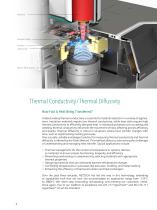
Sample holder Furnace Light pulse Xenon light source Thermal Conductivity/Thermal Diffusivity How Fast Is Heat Being Transferred? Understanding thermal conductivity is essential to material selection in a variety of applications. Insulation materials require low thermal conductivity, while heat sinks require high thermal conductivity to efficiently dissipate heat. In industrial processes such as casting and welding, thermal conductivity influences the movement of heat, affecting process efficiency and quality. Thermal diffusivity is critical in situations where heat transfer changes with time,...
Open the catalog to page 2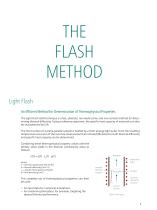
THE FLASH METHOD Light Flash An Efficient Method for Determination of Thermophysical Properties The Light Flash (LFA) technique is a fast, absolute, non-destructive, and non-contact method for determining thermal diffusivity. Using a reference specimen, the specific heat capacity of materials can also be characterized by LFA. The front surface of a plane-parallel sample is heated by a short energy light pulse. From the resulting temperature excursion of the rear face measured with an infrared (IR) detector, both thermal diffusivity and specific heat capacity can be determined. Combining these...
Open the catalog to page 3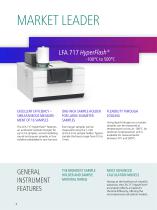
EXCELLENT EFFICIENCY -SIMULTANEOUS MEASUREMENT OF 16 SAMPLES The LFA 717 HyperFlash® features an automatic sample changer for up to 16 samples, accommodating round and square samples in four holders embedded in one furnace. ONE-INCH SAMPLE HOLDER FOR LARGE-DIAMETER SAMPLES Even larger samples can be measured using the 1-inch (0 25.4 mm) sample holder. Typical sample thickness range from 0.5 to 3 mm. FLEXIBILITY THROUGH COOLING Using liquid nitrogen as a coolant, samples can be measured at temperatures as low as -100°C. An optional compressed air unit is available for measurements between 0°C...
Open the catalog to page 4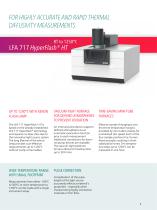
FOR HIGHLY ACCURATE AND RAPID THERMAL DIFFUSIVITY MEASUREMENTS RT to 1250°C UP TO 1250°C WITH XENON FLASH LAMP The LFA 717 HyperFlash® HT is based on the already-established LFA 717 HyperFlash® technology and requires no laser class due to the innovative light source system. The long lifetime of the xenon lamp provides cost-effective measurements up to 1250°C without costly consumables. WIDE TEMPERATURE RANGE WITH SMALL FOOTPRINT Measurements from either -100°C to 500°C or room temperature to 1250°C can be made with a single instrument setup. VACUUM-TIGHT FURNACE FOR DEFINED ATMOSPHERES TO PREVENT...
Open the catalog to page 5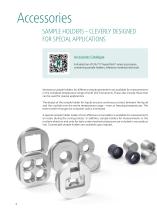
Accessories SAMPLE HOLDERS – CLEVERLY DESIGNED FOR SPECIAL APPLICATIONS Accessories Catalogue Full selection of LFA 717 HyperFlash® series accessories, containing sample holders, reference materials and tools Numerous sample holders for different sample geometries are available for measurements in the complete temperature range of both LFA instruments. These also include those that can be used for special applications. The design of the sample holder for liquids ensures continuous contact between the liquid and the crucible over the entire temperature range – even at freezing temperatures. The...
Open the catalog to page 6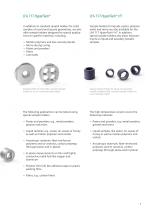
In addition to standard sample holders for solid samples of round and square geometries, we also offer sample holders designed for special applications on specific materials, including: Sample holders for liquids, pastes, polymer melts and resins are also available for the LFA 717 HyperFlash® HT. In addition, special sample holders also allow measurements on "liquid"* and powdery metallic samples. Molten polymers and low-viscosity liquids Resins during curing Pastes and powders Fibers Laminates Sample holder for foils (left), standard sample holder for up to 4 round samples (right) Special sample...
Open the catalog to page 7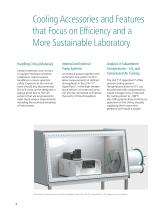
Cooling Accessories and Features that Focus on Efficiency and a More Sustainable Laboratory Handling Critical Materials Certain materials, such as toxic or oxygen/moisture-sensitive substances, require special handling to ensure operator safety. Exposure to the environment should also be prevented. Our LFA units can be designed in special glove box or hot cell versions that are engineered to meet these unique requirements, including the restricted handling of instruments. Internal and External Pump Systems An internal pump together with automatic evacuation control allow measurements in defined...
Open the catalog to page 8
LESS ENERGY CONSUMPTION WITH THE LATEST CHILLER TECHNOLOGY The integration of a chiller in laser flash analysis plays a crucial role in ensuring stable initial temperatures and maintaining a controlled environment, both of which are essential for accurate measurements of thermal diffusivity and the subsequent determination of thermal conductivity. By minimizing temperature fluctuations, chillers enhance the reproducibility and reliability of measurements. However, chillers also consume energy and produce waste heat, which can contribute to operational inefficiencies. Therefore, the use of energy-efficient...
Open the catalog to page 9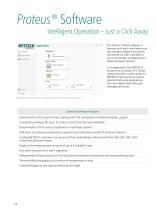
Proteus® Software Intelligent Operation – Just a Click Away The Proteus® 64-bit software is licensed with each instrument and can handle multiple instruments connected via USB in parallel or run on secondary installations on other computer systems. It is integrated in the NETZSCH Assistant as of version 9.5, which collectively links a wide variety of NETZSCH instruments as well as several third-party applications into one higher-level software management suite. NETZSCH Assistant to for managing all instruments and applications General Software Features Determination of the specific heat capacity...
Open the catalog to page 10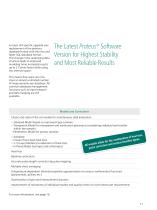
A major LFA-specific upgrade was replacement of the previous database format with the new and faster SQL database format. This change in the underlying data structure leads to improved modeling times and yields results up to 2.5 times faster while using less memory space. The Latest Proteus® Software Version for Highest Stability and Most Reliable Results This means that users can now store an almost unlimited number of measurements per database. All common database management functions such as import/export and data merging are still available. Models and Corrections Classic and state-of-the-art...
Open the catalog to page 11All NETZSCH Analyzing & Testing catalogs and technical brochures
 TG 309 Libra Series
24 Pages
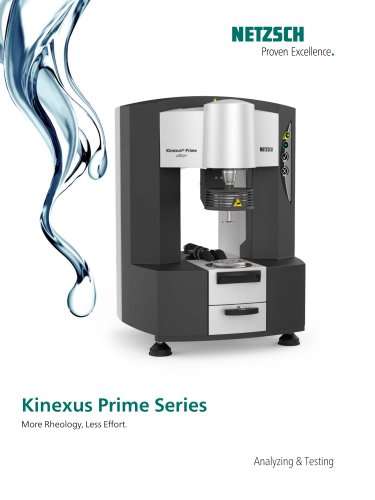 Kinexus Prime Series
20 Pages
 NTA Fire Testing Systems
20 Pages
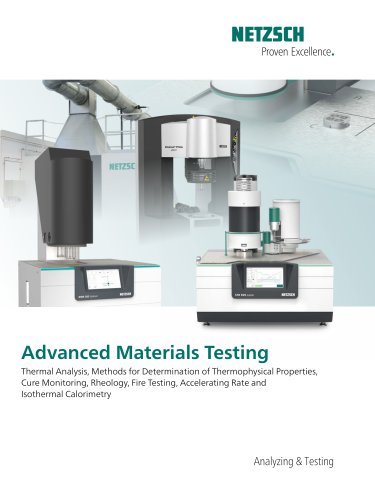 Advanced Materials Testing
32 Pages
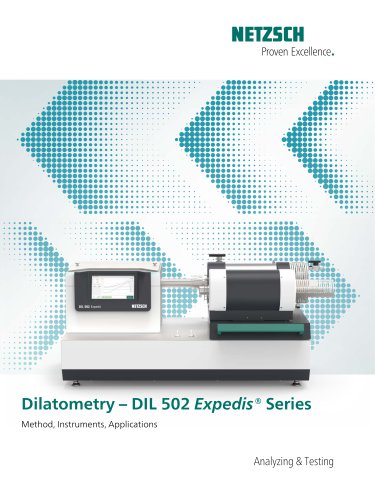 DIL 502 Expedis Series
28 Pages
 NETZSCH Energy Solutions
40 Pages
 Product Overview
12 Pages
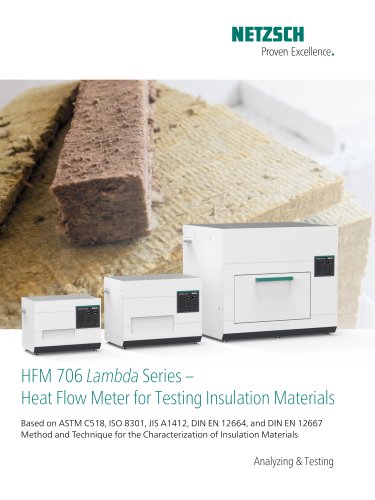 HFM 706 Lambda Series
16 Pages
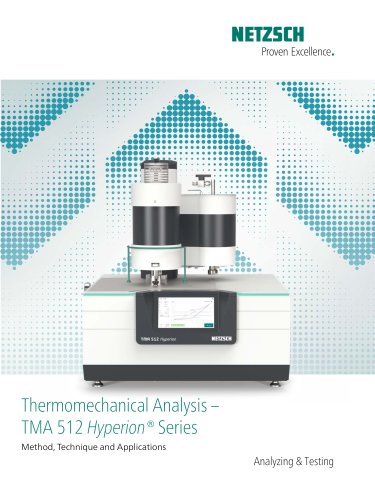 TMA 512 Hyperion® Series
24 Pages
 LFA 427 - product brochure
24 Pages
 Kinexus Prime DSR Series
20 Pages
 DMA 303 Eplexor
24 Pages
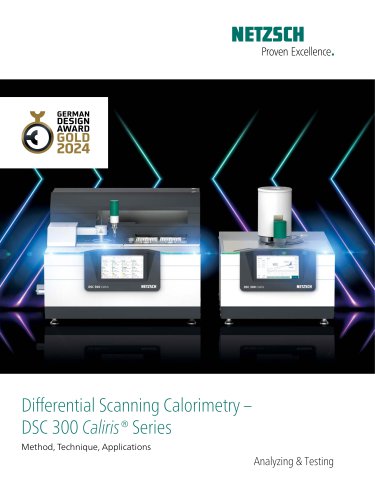 DSC 300 Caliris Series
28 Pages
 STA 509 Jupiter Series
28 Pages
 DEA 288 Ionic
20 Pages
 STA 2500 Regulus
12 Pages
 NTA Guarded Hot Plate Series
16 Pages
 Rosand Series
20 Pages
 Accelerating Rate Calorimetry
20 Pages
 NTA HotBoxes
16 Pages
 DIL 402 Expedis Classic
16 Pages
 Kinetics NEO
20 Pages
 TG-FTIR - product brochure
24 Pages
 TA-QMS Coupling
28 Pages
 HMOR 422
1 Page
 RUL/CIC 421
1 Page
 Cone Calorimeter TCC 918
12 Pages
 SBA 458 Nemesis®
24 Pages
 NETZSCH NEVIO Instrument Series
24 Pages
 Thermal Insulation Materials
24 Pages
 DMA GABO EPLEXOR up to 1500°C
12 Pages
 GABOMETER®
8 Pages





- Test machine
- NETZSCH measuring instrument
- NETZSCH gas analyzer
- NETZSCH test chamber
- Concentration analyzer
- Monitoring analyzer
- Liquids analyzer
- Test stand
- NETZSCH automatic analyzer
- Windows software
- Automated testing machine
- Material test machine
- Temperature test chamber
- NETZSCH benchtop analyzer
- NETZSCH solids analyzer
- Spectrometer
- Climatic test cabinet
- Quality control test cell
- Computer-controlled test machine