
- Catalogs
- NETZSCH Analyzing & Testing
- Instruments for Testing Refractories - product brochure


- Company
- Products
- Catalogs
- News & Trends
- Exhibitions
Instruments for Testing Refractories - product brochure

Instruments for Testing Refractories - product brochure
Testing Applications: Refractory testing is crucial for material selection, new material characterization, service condition prediction, quality control, failure analysis, and product improvement through modeling.
NETZSCH Instruments: The document describes instruments for testing refractories under thermal stress, such as the Refractoriness under Load (RUL) and Creep in Compression (CIC) tests, which operate from room temperature to 1700°C.
RUL/CIC 421 Methodology: The RUL test assesses a refractory's resistance to subsidence under load and temperature, while the CIC test measures deformation at constant temperature. Both use cylindrical test pieces and adhere to ISO standards.
Measuring Unit and Test Atmosphere: The unit includes a furnace reaching 1700°C, a loading device, and a differential measuring system. Tests can be conducted in static air or inert gas to prevent oxidation.
Sample Preparation and Testing: Test pieces are 50 mm in diameter and height, with a coaxial bore. NETZSCH provides equipment for sample preparation.
Data Evaluation and Software: The software provides graphic and tabulated results, automatic softening point detection, and calculations for creep rates and expansion coefficients. It supports simultaneous analysis of multiple curves.
Technical Specifications: The RUL/CIC 421 E/6 system operates from room temperature to 1700°C, with a load range of 1 N to 1000 N, and features a digital resolution of 5 nm.
Overview: The document outlines the technical specifications and capabilities of a control unit and software system for thermal analysis and calorimetry, offered by NETZSCH-Gerätebau GmbH.
Specifications: The control unit weighs approximately 220 kg and operates under Proteus® software on Windows® for automatic test runs and data management. It includes routines for determining reaction steps and supports data export.
Company Background: NETZSCH-Gerätebau GmbH is part of the NETZSCH Group, specializing in thermal analysis, calorimetry, and more, with a history dating back to 1873.
Contact Information: Located at Wittelsbacherstraße 42, 95100 Selb, Germany. Contact via phone at +49 9287 881-0, fax at +49 9287 881-505, or email at [email protected]. More information is available on their website.
Catalog excerpts

Proven Excellence. Refractories under Load and Creep in Compression - RUL/CIC 421 Analyzing & Testing
Open the catalog to page 1
The testing of refractories - clearly an essential process - includes the following applications: ■ Prediction of service conditions ■ Quality control of the process and the product ■ Mathematical modeling for product improvements Today, selection of the proper refractory material is more crucial than ever when it comes to improving the cost-effectiveness of a process and prolonging the life cycle. Appropriate selection of the refractory furnace lining can only be made with accurate knowledge of the properties of the refractory materials and the stresses on the materials during service. Thermomechanical...
Open the catalog to page 2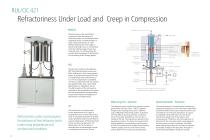
NETZSCH Instruments for Testing Refractories under Thermal and Thermomechanical Stress Thermal and Thermomechanical Properties Temperature Range Refractoriness under Load (RUL) Refractoriness under Load/ Creep in Compression (CIC) Creep in Compression (RUL/CIC 421) Thermal Expansion (DIL) Dilatometer Volume Stability (DIL) (DIL 402 E, DIL Expedis series) Thermal Stress Specific Heat Capacity (LFA) Specific Heat Capacity (DSC) Thermal Diffusivity/ Temperature Range Laser/Light Flash Apparatus (LFA 427, Differential Scanning Calorimeter (DSC 404 F1/F3 Pegasus®) Laser/Light Flash Apparatus (LFA...
Open the catalog to page 3
Refractoriness under load evaluates the behavior of fired refractory bricks under rising temperature and constant load conditions. Refractoriness under load (RUL) is a measure of the resistance of a refractory product to subsidence when subjected to the combined effects of load, rising temperature at a predefined heating rate. The range in which softening occurs is not identical with the melting range of pure raw materials, but it is influenced by the content and the degree of distribution of low melting point fluxing agents. The RUL test method is described in ISO 1893, Refractoriness under...
Open the catalog to page 4
Creep in Compression Variable load Loading column Heating element Sample Protective tube Inner thermocouple Outer thermocouple Control thermocouple Outer tube Inner tube Hood type furnace Supporting column Sample with coaxial bore and inner tube Bellows Vacuum-tight seal Variable contact force Gastight casing Evacuating system Inductive transducer Gas inlet Schematic of the gas-tight RUL/CIC 421 for measurements in protective gas atmosphere Measuring Unit – Specimen Signal Generation – Expansion The measuring unit consists of a console, furnace guide frame, furnace (max. 1700°C), balance weight...
Open the catalog to page 5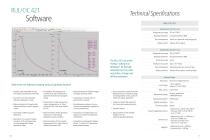
Test Atmosphere Measurements can be carried out in static air (basic version) or using an optional device for inert gas purge within the test piece area. For testing carbon-containing materials (e.g., magnesia-carbon graphite bricks), a non-oxidizing test atmosphere can be realized with a gas-tight test chamber (optional; see figure on previous page). This chamber can be evacuated and then purged with protective gas. Measurements can be carried out up to 1600°C. Optionally, the loading device can be equipped for load variation. The preload can be up to 300 N and the verifying load can be applied...
Open the catalog to page 6
The upper plot shows a RUL measurement (differential) on a test piece of a fireclay brick with increasing temperature. At 1387°C, the test piece reaches its maximum expansion. Deformations of 0.5% and 1.0% occurred at 1565°C (T0.5) and 1600°C (T1), respectively. Peak: Peak: 1387.0 1387.0 °C °C Peak: 1387.0 °C 800 1000 800 1000 Temperature // °C 800 Temperature °C 1000 Temperature / °C Refractoriness under Load; test conditions: 0.2 N/mm², 5 K/min, static air The lower one shows the timescaled creep over 25 hours at a constant temperature of 1280°C. 1.0 1.0 1.0 Peak: Peak: 1283.0 1283.0 °C °C...
Open the catalog to page 7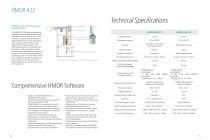
Refractoriness under Load (RUL) of Andalusite Bricks This plot shows three measurements on andalusite bricks fired at three different temperatures: 1430°C, 1470°C and 1510°C. At approx. 1425°C, all three test pieces reach their maximum expansion. After applying sample or calibration curve correction, the software calculates the characteristic T0.5, T1 and T2 temperatures from the RUL tests where 0.5%, 1% or 2% shrinkage is reached after the maximum expansion. The influence of the firing temperature can be clearly seen. RUL behavior of andalusite bricks (approx. 65% Al2O3) fired at three different...
Open the catalog to page 8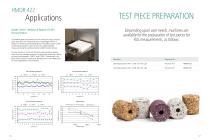
Creep in Compression (CIC) of Andalusite Bricks Test pieces of the andalusite bricks fired at different temperatures are used for CIC tests. In these tests, the load is applied once the temperature is reached (here, at 1425°C). This is contrary to RUL tests, where the load is applied from the very beginning of the measurement. This plot only shows the time-scaled creep at constant temperature (the heating segment is not depicted). 1430 of andalusite bricks (approx. 65% Al2O3) fired at three different 0.1 CIC behavior 1470 temperatures; test conditions: 0.2 N/mm2, 5 K/min, static air, 25 h at...
Open the catalog to page 9
State-of-the-Art Software Including Various Evaluation Routines ■ Graphic and tabulated results, calculated according to ISO/DIN ■ Correction of the measured data by calibration curves ■ Determination of characteristic data according to user's requirements ■ Automatic softening point detection ■ Derivation of curves for determination of the temperature-or time-dependent linear expansion rates ■ Possibilities for temperature control (max. 96 isothermal or dynamic temperature program steps) ■ Presentation of the measuring values temperature- or time-scaled for RUL and time-scaled for CIC ■ Determination...
Open the catalog to page 10
RUL/CIC 421 E/6 The RUL/CIC runs under Proteus® software on Windows® for the fully automatic test run, data acquisition, storage and offline evaluation. Temperature range Heating elements Test atmosphere Safety switch Test piece Load range Measuring range Measuring system Digital resolution Thermocouples Power Supply Electronics ■ Semi-automatic routines for the determination of reaction steps as extrapolated onset, point of inflection, peak, peak end ■ Output or ASCII file export of the corrected measuring data ■ Data transfer of the sample length from an external gauge (optional) Static air;...
Open the catalog to page 11All NETZSCH Analyzing & Testing catalogs and technical brochures
 TG 309 Libra Series
24 Pages
 Kinexus Prime Series
20 Pages
 NTA Fire Testing Systems
20 Pages
 Advanced Materials Testing
32 Pages
 DIL 502 Expedis Series
28 Pages
 NETZSCH Energy Solutions
40 Pages
 Product Overview
12 Pages
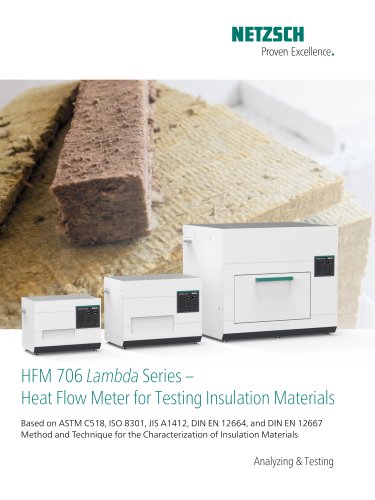 HFM 706 Lambda Series
16 Pages
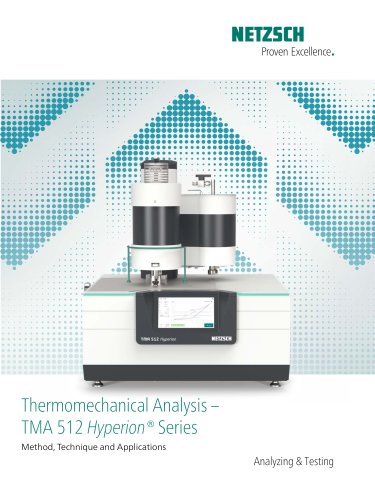 TMA 512 Hyperion® Series
24 Pages
 LFA 427 - product brochure
24 Pages
 Kinexus Prime DSR Series
20 Pages
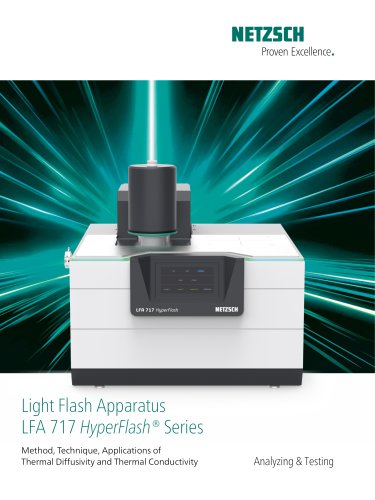 LFA 717 HyperFlash® Series
28 Pages
 DMA 303 Eplexor
24 Pages
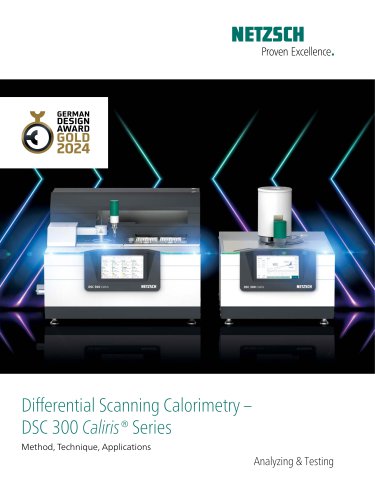 DSC 300 Caliris Series
28 Pages
 STA 509 Jupiter Series
28 Pages
 DEA 288 Ionic
20 Pages
 STA 2500 Regulus
12 Pages
 NTA Guarded Hot Plate Series
16 Pages
 Rosand Series
20 Pages
 Accelerating Rate Calorimetry
20 Pages
 NTA HotBoxes
16 Pages
 DIL 402 Expedis Classic
16 Pages
 Kinetics NEO
20 Pages
 TG-FTIR - product brochure
24 Pages
 TA-QMS Coupling
28 Pages
 HMOR 422
1 Page
 RUL/CIC 421
1 Page
 Cone Calorimeter TCC 918
12 Pages
 SBA 458 Nemesis®
24 Pages
 NETZSCH NEVIO Instrument Series
24 Pages
 Thermal Insulation Materials
24 Pages
 DMA GABO EPLEXOR up to 1500°C
12 Pages
 GABOMETER®
8 Pages





- Test machine
- NETZSCH measuring instrument
- NETZSCH gas analyzer
- Concentration analyzer
- Monitoring analyzer
- Analysis software solution
- Liquids analyzer
- Test stand
- NETZSCH automatic analyzer
- Temperature test chamber
- Windows software
- Automated testing machine
- Material test machine
- Climatic test cabinet
- NETZSCH benchtop analyzer
- NETZSCH solids analyzer
- Spectrometer
- Quality control test cell
- Computer-controlled test machine