
- Catalogs
- NETZSCH Analyzing & Testing
- DSC 300 Caliris Series


- Company
- Products
- Catalogs
- News & Trends
- Exhibitions
DSC 300 Caliris Series
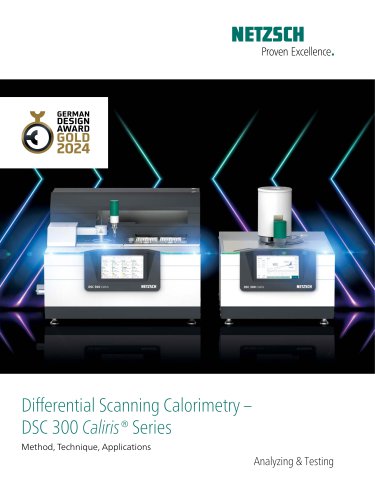
DSC 300 Caliris Series
The DSC 300 Caliris® Series is a differential scanning calorimetry (DSC) instrument designed for material characterization. It is used in research, development, quality control, and material specification to analyze material behavior under different temperatures and atmospheres.
The DSC 300 Caliris® supports various applications such as material identification, process optimization, quality control, phase diagrams, kinetic analysis, compatibility, and failure analysis. It provides results like melting and crystallization temperatures, specific heat capacity, polymorphism, and oxidative stability.
The instrument complies with ISO 11357 and ASTM standards, featuring a modular design with interchangeable sensor-furnace modules. The Supreme version operates from -180°C to 750°C, while the Select version ranges from -170°C to 650°C.
The DSC 300 Caliris® offers three modules:
- H-Module: High-temperature range of -180°C to 750°C for advanced materials research.
- P-Module: Polymer module with a range of -170°C to 600°C for polymer processing.
- S-Module: Standard module with a range of -170°C to 600°C for routine measurements.
The compact design of the DSC 300 Caliris® Classic is suitable for limited lab spaces. It includes a gas-tight measurement cell, LED status bar, and color touch display for easy monitoring and control.
The Proteus® software offers SmartMode for routine tasks and ExpertMode for advanced analysis. Features like AutoEvaluation and Identify enhance productivity and workflow efficiency.
The DSC 300 Caliris® Series is a comprehensive tool for thermal analysis, offering flexibility, precision, and ease of use, making it valuable for laboratories focused on material characterization.
The Proteus® software suite includes features like AutoEvaluation, Report Generator, Identify, Search Engine, and LabV® Integration, enhancing data management and material identification.
Techniques include Temperature-Modulated DSC, Peak Separation, Purity Determination, and Kinetics Neo, providing precise measurement and analysis capabilities.
Includes an Automatic Sample Changer (ASC), Photo-Calorimetry, and various cooling options, enhancing efficiency and accommodating a wide temperature range.
Graphical data illustrates DSC measurements, supporting detailed explanations of software and equipment capabilities.
Intracoolers are used for mechanical cooling below specific temperatures, reducing liquid nitrogen consumption and enhancing system efficiency.
Detailed thermal analysis data, including DSC measurements, are used to determine specific heat capacities and other thermal properties, showing good correlation with literature values.
Measured up to 740°C with less than 1% deviation from literature values, crucial for thermal simulations.
Measurements above 600°C use platinum crucibles with Al2O3 liners, showing high reproducibility with deviations below 1%.
Data on glass transition temperatures (Tg) of various polymers is provided, critical for understanding usability and performance.
OIT measurements assess material resistance to oxidative decomposition, important for evaluating materials like PE pipes.
Discusses isothermal crystallization measurements, providing insights into crystallization behavior and optimal processing conditions.
Discusses DSC use for analyzing crystallinity and thermal properties, highlighting the DSC 300 Caliris® with P-Module for fast cooling.
Fast cooling affects PET crystallinity, with DSC experiments showing endothermic and exothermic effects at various temperatures.
Analyzes Eudragit® L100-55 using temperature-modulated DSC, separating signals to evaluate glass transition and water release.
Highlights polymorphism in paracetamol with transitions between different forms and melting points.
Turmeric's glass transition temperature (Tg) is crucial for quality and shelf life, with moisture affecting Tg and processing.
Thermal analysis reveals endothermal effects in lipsticks, indicating solid-fat-content changes at different temperatures.
The document emphasizes the importance of precise thermal analysis in material science, providing insights into thermal properties and crystallinity.
Technical specifications for the Supreme Select Classic from NETZSCH-Gerätebau GmbH, focusing on thermal analysis and calorimetry.
Features a color touch display, selectable modules, and temperature accuracy, with a range from 600°C to 750°C.
Supports heating/cooling rates from 0.001 to 500 K/min, with various cooling options including liquid nitrogen and intra-cooler.
Gas-tight design suitable for various gas atmospheres, with integrated multi-flow controllers and optional features.
Enthalpy accuracy is less than 1%, with a measuring range up to ±750 mW, and an unlimited warranty with a maintenance contract.
NETZSCH Group, established in 1873, is a global leader in technology with a focus on customer service and proximity, divided into three business units.
Catalog excerpts

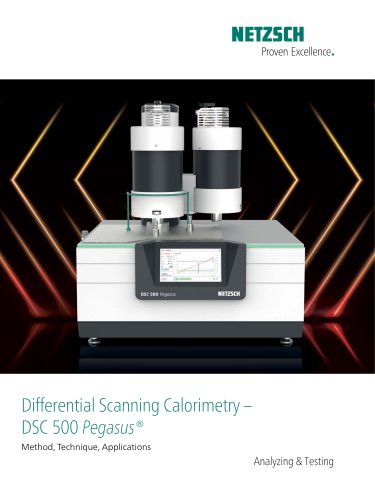
Differential Scanning Calorimetry – DSC 300 Caliris® Series Method, Technique, Applications Analyzing & Testing
Open the catalog to page 1
DSC 300 Caliris® Series Whether you are working in research & development, quality control, contract testing or the specification of materials for applications, information about a material's behavior under changing temperature and different atmospheres is important. The DSC 300 Caliris® can support: Material identification Process optimization Quality control Phase diagrams Kinetic analysis Compatibility Failure Analysis Melting temperature and enthalpy Crystallization temperature and enthalpy Specific heat capacity Solid-liquid ratio (solid-fat content) Polymorphism Solid-solid transitions...
Open the catalog to page 2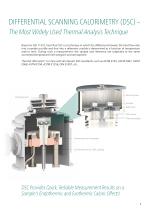
DIFFERENTIAL SCANNING CALORIMETRY (DSC) – The Most Widely Used Thermal Analysis Technique Based on ISO 11357, heat-flux DSC is a technique in which the difference between the heat flow rate into a sample crucible and that into a reference crucible is determined as a function of temperature and/or time. During such a measurement, the sample and reference are subjected to the same controlled temperature/time program and atmosphere. The DSC 300 Caliris® is in line with all relevant DSC standards, such as ASTM E793, ASTM E967, ASTM E968, ASTM E794, ASTM E1356, DIN 51007, etc. Silver furnace Sample...
Open the catalog to page 3
Modular Design – Change the Setup if You Need to Ever-accelerating new material developments, triggered by fast-moving mobility and technical trends, require continuous adaptability. The new generation of NETZSCH DSCs is based on a modular concept. The DSC 300 Caliris® the only instrument of its kind with interchangeable and/or exchangeable sensor-furnace modules. The Supreme version of the DSC 300 Caliris® allows the exchange of modules, to be able to adapt to current and future needs. Just choose between broad temperature range, fast heating rates and high sensitivity as needed, whereas the...
Open the catalog to page 4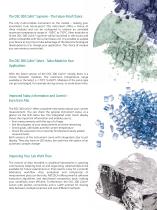
The DSC 300 Caliris® Supreme – The Future-Proof Choice The only multi-module instrument on the market – making your investment truly future-proof. This instrument offers a choice of three modules and can be configured to achieve an unrivaled maximum temperature range of -180°C to 750°C. New modules to fit the DSC 300 Caliris® Supreme will be launched in the future and will be compatible with the current base unit. It is possible to update your device at any time to take advantage of the latest technological developments or to change your application. The choice of module you use remains unrestricted....
Open the catalog to page 5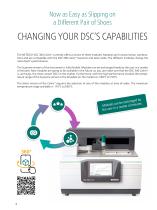
Now as Easy as Slipping on a Different Pair of Shoes CHANGING YOUR DSC’S CAPABILITIES The NETZSCH DSC 300 Caliris® currently offers a choice of three modules. Modules are furnace/sensor combinations and are compatible with the DSC 300 Caliris® Supreme and Select alike. The different modules change the instrument’s performance. The Supreme version of the instrument is fully flexible. Modules can be exchanged freely by the user in a matter of minutes. New modules are going to be available in the future, so you can make sure that the DSC 300 Caliris® is, and stays, the most current DSC on the market....
Open the catalog to page 6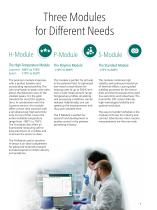
Three Modules for Different Needs H-Module The premium module impresses with a perfect baseline and outstanding reproducibility. The very small peak-to-peak noise ratio allows the detection even of the smallest peaks. It is the gold standard for most DSC applications. In combination with the Supreme version, this module offers a short time constant with a simultaneously high sensitivity and, on top of that, covers the entire available temperature range from -180°C to 750°C. The H-module also offers an illuminated measuring cell for easy placement of crucibles and to ensure the sensor is clean....
Open the catalog to page 7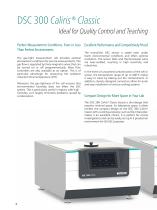
Ideal for Quality Control and Teaching Perfect Measurement Conditions, Even in Less Than Perfect Environments The gas-tight measurement cell provides optimal atmospheric conditions for precise measurements. The gas flow is regulated by three magnetic valves that can be turned on or off programmatically. Mass flow controllers are also available as an option. This is of particular advantage for measuring the oxidative induction time/temperature (OIT). Moreover, the gas-tightness of the cell ensures that environmental humidity does not affect the DSC system. This is particularly useful in regions...
Open the catalog to page 8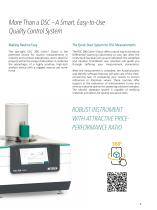
More Than a DSC – A Smart, Easy-to-Use Quality Control System Making Routine Easy The Quick-Start System for DSC Measurements The gas-tight DSC 300 Caliris® Classic is the preferred choice for routine measurements in industry and contract laboratories, and is ideal for projects within the scope of education. It combines the advantages of a highly sensitive, high-tech analysis device with a rugged, easy-to-use workhorse. The DSC 300 Caliris® Classic offers a quick way to introduce Differential Scanning Calorimetry to your lab. After the instrument has been set up and calibrated, the simplified...
Open the catalog to page 9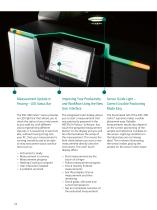
Measurement Update in Passing – LED Status Bar Improving Your Productivity and Workflow Using the New User Interface Sensor Guide Light – Correct Crucible Positioning Made Easy The DSC 300 Caliris® series provides an LED light bar that allows you to check the status of your instrument as you walk by, with different colors representing different statuses. It is reassuring to see from afar, without having to log into your PC, that your measurement is running smoothly and to be able to read instrument status notifications such as: The integrated color display allows you to start a measurement that...
Open the catalog to page 10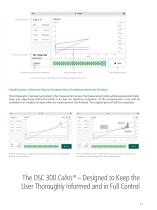
Time remaining Current measurement segment Measurement curve Stop measurement Control over your measurements without logging into a PC AutoEvaluation: Objective Results Available After the Measurement Has Finished If AutoEvaluation has been activated in the measurement setup, the measurement data will be evaluated immediately and objectively within the blink of an eye. An objective evaluation of the measurement curve will be available in an analysis window after the measurement has finished. The original plot will still be accessible. Measurement plot, current temperature and gases are displayed...
Open the catalog to page 11All NETZSCH Analyzing & Testing catalogs and technical brochures
 TG 309 Libra Series
24 Pages
 Kinexus Prime Series
20 Pages
 NTA Fire Testing Systems
20 Pages
 Advanced Materials Testing
32 Pages
 DIL 502 Expedis Series
28 Pages
 NETZSCH Energy Solutions
40 Pages
 Product Overview
12 Pages
 HFM 706 Lambda Series
16 Pages
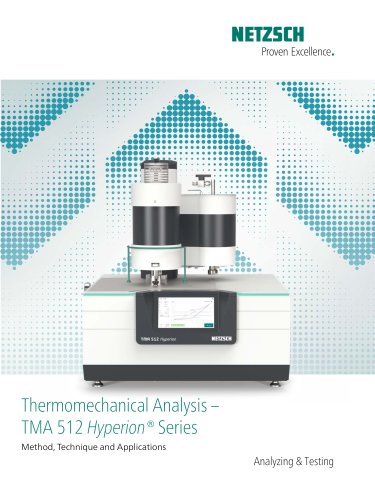 TMA 512 Hyperion® Series
24 Pages
 LFA 427 - product brochure
24 Pages
 Kinexus Prime DSR Series
20 Pages
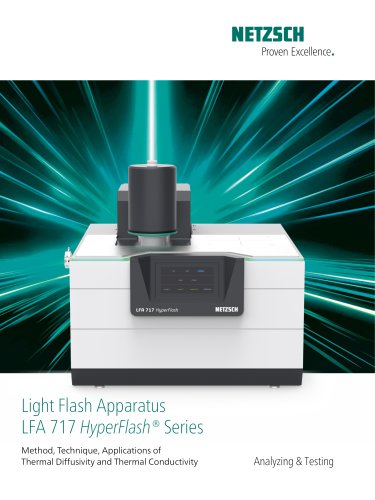 LFA 717 HyperFlash® Series
28 Pages
 DMA 303 Eplexor
24 Pages
 STA 509 Jupiter Series
28 Pages
 DEA 288 Ionic
20 Pages
 STA 2500 Regulus
12 Pages
 NTA Guarded Hot Plate Series
16 Pages
 Rosand Series
20 Pages
 Accelerating Rate Calorimetry
20 Pages
 NTA HotBoxes
16 Pages
 DIL 402 Expedis Classic
16 Pages
 Kinetics NEO
20 Pages
 TG-FTIR - product brochure
24 Pages
 TA-QMS Coupling
28 Pages
 HMOR 422
1 Page
 RUL/CIC 421
1 Page
 Cone Calorimeter TCC 918
12 Pages
 SBA 458 Nemesis®
24 Pages
 NETZSCH NEVIO Instrument Series
24 Pages
 Thermal Insulation Materials
24 Pages
 DMA GABO EPLEXOR up to 1500°C
12 Pages
 GABOMETER®
8 Pages





- Test machine
- NETZSCH measuring instrument
- NETZSCH gas analyzer
- NETZSCH test chamber
- Concentration analyzer
- Monitoring analyzer
- Analysis software solution
- Liquids analyzer
- Test stand
- NETZSCH automatic analyzer
- Temperature test chamber
- Windows software
- Automated testing machine
- Material test machine
- Climatic test cabinet
- NETZSCH benchtop analyzer
- NETZSCH solids analyzer
- Spectrometer
- Quality control test cell
- Computer-controlled test machine