
- Catalogs
- NETZSCH Analyzing & Testing
- DMA 523 Eplexor® 2000 N and 4000 N HBU 523 Gabometer® 2000 N and 4000 N


- Company
- Products
- Catalogs
- News & Trends
- Exhibitions
DMA 523 Eplexor® 2000 N and 4000 N HBU 523 Gabometer® 2000 N and 4000 N

DMA 523 Eplexor® 2000 N and 4000 N HBU 523 Gabometer® 2000 N and 4000 N
The document provides an overview of the DMA 523 Eplexor® and HBU 523 Gabometer® series, designed for dynamic mechanical testing, fatigue, and heat build-up analysis of large and high-modulus specimens. These instruments are suitable for testing stiff materials such as metals, ceramics, composites, and polymers below their glass transition temperatures.
The models offer a static force range up to 6000 N and a dynamic force range of ±2000 N or ±4000 N. They feature a modular design for various configurations, capable of dynamic deformation up to ±15 mm and static deformation up to 70 mm.
DMA determines a material’s mechanical and viscoelastic properties, including phase transformations like glass transitions. It involves applying a sinusoidal force to a sample and measuring deformation, yielding parameters such as complex modulus (E*), storage modulus (E’), loss modulus (E’’), and loss factor (tan δ).
The instruments perform tests to determine glass transition temperatures, secondary transitions, dynamic modulus, and damping factors. They support quasi-static universal testing modes like tensile, compression, creep, and relaxation tests.
The Eplexor® series features a modular design with a temperature range from -160°C to 500°C, stroke protection via a blade spring system, and interchangeable force sensors. The system can be upgraded to meet future needs.
The instruments are suitable for fatigue testing, heat build-up analysis, and tensile tests on reinforced materials. They also perform hysteresis analysis and immersion tests in liquid media.
The HBU 523 Gabometer® is ideal for heat build-up and blow-out tests, measuring temperature increases due to internal friction in materials like rubber. It can be upgraded with a flexometer package.
The document describes using a Humidity Generator (HYGROMATOR®) for controlled humid atmospheres, with humidity levels from 5% to 95%. Cooling options include an air intracooler and a liquid nitrogen system for low temperatures.
The system supports up to 150 samples with automatic sample changers, allowing for non-stop operation. It includes a storage magazine, pneumatic gripping arm, and automatic furnace door mechanism.
The Eplexor® software offers comprehensive measurement program definitions and data analysis, supporting various tests such as creep, relaxation, fatigue, and energy loss.
The series offers temperature ranges from -160°C to 500°C, with static and dynamic force capabilities up to ±6000 N and ±4000 N respectively. They support a wide frequency range and comply with multiple international standards.
NETZSCH-Gerätebau GmbH is an international technology company specializing in thermal analysis, calorimetry, rheology, and fire testing, with a strong emphasis on performance standards and customer service.
Catalog excerpts

DMA 523 Eplexor® 2000 N and 4000 N HBU 523 Gabometer® 2000 N and 4000 N Dynamic Mechanical Testing, Fatigue and Heat Build-Up Analyzing & Testing
Open the catalog to page 1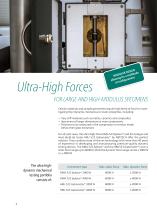
Ultra-High Forces GN DESI ude R A L U tit MOD for a mul ing tions allow onfigura of c FOR LARGE AND HIGH-MODULUS SPECIMENS Certain materials and sample geometries require high levels of force for investigating their dynamic-mechanical or static properties, including: Very stiff materials such as metals, ceramics and composites Specimens of larger dimensions or even components Polymers to be measured in the compression or tension mode below their glass transitions For all such cases, the ultra-high-force DMA 523 Eplexor® and the Fatigue and Heat Build-Up tester HBU 523 Gabometer® by NETZSCH offer...
Open the catalog to page 2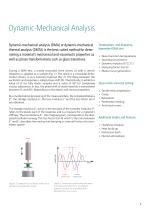
Dynamic-Mechanical Analysis Dynamic-mechanical analysis (DMA) or dynamic-mechanical thermal analysis (DMTA) is the best-suited method for determining a material’s mechanical and viscoelastic properties as well as phase transformations such as glass transitions. During a DMA test, a mostly sinusoidal force (stress, σ) with a certain frequency is applied to a sample (fig. 1). The result is a sinusoidal deformation (strain, ε) as a material response (fig. 2). The delay between the excitation and response is called phase shift (δ). Theoretically, it exhibits a value of 0° for fully elastic samples...
Open the catalog to page 3
THE UNIQUE Eplexor® MODULAR DESIGN PRINCIPLE Eplexor® Ultra-High-Force FORWARD-LOOKING SETUP The Eplexor® high-force line is the only DMA series on the market with hardware that can easily be upgraded – also as a retrofit – to meet future needs. A factor such as this is important in maintaining the value of the investment. ision d Prec y n a y t Quali in German Made Unrivaled Temperature Range from -160°C to 500°C The complete temperature range of a DMA is available for dynamical testing Effective Stroke Protection of the Shaker via the Special Blade Spring System For maximum safety of the shaker...
Open the catalog to page 4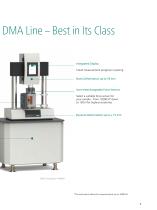
DMA Line – Best in Its Class Integrated Display Check measurement progress in passing Static Deformation up to 70 mm User-Interchangeable Force Sensors Select a suitable force sensor for your sample – from 12000 N* down to 150 N for highest sensitivity *The instrument allows for measurements up to 10000 N.
Open the catalog to page 5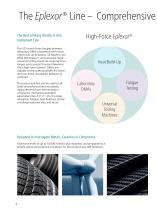
The Eplexor® Line – Comprehensive The Best of Many Worlds in One Instrument Line High-Force Eplexor® The 523 series closes the gap between laboratory DMA instruments with lower total forces up to approx. 50 Newton, the DMA 303 Eplexor®, and powerful, large universal testing machines covering force ranges up to several thousand Newtons. Ultra-high-force Eplexor® DMAs are capable of characterizing both the linear and non-linear viscoelastic behavior of materials. This instrument line can be used for all kinds of mechanical and viscoelastic measurements from determination of dynamic-mechanical standard...
Open the catalog to page 6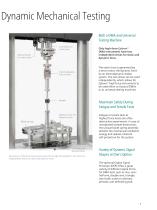
Dynamic Mechanical Testing Both a DMA and Universal Testing Machine Connection to static drive Optical sensor for static strain Interchangeable force sensors Only high-force Eplexor® DMA instruments have two independent drives for static and dynamic force. The static force is generated by a servo motor, the dynamic force by an electrodynamic shaker system. The two drives can be used independently, which allows for Eplexor® high-force instruments to be used either as classical DMAs or as universal testing machines. Maximum Safety During Fatigue and Tensile Tests Optical sensor for dynamic strain...
Open the catalog to page 7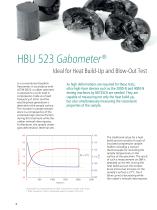
HBU 523 Gabometer® Ideal for Heat Build-Up and Blow-Out Tests Heat build-up measurement on SBR, compression mode, static load: 1 MPa, frequency: 30 Hz, amplitude (peak-to-peak): 4.45 mm As high deformations are required for these tests, ultra-high-force devices such as the 2000-N and 4000-N testing machines by NETZSCH are needed. They are capable of measuring not only the heat build-up, but also simultaneously measuring the viscoelastic properties of the sample. In a conventional Goodrich flexometer, in accordance with ASTM D623, a rubber specimen is exposed to a cyclic load in compression mode...
Open the catalog to page 8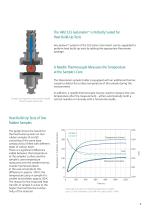
The HBU 523 Gabometer® is Perfectly Suited for Heat Build-Up Tests Any Eplexor® systems of the 523 series instrument can be upgraded to perform heat build-up tests by adding the appropriate flexometer package. A Needle Thermocouple Measures the Temperature at the Sample's Core The Flexometer sample holder is equipped with an additional thermocouple to detect the surface temperature of the sample during the measurement. Sample arrangement with vertical needle thermocouple (optional) In addition, a needle thermocouple may be used to measure the core temperature after the measurement – either automatically...
Open the catalog to page 9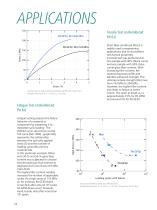
Tensile Test on Reinforced PA 6.6 Short fiber-reinforced PA 6.6 is widely used in engineering applications due to its excellent mechanical properties. A tensile test was performed on one sample with 30% (black curve) and one sample with 50% (blue curve) glass fiber content. With increasing filler content, the material becomes stiffer and exhibits enhanced strength. The ultimate tensile strength (Rm) rises from 143 MPa to 204 MPa. However, the higher filler content also leads to failure at lower strains. The strain at break (εb) is approximately 3.5% for PA GF50 and around 5% for PA GF30. Strain...
Open the catalog to page 10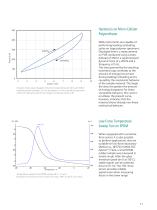
Hysteresis on Micro-Cellular Polyurethane Dynamic stress-strain diagram (total force levels between 50 N and 450 N; resulting strains between 2.5 mm and approx. 9 mm); cylindrical specimen of 30-mm diameter and 30-mm height; compression test at RT DMA instruments are capable of performing loading/unloading cycles on large polymer specimens. Displayed here is a measurement on PUR conducted using a static preload of 250 N, a superimposed dynamic force of ± 200 N and a frequency of 5 Hz. The area spanned by the resulting hysteresis loop correlates to the amount of energy lost as heat during loading/unloading...
Open the catalog to page 11All NETZSCH Analyzing & Testing catalogs and technical brochures
 TG 309 Libra Series
24 Pages
 Kinexus Prime Series
20 Pages
 NTA Fire Testing Systems
20 Pages
 Advanced Materials Testing
32 Pages
 DIL 502 Expedis Series
28 Pages
 NETZSCH Energy Solutions
40 Pages
 Product Overview
12 Pages
 HFM 706 Lambda Series
16 Pages
 TMA 512 Hyperion® Series
24 Pages
 LFA 427 - product brochure
24 Pages
 Kinexus Prime DSR Series
20 Pages
 LFA 717 HyperFlash® Series
28 Pages
 DMA 303 Eplexor
24 Pages
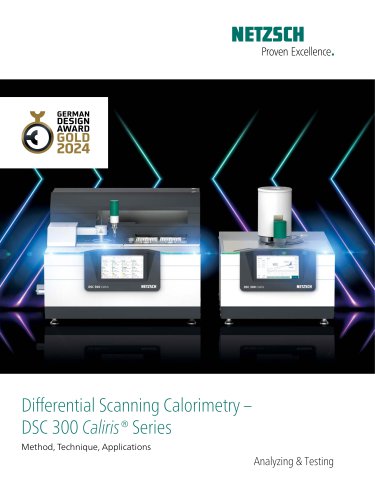 DSC 300 Caliris Series
28 Pages
 STA 509 Jupiter Series
28 Pages
 DEA 288 Ionic
20 Pages
 STA 2500 Regulus
12 Pages
 NTA Guarded Hot Plate Series
16 Pages
 Rosand Series
20 Pages
 Accelerating Rate Calorimetry
20 Pages
 NTA HotBoxes
16 Pages
 DIL 402 Expedis Classic
16 Pages
 Kinetics NEO
20 Pages
 TG-FTIR - product brochure
24 Pages
 TA-QMS Coupling
28 Pages
 HMOR 422
1 Page
 RUL/CIC 421
1 Page
 Cone Calorimeter TCC 918
12 Pages
 SBA 458 Nemesis®
24 Pages
 NETZSCH NEVIO Instrument Series
24 Pages
 Thermal Insulation Materials
24 Pages
 DMA GABO EPLEXOR up to 1500°C
12 Pages
 GABOMETER®
8 Pages





- NETZSCH measuring instrument
- NETZSCH gas analyzer
- NETZSCH test chamber
- Concentration analyzer
- Monitoring analyzer
- Analysis software solution
- Liquids analyzer
- Test stand
- NETZSCH automatic analyzer
- Windows software
- Automated testing machine
- Material test machine
- Temperature test chamber
- NETZSCH benchtop analyzer
- NETZSCH solids analyzer
- Spectrometer
- Climatic test cabinet
- Quality control test cell
- Computer-controlled test machine