
- Catalogs
- NETZSCH Analyzing & Testing
- DIL 502 Expedis Series


- Company
- Products
- Catalogs
- News & Trends
- Exhibitions
DIL 502 Expedis Series
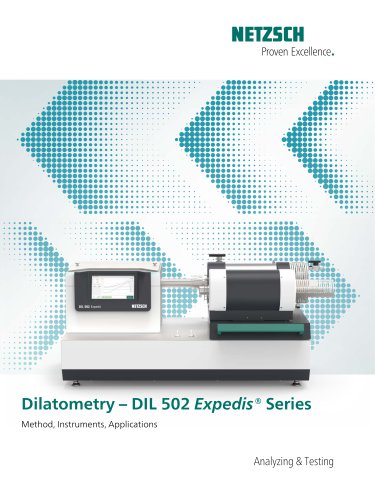
DIL 502 Expedis Series
Dilatometry is a precise technique for measuring dimensional changes in materials with temperature and time, crucial for quality assurance and research. NETZSCH dilatometers comply with standards like DIN EN 821, DIN 51045, and ASTM E228.
Dilatometry is used in various fields:
- Ceramics and Glass: Analyzes sintering and thermal behavior.
- Metals and Alloys: Studies phase transitions and thermal expansion.
- Composites: Ensures compatibility through thermal expansion data.
- Polymers: Determines glass transition temperatures and expansion coefficients.
- Refractories: Measures thermal expansion and phase transitions.
Provides data on linear thermal expansion, coefficient of thermal expansion, softening point, glass transition temperature, phase transitions, and sintering temperature.
Pushrod dilatometry measures dimensional changes versus temperature/time. The NanoEye system offers high resolution and a wide range.
Includes three models:
- Classic: For industrial quality control, up to 1600°C, 2 nm resolution.
- Select: Flexible setup, -180°C to 2000°C.
- Supreme: High-end, -180°C to 2800°C, 0.1 nm resolution.
Features include automatic specimen length detection, MultiTouch technology, adjustable thermocouple positioning, and AutoVac for inert atmosphere measurements.
Incorporates electronic thermal stabilization and Eco/Idle Mode, reducing energy and gas consumption by up to 60%.
Offers an Unlimited Warranty with comprehensive coverage and expert service.
Offers various furnaces and cooling systems for specific applications, including high-temperature and subambient conditions.
Gas-tight instruments allow for controlled environments to prevent unwanted reactions and ensure accuracy.
The DIL 502 Expedis® Supreme reaches up to 2800°C, with a protective tube system for different atmospheres. The glovebox version is for oxygen or humidity-sensitive materials.
Includes alumina, graphite, and fused silica holders, dual sample holders for comparative studies, and protective sleeves to prevent contamination.
Proteus® software offers c-DTA® for simultaneous analysis, density determination, and rate-controlled sintering. AutoEvaluation enhances efficiency and accuracy.
Ideal for precise thermal expansion measurements in ceramics and aerospace components, addressing thermal expansion mismatch issues.
The DIL 502 Expedis® Supreme is versatile and advanced, suitable for high-temperature and sensitive material applications, with comprehensive software and accessory options.
Kinetics Neo software models the sintering process, reducing experimentation and sintering time by over 50%. Termica Neo simulates thermal shrinkage and temperature gradients.
Features include horizontal pushrod design, temperature range up to 2800°C, various cooling systems, and gas atmosphere options.
NETZSCH-Gerätebau GmbH specializes in mechanical, plant, and instrument engineering, offering products and services in thermal analysis, calorimetry, rheology, and fire testing.
Catalog excerpts
Dilatometry – DIL 502 Expedis® Series Method, Instruments, Applications Analyzing & Testing
Open the catalog to page 1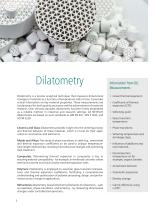
Dilatometry Dilatometry is a precise analytical technique that measures dimensional changes in materials as a function of temperature and/or time. It provides critical information on key material properties. These measurements are fundamental for both quality assurance and the advancement of materials research. Over the past decades, dilatometry has been firmly established as a reliable method in industrial and research settings. All NETZSCH dilatometers are based on such standards as DIN EN 821, DIN 51045, and ASTM E228. Ceramics and Glass: Dilatometry provides insight into the sintering process...
Open the catalog to page 2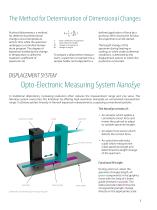
The Method for Determination of Dimensional Changes Pushrod dilatometry is a method for determining dimensional changes versus temperature and/or time while the specimen undergoes a controlled temperature program. The degree of expansion divided by the change in temperature is called the material’s coefficient of expansion (ā). mean coefficient of expansion initial specimen length change in temperature change in length To prepare a dilatometer measurement, a specimen is inserted into a sample holder and subjected to a defined application of force by a pushrod. After closing the furnace, the experiment...
Open the catalog to page 3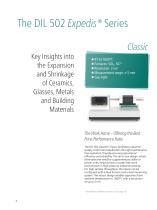
Key Insights into the Expansion and Shrinkage of Ceramics, Glasses, Metals and Building Materials The DIL 502 Expedis® Classic facilitates industrial quality control and application through maintenance-free operation, thereby ensuring operational efficiency and reliability. The all-in-one design, which eliminates the need for supplementary chiller or power units, helps furnish a clutter-free work environment in high-pressure industrial settings. For high sample throughput, the Classic can be configured with a dual furnace and a dual measuring system. The robust design enables operation from ambient...
Open the catalog to page 4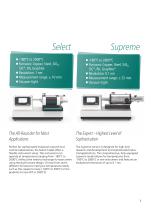
■ Furnaces: Copper, Steel, SIO2, SiC*, Rh, Graphite ■ Furnaces: Copper, Steel, SiO2, SIC*, Rh, Graphite* The All-Rounder for Most ApplicationsThe Expert - Highest Level of Sophistication Perfect for sophisticated industrial research and contract laboratories, the Select model offers a flexible instrument setup. This instrument can operate at temperatures ranging from -180°C to 2000°C without the need to exchange furnaces when using the dual furnace design. Choose from seven different furnaces to meet your temperature needs, such as the copper furnace (-180°C to 500°C) or the graphite furnace...
Open the catalog to page 5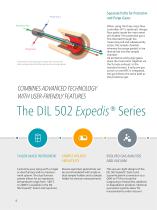
Separate Paths for Protective and Purge Gases Schematic of the gas paths inside the instrument when using one protective gas and two purge gases When using the three mass-flow controllers (4th is optional), the gas flow paths inside the instrument are divided: The protective gas is first directed through the measuring cell and subsequently enters the sample chamber, whereas the purge gas(es) is/are directly fed into the sample chamber. All protective and purge gases leave the instrument together via the furnace exhaust. In the standard version, if only one gas switch or one MFC is integrated,...
Open the catalog to page 6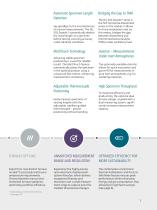
Say goodbye to the inconsistencies of manual measurements. The DIL 502 Expedis® automatically detects the initial length of a specimen before testing, ensuring accuracy under identical conditions. MultiTouch Technology Achieving stable specimen positioning is crucial for reliable results. The MultiTouch feature automatically places the specimen in the optimal position using a unique tail-like motion, enhancing measurement consistency. Automatic Specimen Length Detection Adjustable Thermocouple Positioning Easily measure specimens of varying lengths with the adjustable, capillary-guided thermocouple...
Open the catalog to page 7
REDUCED ENERGY CONSUMPTION AND OPERATING COSTS To achieve accurate expansion results, it is often necessary to rely on thermostatic control using a water cycle. This method requires continuous operation of the thermostat, which consumes a significant amount of energy and produces waste heat. NETZSCH has succeeded in eliminating the external thermostat. The temperature of the measuring chamber is controlled electronically while maintaining excellent temperature stability. This significantly reduces the energy consumption of a DIL 502 Expedis®* Additionally, the user-defined scheduling function...
Open the catalog to page 8
At NETZSCH, our commitment to quality extends well beyond the instruments themselves. We understand that your investment in advanced technology is a long-term one, and that's why we offer something truly unparalleled - our Unlimited Warranty. What Does Unlimited Warranty Mean? Unlike other warranties that may have hidden limitations, NETZSCH's Unlimited Warranty proves our dedication to your success. For as long as it is technically possible, we stand by our instruments and support you with: ■ Expert Service: Receive high-quality service directly from NETZSCH or our authorized dealers. ■ Predictable...
Open the catalog to page 9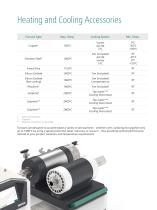
Furnace Type Max. Temp. Copper* 500°C (fast cooling) Cooling System Vortex AIC 80 LN2 Tap water*** Cooling thermostat Tap water*** Cooling thermostat Tap water*** Cooling thermostat * Select and Supreme ** Supreme *** Requires connection to tap water Furnaces are designed to accommodate a variety of atmospheres - whether inert, oxidizing (for graphite only up to 1680°C by using a special protective tube), reducing, or vacuum - thus providing optimal performance tailored to your product variations and temperature requirements.
Open the catalog to page 10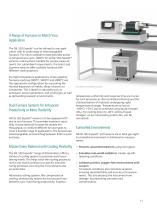
A Range of Furnaces to Match Your Application The DIL 502 Expedis® can be tailored to any application with its wide range of interchangeable furnaces. The silicon carbide furnace provides access to temperatures up to 1600°C for all DIL 502 Expedis® versions, making them suitable for routine measurements. For subambient requirements, the Select and Supreme versions offer coolable furnaces with different cooling options. For high-temperature applications, three graphite furnaces reaching 2000°C, 2400°C and 2800°C are the appropriate configuration for measuring the thermal expansion of metals, alloys,...
Open the catalog to page 11All NETZSCH Analyzing & Testing catalogs and technical brochures
 TG 309 Libra Series
24 Pages
 Kinexus Prime Series
20 Pages
 NTA Fire Testing Systems
20 Pages
 Advanced Materials Testing
32 Pages
 NETZSCH Energy Solutions
40 Pages
 Product Overview
12 Pages
 HFM 706 Lambda Series
16 Pages
 TMA 512 Hyperion® Series
24 Pages
 LFA 427 - product brochure
24 Pages
 Kinexus Prime DSR Series
20 Pages
 LFA 717 HyperFlash® Series
28 Pages
 DMA 303 Eplexor
24 Pages
 DSC 300 Caliris Series
28 Pages
 STA 509 Jupiter Series
28 Pages
 DEA 288 Ionic
20 Pages
 STA 2500 Regulus
12 Pages
 NTA Guarded Hot Plate Series
16 Pages
 Rosand Series
20 Pages
 Accelerating Rate Calorimetry
20 Pages
 NTA HotBoxes
16 Pages
 DIL 402 Expedis Classic
16 Pages
 Kinetics NEO
20 Pages
 TG-FTIR - product brochure
24 Pages
 TA-QMS Coupling
28 Pages
 HMOR 422
1 Page
 RUL/CIC 421
1 Page
 Cone Calorimeter TCC 918
12 Pages
 SBA 458 Nemesis®
24 Pages
 NETZSCH NEVIO Instrument Series
24 Pages
 Thermal Insulation Materials
24 Pages
 DMA GABO EPLEXOR up to 1500°C
12 Pages
 GABOMETER®
8 Pages





- Test machine
- NETZSCH gas analyzer
- NETZSCH measuring instrument
- NETZSCH test chamber
- Concentration analyzer
- Monitoring analyzer
- Analysis software solution
- Liquids analyzer
- Test stand
- NETZSCH automatic analyzer
- Temperature test chamber
- Windows software
- Automated testing machine
- Material test machine
- Climatic test cabinet
- NETZSCH benchtop analyzer
- NETZSCH solids analyzer
- Spectrometer
- Quality control test cell
- Computer-controlled test machine