
- Catalogs
- NETZSCH Analyzing & Testing
- Advanced Materials Testing


- Company
- Products
- Catalogs
- News & Trends
- Exhibitions
Advanced Materials Testing
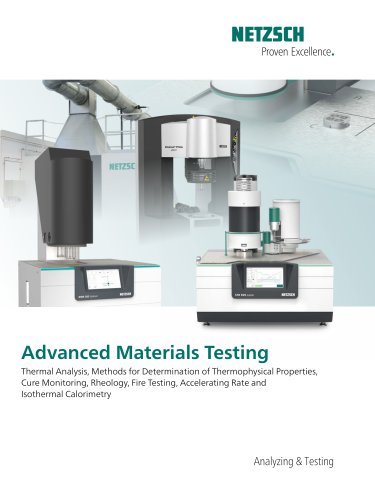
Advanced Materials Testing
NETZSCH Analyzing & Testing has been a leader in thermal analysis since 1962, focusing on customer satisfaction and innovation in material characterization. They offer a wide range of high-quality products and comprehensive technical support worldwide.
NETZSCH provides solutions for analyzing visco-elastic properties, cure monitoring, battery testing, and specific heat capacity. Their instruments are used for quality control, process safety, and failure analysis across various industries.
The company offers a diverse range of instruments for thermal analysis, rheology, and fire testing. These products are designed for research, development, and quality assurance, providing insights into material properties such as thermal conductivity, viscosity, and thermal stability.
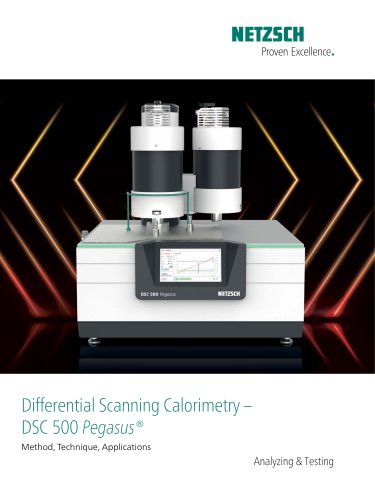
DSC is used to determine transition temperatures and enthalpy changes in materials. NETZSCH offers several DSC models, including the DSC 300 Caliris® series, suitable for both low and high-temperature applications.
Thermogravimetric Analysis (TGA) and Simultaneous Thermal Analysis (STA) investigate thermal stability and decomposition. The STA 509 Jupiter® series combines DSC and TGA methods for comprehensive analysis.
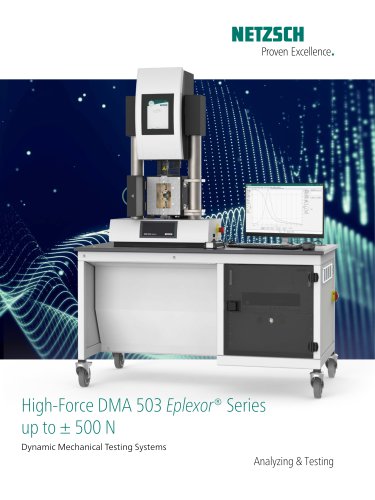
NETZSCH offers a range of DMA instruments for analyzing temperature-dependent visco-elastic properties. The DMA 503 Eplexor® series provides high-resolution measurements for both rigid and soft samples.
Rheology studies the flow and deformation of materials. The Kinexus Prime series offers advanced rheometers for various applications, including asphalt testing. The Rosand RH2000 series provides compact capillary rheometers for diverse testing requirements.
The document outlines specifications for advanced capillary rheometers and thermomechanical analysis equipment, including options for bore diameters and high-speed settings for rheometers, and temperature ranges for thermomechanical analysis (TMA) and dilatometry (DIL) equipment. The TMA 512 series offers a temperature range from -70°C to 1600°C with interchangeable furnaces and high-resolution measurements.
TMA provides insights into material properties under temperature changes, useful for plastics, elastomers, and metals. The DIL 502 Expedis series features the NanoEye measuring cell for high accuracy in length change phenomena analysis.
This section discusses the integration of gas analysis with thermal analysis equipment, allowing for sensitive detection of evolved gases. Coupling options include mass spectrometers and FT-IR spectrometers, enhancing material characterization through comprehensive data collection.
The document describes methods for measuring thermal conductivity, including heat flow meters and guarded hot plates. The HFM 706 Lambda series and GHP 456 Titan® are highlighted for their accuracy and compliance with international standards.
The LFA 717 HyperFlash® series is introduced for measuring thermal diffusivity, featuring a wide temperature range and advanced calculation models. The LFA 427 is noted for its versatility in testing various materials at high temperatures.
This section covers the NanoTR and PicoTR devices for measuring thermal diffusivity in thin films, crucial for electronic device thermal management. These devices offer precise measurements for films in the nm and µm range.
The document briefly mentions the use of accelerating rate calorimeters for battery testing and ensuring safe industrial operations by measuring thermal and pressure properties of exothermic reactions.
The document provides detailed information on various testing and analysis instruments offered by NETZSCH, focusing on calorimetry, dielectric analysis, fire testing, refractories testing, and software solutions. It highlights the specifications, applications, and unique features of each product.
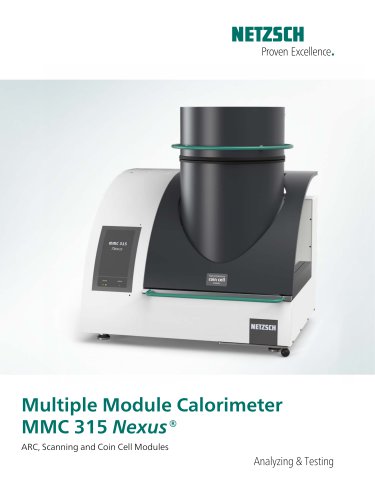
The NETZSCH Accelerating Rate Calorimeters, including the MMC 274 Nexus® and ARC® models, are designed for measuring heat release rates and pressure data. The MMC 274 Nexus® features interchangeable modules for adiabatic and scanning tests, with a temperature range up to 500°C and pressure up to 100 bar. The ARC® models, particularly the ARC 305, offer advanced options like stirring and chemical injection, with a maximum pressure of 200 bar and tracking rates up to 200 K/min.
The DEA 288 Ionic series is used for monitoring changes in viscosity and cure state by measuring dielectric properties. It supports a wide frequency range and rapid data acquisition, suitable for fast-curing systems. The series includes portable and rack versions, with the latter designed for industrial integration.
NETZSCH provides comprehensive fire testing solutions according to international standards. The tests focus on flammability, flame spread, smoke production, and other critical parameters for various industries, including construction, automotive, and textiles. Specific instruments like the SBI 915 and KBT 916 are highlighted for their roles in fire prevention and material classification.
The RUL/CIC 421 instrument measures refractoriness under load and creep in compression, essential for evaluating the deformation resistance of refractory products. It operates up to 1700°C and supports various test atmospheres.
Proteus® software offers a comprehensive suite for thermal analysis, featuring multi-tasking, combined method analysis, and user-friendly interfaces. Advanced modules like Kinetics Neo provide kinetic modeling for process optimization. The software ensures data integrity and compliance with regulatory standards.
NETZSCH emphasizes its global service network, offering training, maintenance, and technical support to maximize the potential of their instruments. The company provides tailored training programs and comprehensive service packages to ensure customer satisfaction.
Catalog excerpts
Proven Excellence. Advanced Materials Testing Thermal Analysis, Methods for Determination of Thermophysical Properties, Cure Monitoring, Rheology, Fire Testing, Accelerating Rate and Isothermal Calorimetry
Open the catalog to page 1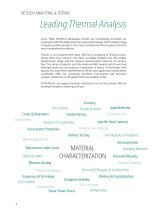
Since 1962, NETZSCH-Geratebau GmbH has consistently provided our customers with the latest thermal analysis techniques, the broadest range of highest quality products, the most complete technical support and the most comprehensive service. Thanks to our experienced team, NETZSCH Analyzing & Testing consistently offers the "utmost": the most complete product line, the widest temperature range and the highest measurement pressure, to name a few. The series of patents and international R&D awards which we have received attest to our products' leadership in terms of technique and quality. Our branches,...
Open the catalog to page 2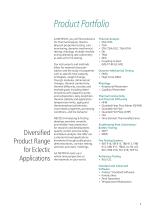
Diversified Product Range for Eclectic Applications At NETZSCH, you will find solutions for Thermal Analysis, thermophysical properties testing, cure monitoring, dynamic-mechanical testing, rheology, multiple module and accelerating rate calorimetry as well as for fire testing. Our instruments and methods allow for material characterization and the study of properties such as specific heat capacity, enthalpies, weight change, Young's modulus, dimensional changes, thermal conductivity, thermal diffusivity, viscosity and evolved gases including determinations with regard to purity and composition,...
Open the catalog to page 3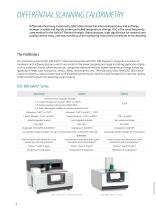
DIFFERENTIAL SCANNING CALORIMETRY Differential Scanning Calorimetry (DSC) determines transition temperatures and enthalpy changes in solids and liquids under controlled temperature change. DSC is the most frequently used method in the field of Thermal Analysis. Rapid analyses, high significance for research and quality control tasks, and easy handling of the measuring instrument contribute to its versatility. The Pathfinders The premium systems DSC 300 Caliris® Select and Supreme and DSC 500 Pegasus® integrate a number of hardware and software features which are useful in the lower temperature...
Open the catalog to page 4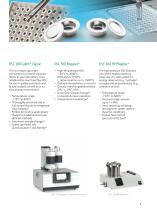
DSC 300 Caliris® Classic This is a robust, gas-tight instrument for routine measurements in your laboratory. It is a reliable entry-level heat flux DSC for use in quality assurance and failure analysis, as well as in an educational environment. ■ "horoughly informed and in full control thanks to integrated touch display* ■ 5erfect for routine applications thanks to predefined and user defined methods ■ Automatic sample changer* ■ Speed up results wih AutoEvaluation* and Identify* ■ Defined atmospheres or vacuum ■ Quickly interchangeable sensors (DSC-cp, DSC, DTA) ■ Automatic sample changer* or...
Open the catalog to page 5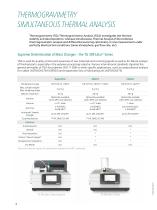
THERMOGRAVIMETRY SIMULTANEOUS THERMAL ANALYSIS Thermogravimetry (TG)/Thermogravimetric Analysis (TGA) investigates the thermal stability and decomposition, whereas Simultaneous Thermal Analysis (STA) combines thermogravimetric analysis and differential scanning calorimetry in one measurement under perfectly identical test conditions (same atmosphere, gas flow rate, etc). Supreme Determination of Mass Changes – the TG 309 Libra® Series TGA is used for quality control and assurance of raw materials and incoming goods as well as for failure analysis of finished parts, especially in the polymer-processing...
Open the catalog to page 6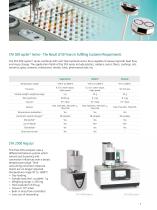
STA 509 Jupiter® Series - The Result of 50 Years in Fulfilling Customer Requirements The STA 509 Jupiter® series combines DSC and TGA methods and is thus capable of measuring both heat flow and mass change. The application fields of the STA series include plastics, rubbers, resins, fibers, coatings, oils, ceramics, glass, cements, refractories, metals, fuels, pharmaceuticals, etc. Temperature range Furnaces Sample weight, weighing range TGA resolution Vacuum Temperature-modulation Automatic sample changer* DSC-BeFlat® Tau-R® Mode TGA-BeFlat® 9, incl. water-vapor, high-speed 12, incl. water-vapor,...
Open the catalog to page 7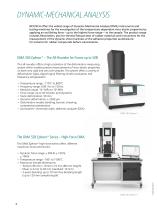
NETZSCH offers the widest range of Dynamic-Mechanical Analysis (DMA) instruments and testing machines for the investigation of the temperature-dependent visco-elastic properties by applying an oscillating force - up to the highest force range— to the sample. The product range includes flexometers, also for thermal fatique tests of rubber materials and instruments for the measurement of the dynamic shore hardness or the adhesive properties (autohesion), for instance for rubber compounds before vulcanization. * Optional feature DMA 303 Eplexor® - The All-Rounder for Forces up to 50N This all-rounder...
Open the catalog to page 8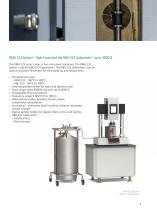
DMA 523 Eplexor® High-Force and the HBU 523 Gabometer® up to 4000 N The DMA 523 series comes in two instrument variations, the DMA 523 Eplexor® and the HBU 523 Gabometer®. The HBU 523 Gabometer® can be used as Goodrich flexometer for heat build-up and fatigue tests. Temperature range: DMA 523: -160°C to 500°C HBU 523: -160°C to 300°C Two independent drives for static and dynamic load Force range: static 6000 N, dynamic up to 4000 N Changeable force transducers Frequency range: 0.0001 Hz to 100 Hz Deformation modes: bending, tension, shear, compression/penetration Accessories*: immersion bath,...
Open the catalog to page 9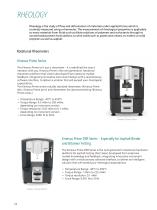
Rheology is the study of flow and deformation of materials under applied forces which is routinely measured using a rheometer. The measurement of rheological properties is applicable to many materials from fluids such as dilute solutions of polymers and surfactants through to concentrated protein formulations, to semi-solids such as pastes and creams, to molten or solid polymers as well as asphalt. Kinexus Prime Series The Kinexus Prime isn't just a rheometer - it is redefined the way it interacts with you. Kinexus Prime is the next generation rotational rheometer platform that's been developed...
Open the catalog to page 10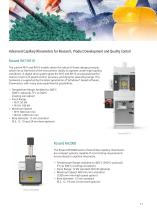
Advanced Capillary Rheometers for Research, Product Development and Quality ControlRosand RH7/RH10 The current RH7 and RH10 models retain the robust H frame design principle, which lies at the heart of the instruments' ability to operate under high loading conditions. A digital drive system gives the RH7 and RH10 unsurpassed performance in terms of speed control, accuracy, and dynamic operating range. This hardware is supported by the latest generation of Windows® based software, Flowmaster, with many new experimental possibilities. ■ Temperature Range: Ambient to 400°C (500°C optional), 5°C...
Open the catalog to page 11All NETZSCH Analyzing & Testing catalogs and technical brochures
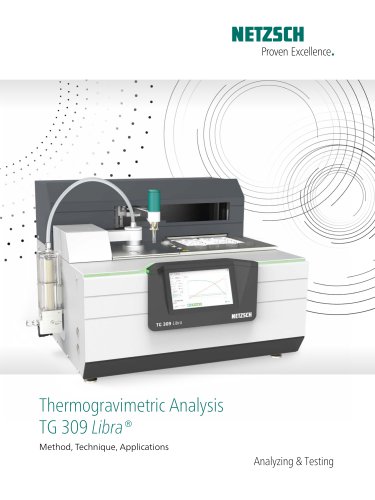 TG 309 Libra Series
24 Pages
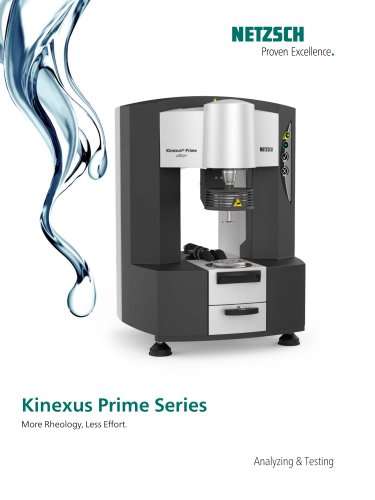 Kinexus Prime Series
20 Pages
 NTA Fire Testing Systems
20 Pages
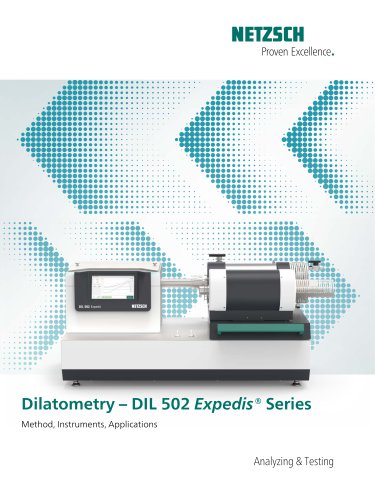 DIL 502 Expedis Series
28 Pages
 NETZSCH Energy Solutions
40 Pages
 Product Overview
12 Pages
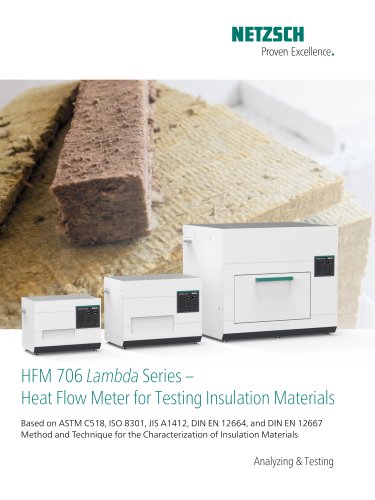 HFM 706 Lambda Series
16 Pages
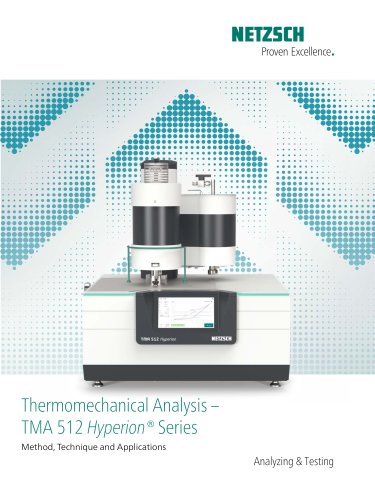 TMA 512 Hyperion® Series
24 Pages
 LFA 427 - product brochure
24 Pages
 Kinexus Prime DSR Series
20 Pages
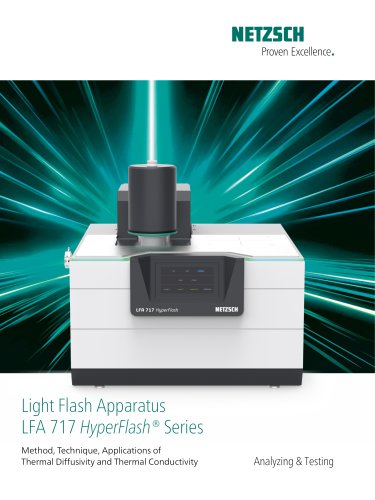 LFA 717 HyperFlash® Series
28 Pages
 DMA 303 Eplexor
24 Pages
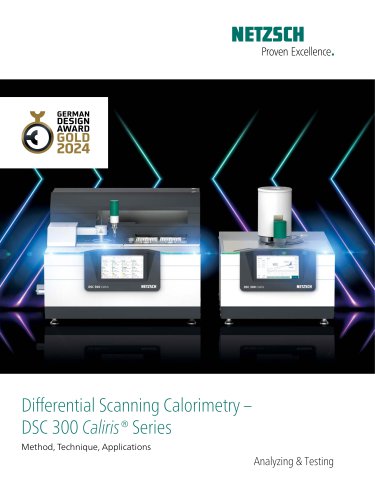 DSC 300 Caliris Series
28 Pages
 STA 509 Jupiter Series
28 Pages
 DEA 288 Ionic
20 Pages
 STA 2500 Regulus
12 Pages
 NTA Guarded Hot Plate Series
16 Pages
 Rosand Series
20 Pages
 Accelerating Rate Calorimetry
20 Pages
 NTA HotBoxes
16 Pages
 DIL 402 Expedis Classic
16 Pages
 Kinetics NEO
20 Pages
 TG-FTIR - product brochure
24 Pages
 TA-QMS Coupling
28 Pages
 HMOR 422
1 Page
 RUL/CIC 421
1 Page
 Cone Calorimeter TCC 918
12 Pages
 SBA 458 Nemesis®
24 Pages
 NETZSCH NEVIO Instrument Series
24 Pages
 Thermal Insulation Materials
24 Pages
 DMA GABO EPLEXOR up to 1500°C
12 Pages
 GABOMETER®
8 Pages





- NETZSCH gas analyzer
- NETZSCH test chamber
- Concentration analyzer
- Monitoring analyzer
- Analysis software solution
- Liquids analyzer
- Test stand
- NETZSCH automatic analyzer
- Windows software
- Automated testing machine
- Material test machine
- Temperature test chamber
- NETZSCH benchtop analyzer
- NETZSCH solids analyzer
- Climatic test cabinet
- Quality control test cell
- Computer-controlled test machine